

Weeders Digest Guide: Understanding Herbicide Half-Life in Your Pond
 |

Summary:
The "half-life" of an aquatic herbicide is the specific amount of time it takes for exactly half of the active chemical concentration to break down or dissipate within your water body. Understanding this concept is essential for any pond owner because it dictates how long a treatment remains effective against target weeds and when it is safe for the chemical to be considered reduced to negligible levels. It is important to remember that a single half-life does not mean the chemical is gone; rather, it means the concentration has been cut by 50 percent, and this process continues in subsequent cycles until the substance reaches near-zero levels.
In my years of field experience managing diverse aquatic ecosystems, I have learned that the "textbook" half-life provided on a product label is often just a baseline. Real-world conditions—such as a pond's specific water temperature, the intensity of sunlight reaching the water surface, and the organic matter content in the sediment—frequently accelerate or delay this breakdown process. I often see cases where a herbicide that is expected to persist for weeks degrades much faster in a clear, shallow, sunlit pond than in a deep, turbid one, highlighting why local environmental factors are just as important as the chemical’s inherent properties.
The Science Behind It:
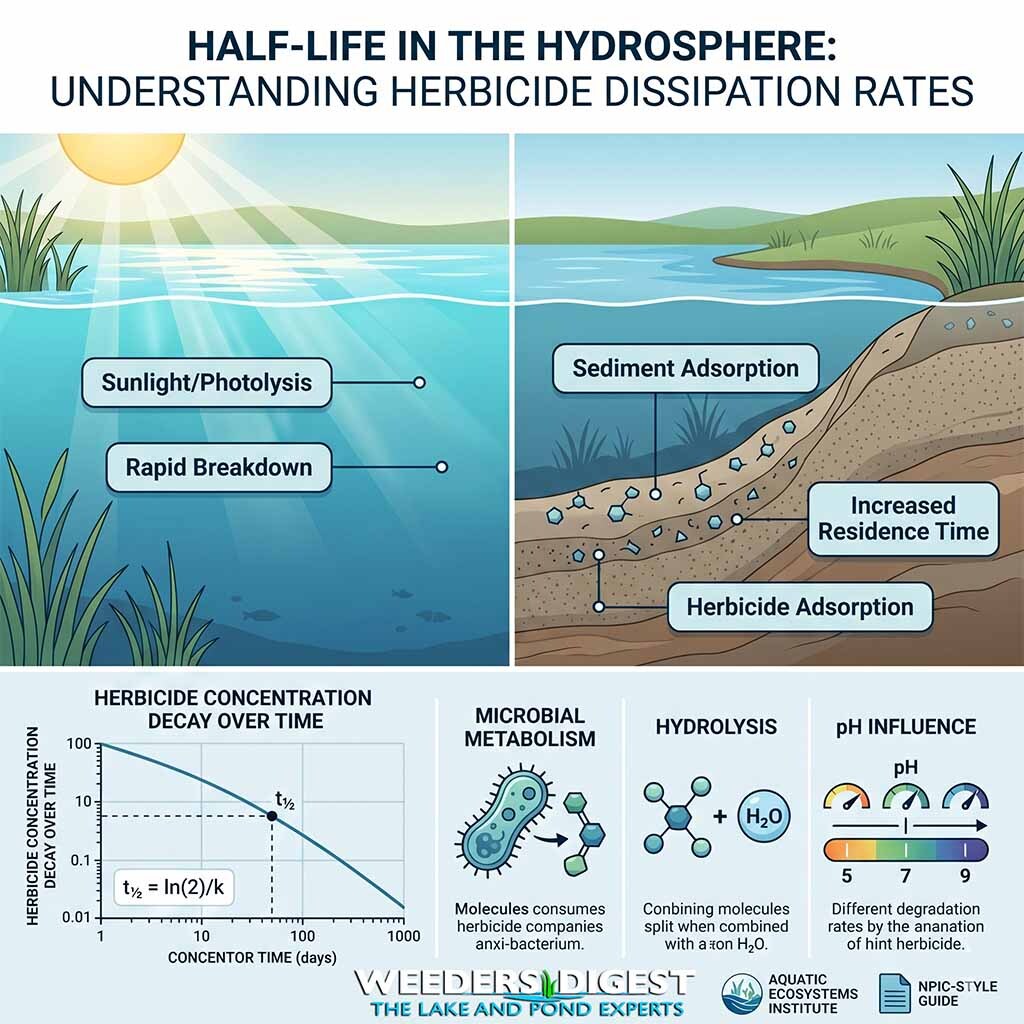
The persistence of a herbicide in the aquatic environment is governed by complex kinetic processes where the chemical concentration follows an exponential decay pattern. This dissipation is defined by the half-life (t_1/2), which is mathematically derived from the dissipation rate constant (k). According to standard environmental toxicology protocols, such as those described by the California Department of Pesticide Regulation, this is modeled by calculating the slope of the natural log-transformed residue data over time to determine the rate at which the herbicide molecule disappears from the water column.
Several primary mechanisms drive this degradation, including photolysis, microbial metabolism, and hydrolysis. Photolysis occurs when solar radiation, particularly ultraviolet rays, breaks chemical bonds within the herbicide. Microbial degradation involves bacteria and fungi utilizing the herbicide as a substrate, converting it into metabolites. Hydrolysis involves the chemical cleavage of bonds through reactions with water molecules. Factors such as pH significantly influence these rates; for example, certain compounds are highly stable in acidic environments but undergo rapid hydrolysis in alkaline conditions (pH > 8.0).
Environmental variables introduce significant variability into these dissipation rates. Research indicates that the half-life of a herbicide can be remarkably inconsistent across different habitats. For instance, while permethrin may have a water column half-life of only 19 to 27 hours, its persistence increases dramatically if it adsorbs to benthic sediments, where it can remain detectable for over a year. Furthermore, studies on substances like 2,4-D have shown that persistence is highly temperature-dependent, with one experiment recording a half-life of 88 days at 31°C, while other herbicides in the same study exhibited half-lives exceeding 365 days, indicating high environmental persistence.
It is crucial to recognize that the disappearance of an herbicide from the water column does not necessarily equate to total environmental removal. Adsorption to clay particles or organic matter in the sediment can effectively remove the chemical from the immediate water column while increasing its residence time in the system's "sink." Consequently, when evaluating the environmental fate of a treatment, a manager must account for both the water-phase half-life and the potential for long-term accumulation within the sediment, as these dictate the overall ecological impact and the timing of follow-up applications.
Sources / References:
- National Pesticide Information Center (NPIC) - Pesticide Half-life
- University of Florida IFAS Extension - Aquatic Herbicide Testing, Toxicity, and EPA Registration
- California Department of Pesticide Regulation - Calculation of Pesticide Half-life from a Terrestrial Field Dissipation Study