

What Freezing Surface Temperatures Really Do to Your Lake’s Thermocline
 |

Summary:
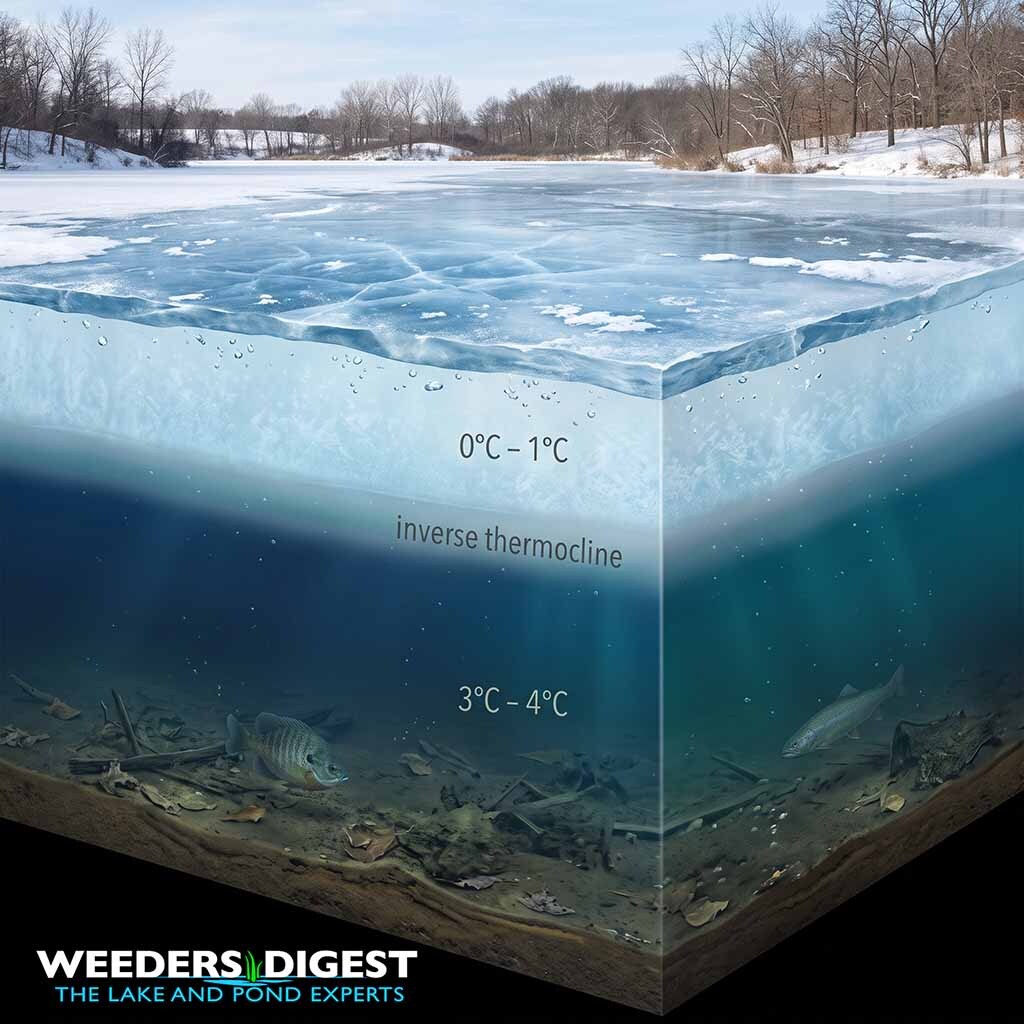
When lake surface water reaches freezing temperatures (0°C / 32°F), the summer thermocline does not persist; instead, it inverts into an inverse stratification layer. While summer stratification traps warm water above cold bottom water, winter conditions flip this gradient. Because pure freshwater reaches its maximum physical density at approximately 3.98°C (39.2°F), water cooling below this threshold becomes lighter and floats directly under the developing ice sheet.
In the field along northern shorelines during early ice-on, our lake and pond experts consistently observe this physical boundary within the top few feet of the water column. Benthic sensors dropped through the ice register near-freezing conditions right below the sheet, yet quickly stabilize to a denser, uniform 4°C zone near the bottom substrate where native fish overwinter.
The formation of an ice cap seals the lake off from atmospheric wind action, locking this inverted thermocline in place until the spring thaw. While this unique thermal ceiling keeps deep waters from freezing solid, it simultaneously terminates wind-driven re-aeration, isolating the bottom sediment and allowing biological oxygen demand to deplete benthic dissolved oxygen levels.
The Science Behind It:
The physical behavior of a lake entering winter is governed by the anomalous thermal expansion of water. In dimictic lakes—water bodies that experience complete vertical overturn twice annually—fall cooling causes surface waters to drop toward 4°C, gaining density and sinking through the water column until the summer epilimnion, metalimnion (thermocline), and hypolimnion fully blend into an isothermal, uniform profile. Once the entire water body reaches roughly 4°C, further atmospheric cooling creates a reverse buoyancy flux. Freshwater reaches its maximum density of 0.99997g/cm3 at 3.98°C; as surface water chills toward 0°C, its density drops to 0.99984g/cm3 before solidifying into crystalline ice at 0.9167g/cm3.
This density differential creates a winter inverse thermocline, characterized by a negative temperature gradient where temperature increases with depth rather than decreasing. Peer-reviewed limnological research published in Limnology and Oceanography Letters classifies seasonally frozen dimictic lakes into distinct mixing regimes: cryostratified systems, which exhibit robust inverse stratification near the surface with depth-averaged temperatures near 4°C, and cryomictic systems, where winter stratification is weaker. The study highlighted that density thresholds as minor as 0.0001to0.0002g/cm3 between the surface boundary and depth are sufficient to stabilize the winter water column against weak convective currents.
As ice forms across the surface, the physical energy transferred into the lake shifts dramatically. Wind shear, which drives circulation and epilimnetic oxygen saturation across open water, drops to zero. According to limnological models from university extension networks, the under-ice column stratifies into a thin, buoyant surface zone between 0°C and 2°C (often only 1 to 2 meters thick), a sharp inverse metalimnion, and a large, semi-quiescent bottom zone hovering between 3°C and 4°C.
Without surface air interaction or sunlight penetration through snow cover, photosynthesis ceases, but benthic microbial decomposition continues. Heterotrophic bacteria decompose accumulated organic muck, leaves, and dying weed fragments along the lakebed, driving oxygen consumption. Research across Upper Midwest temperate lakes demonstrates that winter biological oxygen demand can systematically exhaust benthic dissolved oxygen, driving levels from healthy concentrations above 8 mg/L down to hypoxic thresholds under 2 mg/L, triggering internal phosphorus loading from sediment and heightening winterkill risks for aquatic organisms.
Our Recommendation for Managing Inverse Stratification & Winter Benthic Stagnation:
When winter's inverse stratification locks a lake under ice, mechanical surface exchange ceases entirely, leaving organic muck and decaying vegetation on the lake bed to rapidly consume bottom oxygen. The scientific remedy to preventing stagnant, anoxic shoreline dead-zones is consistent, targeted water velocity before and during freeze-up. By introducing continuous directional flow, waterfront owners eliminate thermal stratification pockets, flush decaying weeds away from docks, and keep littoral zones oxygenated.
To break the cycle of seasonal muck accumulation and winter habitat suffocation, continuous underwater directional blowers are essential. Deploying automated circulation tools from our AquaThruster Muck & Weed Blower collection generates high-volume, laminar flow that scours accumulated organic silt off the bottom substrate and maintains open-water zones or aerated currents. Combining targeted mechanical flow with our shoreline cutters and heavy-duty aquatic lake rakes before the winter freeze ensures that dying bio-mass is physically removed, preserving critical oxygen reserves under the ice all winter long.
Sources / References:
- Limnology and Oceanography Letters / Lake Scientist: How Climate Change Impacts Inverse Stratification in Northern Lakes
- University of Minnesota / Water on the Web: Density Stratification and Lake Mixing Regimes (https://waterontheweb.org/under/lakeecology/05_stratification.html)
- IISD Experimental Lakes Area: The Science of Thermal Stratification and Overturn in Freshwater Lakes (https://www.iisd.org/ela/blog/lakes-stratify-turn-explain-science-behind-phenomena/)