

Why Anchor Ice Forms on the Bottom of Your Lake Instead of the Top
 |

Summary:
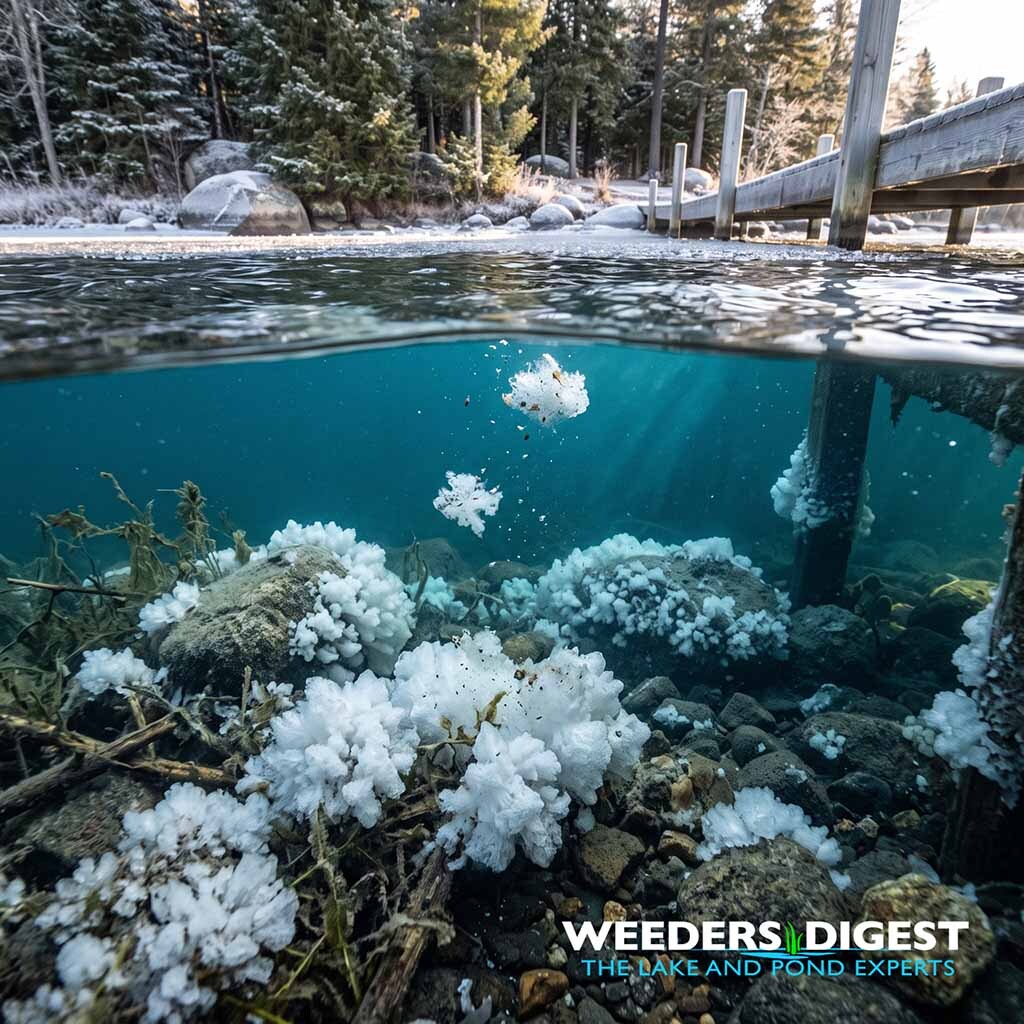
Anchor ice is a submerged sheet or spongy crust of ice that crystallizes directly onto benthic substrates or adheres to rocks, gravel, and submerged vegetation at the bottom of a water body rather than floating on the surface. In standard limnological conditions, freshwater reaches maximum density at 3.98°C (39.2°F), causing colder, buoyant water to remain at the surface where it freezes into an insulating sheet. Anchor ice defies this typical thermal stratification when turbulent winds, wave actions, or active currents mix supercooled surface water down to the lakebed, where sticky frazil ice crystals adhere to benthic structures.
In our work monitoring shoreline dynamics across northern lakes before winter freeze-up, our lake and pond experts frequently observe this phenomenon during clear, sub-zero nights with high winds. You can look down through crystal-clear water on a morning dock inspection and spot large, cauliflower-like ice clusters clinging tenaciously to rocks, weed beds, and dock pilings six feet under open water. When the sun warms the substrate the following morning, these buoyant sheets tear free, often lifting gravel and benthic muck straight to the surface.
The Science Behind It:
The thermodynamic anomaly of anchor ice begins with the generation of supercooled water—liquid water that has dropped below its thermodynamic freezing point of 0.00°C without phase transformation. For anchor ice to generate, two fundamental criteria must coincide: severe thermodynamic heat loss (typically driven by clear-sky nocturnal radiation and frigid winds) and intense dynamic turbulence. In calm basins, a lake stratifies inversely once the water column cools below 4°C; the lightest 0°C water rests on the surface and skins over as primary ice. However, strong wind shear or fetch currents prevent a static surface skim from solidifying, mechanically entraining thermal deficit throughout the entire water column.
Under these agitated, supercooled conditions—frequently measured in natural environments between -0.01°C and -0.05°C—minute disk- or needle-like crystals known as frazil ice spontaneously nucleate in the open water. These active frazil crystals possess high adhesive energy. As turbulent eddies and vertical advection pump frazil crystals downward, they collide with submerged substrates such as cobble, boulders, woody debris, or structural pilings. Upon impact, the crystals sinter together through regelation, forming an anchoring base layer on the lakebed.
Research published in The Cryosphere by Ghobrial et al. demonstrates that anchor ice growth follows a distinct multi-phase cycle. During Stage 1 (initial crystal nucleation and accretion), growth rates rapidly surge between 1.3 and 2.0 cm per hour. As the accumulation transitions to Stage 2 and Stage 3 (linear accumulation of suspended frazil particles), growth rates stabilize between 0.3 and 0.9 cm per hour. Field limnology investigations conducted by Kempema et al. in the Laurentian Great Lakes identified that anchor ice sheets can expand to thicknesses exceeding 30 to 50 cm across nearshore environments.
The eventual detachment phase is equally dynamic. As solar radiation penetrates the water column or latent geothermal heat radiates from the lake floor, the ice-substrate bond weakens thermally. Because solid ice maintains a density of approximately 0.917 g/cm³ compared to 1.0 g/cm³ for water, the positive buoyant upward force overwhelms the degraded mechanical grip. The anchor ice rafts upward, ripping rooted aquatic weeds, gravel, and organic sediment from the floor and depositing them offshore—a major driver of winter benthic scouring and shoreline erosion.
Our Recommendation for Managing Anchor Ice & Benthic Debris:
When anchor ice forms around private shorelines, boat lifts, and docks, the structural uplifting forces and sediment displacement can wreak havoc on waterfront investments. Furthermore, the jagged frazil matrix readily locks onto dormant, rooted weeds and muck deposits, creating unstable bottom conditions and sediment drift.
To prevent anchor ice from locking onto benthic architecture or tearing out native shorelines, lakefront owners must manage both water velocity and localized thermal exchange. Breaking the boundary layer where supercooled frazil crystals attach requires proactive, continuous directional water circulation. Utilizing continuous-duty circulation systems—such as our AquaThruster Muck & Weed Blower collection—keeps water moving across critical zones, preventing stagnant supercooling at the lakebed and blowing buoyant debris clear before ice can anchor to the substrate. Pairing continuous hydrodynamic movement with our specialized shoreline sweepers and weed removal equipment ensures your lakebed remains free of organic muck traps, protecting docks and shorelines from winter freeze hazards.
Sources / References:
- University of Minnesota Sea Grant: Lake and River Ice: Formation and Classification (https://seagrant.umn.edu/news-info/featured-stories/lake-river-ice-formation-classification)
- Copernicus - The Cryosphere: Continuous in situ measurements of anchor ice formation, growth, and release (https://tc.copernicus.org/articles/15/49/2021/)
- Encyclopedia Britannica: Anchor Ice Formation & Dynamics (https://www.britannica.com/science/anchor-ice)