

Why Do Some Bays Freeze Weeks Before the Rest of Your Lake?
 |

Summary:
Certain shallow, protected bays freeze weeks before the main body of water because they hold significantly less total thermal energy and experience far less wind-induced mechanical mixing. A lake cannot cap over with surface ice until its convective cooling cycle finishes and the entire water column drops to approximately 39.2°F (4°C). Because sheltered embayments possess low water volume relative to their surface area, they bleed off accumulated summer heat into the cold autumn atmosphere in a fraction of the time required by deeper basins.
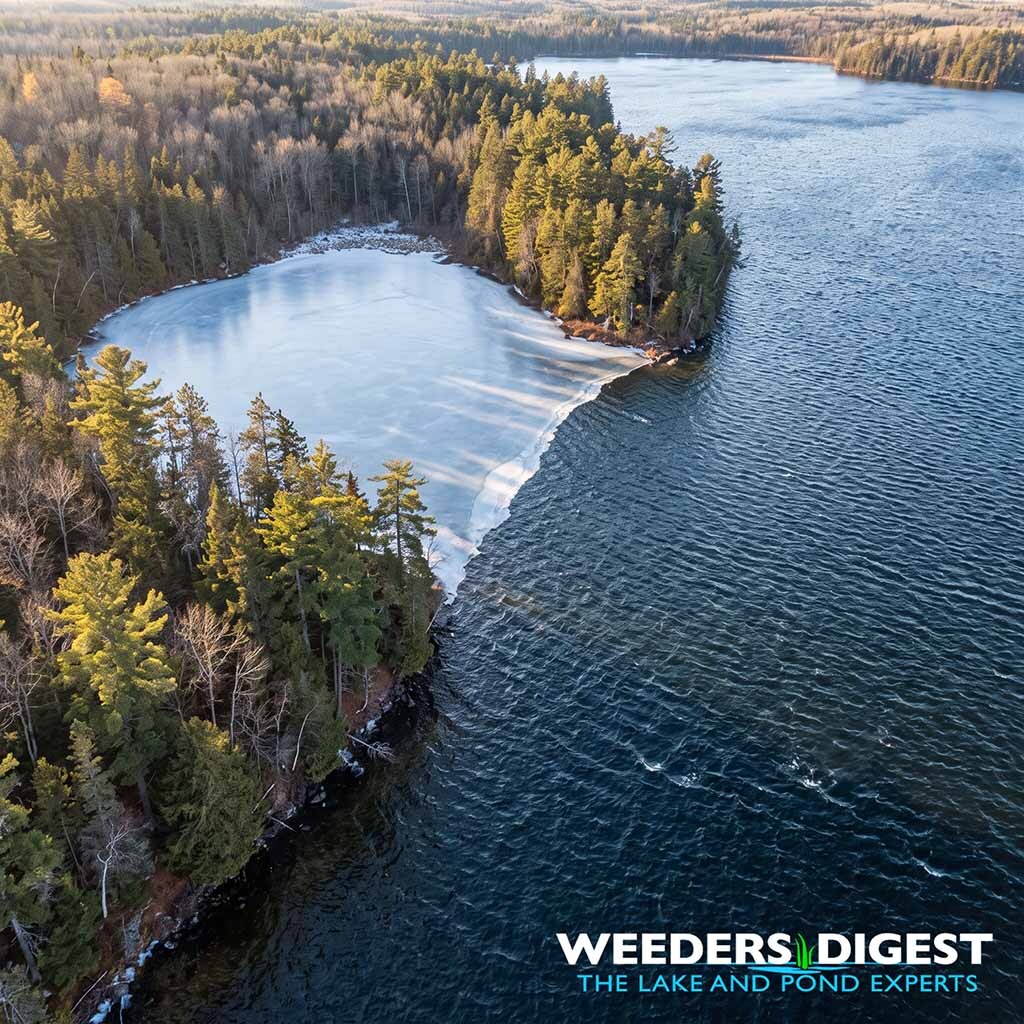
Surrounding topography, dense shoreline tree canopies, and narrow bay geometry drastically shorten the open wind path, effectively shielding these coves from the mechanical turbulence that tears apart early crystal lattices on the main lake. We routinely observe this dramatic contrast across northern shorelines during early winter surveys: waterfront docks inside secluded channels sit locked in several inches of rigid sheet ice while open-water main basins just a couple hundred yards away remain completely ice-free, whitecapping under strong late-autumn gusts.
The Science Behind It:
The differential timing of lake freeze-up is rooted in physical limnology, driven by the specific heat capacity of water, volumetric heat storage, and hydrodynamic shear forces. Water reaches its maximum density at 39.2°F (4°C). As autumn temperatures decline, surface water cools, becomes denser, and sinks toward the lakebed, displacing relatively warmer water upward in continuous vertical convective loops. Only after the entire convective mixing depth reaches this isothermal state at 39.2°F can surface water further cool to 32°F (0°C), where it becomes buoyant, remains at the top, and solidifies into surface ice crystals.
Because deep basins retain immense thermal mass, they demand extensive net atmospheric energy loss before reaching that threshold. Peer-reviewed research investigating lake morphometry and ice phenology indicates that morphometric characteristics—predominantly mean depth—account for roughly 36% of the variation observed in lake freeze-up dates. Limnological studies analyzing heat retention across freshwater basins establish that every additional single meter of average depth delays the onset of solid surface ice cover by approximately one full day. Consequently, a sheltered bay with a mean depth of 6 feet (1.8 meters) reaches the isothermal freeze-up threshold 10 to 20 days sooner than an adjacent 40- to 60-foot (12- to 18-meter) open-water basin.
Furthermore, empirical cooling models published by Canada's National Research Council show that small freshwater bodies typically require between 70 to 100 accumulated freeze-degree days (with 32°F as the baseline) to transition from 39.2°F to forming 4 to 6 inches of solid sheet ice. In deep main bodies, incoming solar irradiance, greater water volume, and deep water turnover require significantly higher cumulative cold exposure before completing this phase.
The second determining factor is wind fetch—the uninterrupted distance over which wind travels across open water. Large open bodies of water exhibit expansive fetch, generating substantial wave action and turbulent kinetic energy that physically shears forming frazil ice crystals into unstable slush. In contrast, narrow bays and cove shorelines break the boundary layer of the wind. With fetch minimized to near zero, calm surface waters allow delicate floating dendritic ice crystals to lock together rapidly into continuous columnar sheet ice without mechanical interruption.
Our Recommendation for Managing Premature Bay Freezing & Ice Damage:
Early ice formation in sheltered bays introduces significant mechanical stress to shoreline investments. When shallow bays freeze over while the main lake remains dynamic, temperature shifts and wind can drive expanding shoreline ice directly into permanent pilings, docks, and boat lifts. Once water molecules drop below 39.2°F and solidify at 32°F, water expands by approximately 9% in volume, exerting thousands of pounds of lateral pressure and vertical lifting force against fixed structures.
Preventing costly structural damage requires breaking the physical conditions that allow ice sheets to bond. Scientifically, this is accomplished by deploying continuous directional flow tools that draw denser, thermal-reserve water from the lakebed and direct it upward toward vulnerable surface areas. Utilizing high-velocity directional circulators—such as our AquaThruster Muck & Weed Blower collection fitted with winter mounting brackets or heavy-duty de-icing agitators—maintains unbroken kinetic energy across the surface. This artificial current prevents the water column from stratifying into buoyant freezing layers, keeping docks, pilings, and seawalls safely free from ice jacking throughout the freeze-thaw cycles of early winter.
Sources / References:
- Williams, G. P. Freeze-up and break-up of fresh water lakes. National Research Council of Canada, Division of Building Research, Research Paper No. 203. URL: (https://nrc-publications.canada.ca/eng/view/ft/?id=05e9e078-6f46-4fa4-bbd7-2a608aa77b3c)
- Skowron, R., & Piasecki, A. Modelling the Formation and Decay of Lake Ice. Environmental Sciences & Limnological Dynamics. URL: (https://www.researchgate.net/publication/227166763_Modelling_the_Formation_and_Decay_of_Lake_Ice)
- Minnesota Sea Grant. Lake and River Ice: Formation and Classification. University of Minnesota Extension. URL: (https://seagrant.umn.edu/news-info/featured-stories/lake-river-ice-formation-classification)