

Why Does Our Lake Stay Open? The Physics of Lakes That Defy Freezing
 |

Summary:
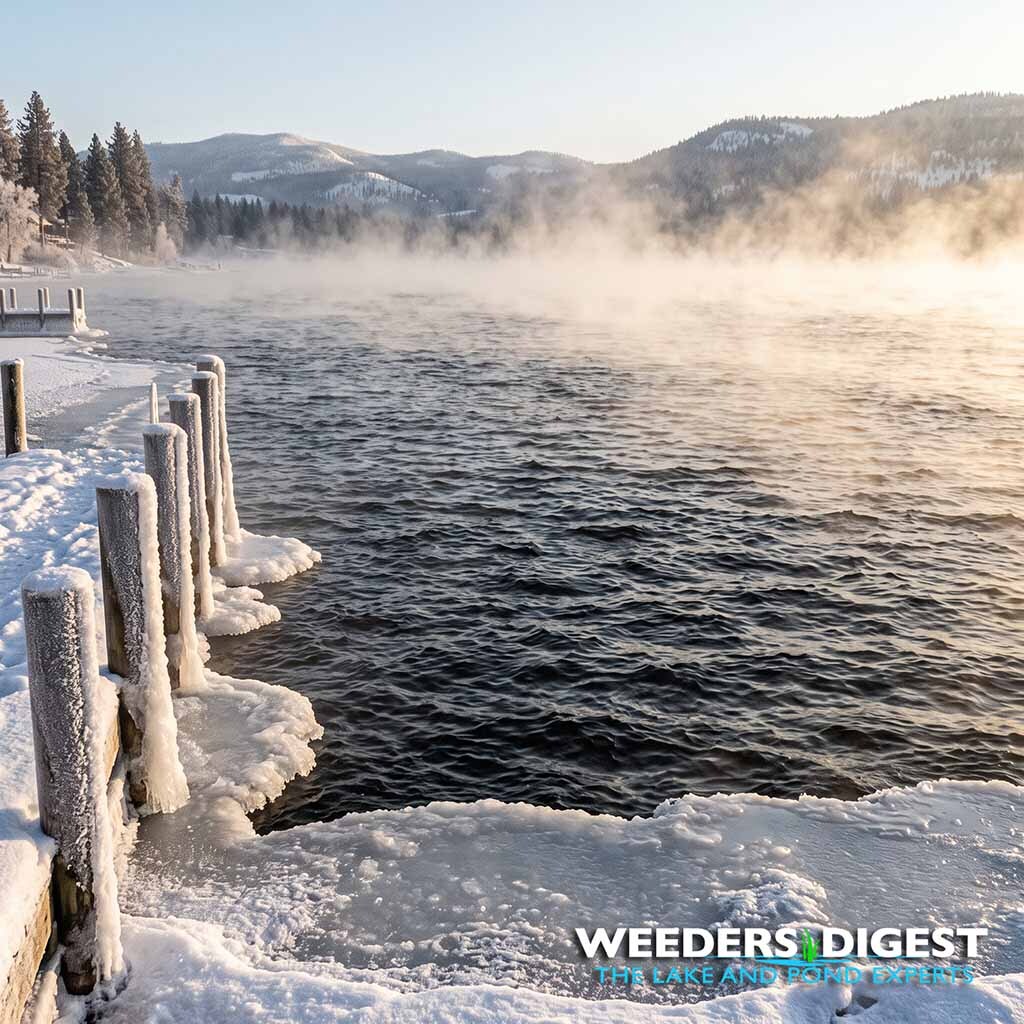
Some lakes never fully freeze over during sub-zero winters because their sheer water volume acts as a massive thermal reservoir that continuously circulates warm water to the surface before ice can solidify. For a water body to form a sheet of surface ice, the entire water column must first cool down to roughly 39.2°F (4°C), the threshold where water achieves its maximum physical density. In exceptionally deep or high-volume lakes, convective cooling takes months; surface water chills, grows dense, sinks, and forces warmer, buoyant water upward from the depths. When paired with persistent surface winds that churn up waves and shear fragile ice crystals before they can lock together, the cooling season simply ends before the lake can release its stored heat.
In our field evaluations across northern lakefronts during peak January cold snaps, our lake experts regularly observe completely ice-locked, shallow shorelines sitting merely 50 yards away from violent, open, rolling water in the main basin. While private boat docks and shallow bays are choked in a foot of solid white ice, deep drop-offs stay wide open because thermal convection is actively pumping bottom heat upward. This natural dynamic proves an essential ecological principle: thermal capacity and directional kinetic water movement are the two greatest natural defenses against ice formation.
The Science Behind It:
The primary barrier to ice formation in deep basins is the anomalous density curve of water. Unlike almost every other liquid on Earth—which contracts and increases in density until solidifying—freshwater reaches its peak density at 39.2°F (3.98°C). As autumnal temperatures plummet, surface water cools toward 4°C, contracts, increases in density, and sinks into the hypolimnion (the deep, cold bottom layer). This initiates convective overturn: the sinking dense water displaces warmer, less dense bottom water, pushing it upward to the surface where it releases heat into the sub-zero atmosphere.
Ice cannot crystallize across a lake's surface until this overturn process runs its course and the entire water column cools to 4°C. Only after reaching this uniform state can the top layer supercool to 32°F (0°C), drop in density, float at the surface, and form an inverse thermal stratification capped by sheet ice. In deep water systems—such as Lake Superior, which averages 483 feet in depth—the volume of antecedent summer heat stored within the basin is monumental. According to thermal capacity studies published by the American Meteorological Society, Lake Superior typically requires roughly 2,000 accumulated freezing degree-days (FDDs) to approach comprehensive ice cover, whereas shallower basins like Lake Erie require only 700 to 900 FDDs. In many sub-zero winter seasons, meteorological conditions simply run out of freezing degree-days before the convective engine exhausts the lake's thermal core.
Physical limnology also demonstrates that kinetic energy disrupts the lattice structure of ice nucleation. For fragile frazil ice crystals to consolidate into skim ice and rigid sheet ice, water requires quiescent, calm hydrodynamic conditions. Wind stress acting across large fetches creates continuous wave action and shear turbulence, mechanically shattering initial ice crystals. Furthermore, wind-driven surface divergence drives upwelling, actively pulling the remaining 39°F water reserve to the surface and melting any peripheral ice sheets forming along shoreline perimeters.
Finally, chemical variations and geographic inputs can prevent freeze-over. In meromictic lakes—lakes with chemically stratified layers that never intermix—high concentrations of dissolved salts and minerals increase density and depress the freezing point of lower strata. In other basins, continuous sub-surface groundwater inputs entering at steady 45°F to 52°F baselines provide a constant influx of thermal energy, preventing localized crystallization regardless of air temperature.
Our Recommendation for Managing Winter Ice Around Waterfront Infrastructure:
The limnological mechanics that prevent deep lakes from freezing provide the exact blueprint for protecting shoreline docks, boat lifts, and retaining walls against devastating winter ice expansion and winterkill.
Left undisturbed, calm shorelines and shallow bays lose thermal buoyancy rapidly, allowing thick surface ice to lock onto dock pilings and rip them from the lakebed through thermal jacking and shoreline expansion. To simulate nature's self-clearing mechanisms—kinetic agitation and thermal upwelling—waterfront owners must maintain continuous directional water movement.
Scientifically, passive aeration is often insufficient in freezing conditions because rising bubbles can lose velocity before properly deflecting surface ice sheets. Instead, high-velocity directional flow tools—such as our AquaThruster Muck & Weed Blower collection—draw warmer, denser 39°F water from below the ice ceiling and continuously stream it horizontally toward vulnerable pilings and lift legs. By pairing continuous water circulation with thermal transport, shoreline equipment remains enclosed in a protected pool of open water all winter long, eliminating ice damage and preserving dissolved oxygen levels until spring.
Sources / References:
- Richards, T. L. (1964). The Meteorological Aspects of Ice Cover on the Great Lakes. Monthly Weather Review, American Meteorological Society. https://journals.ametsoc.org/view/journals/mwre/92/6/1520-0493_1964_092_0297_tmaoic_2_3_co_2.pdf
- University of Wisconsin Center for Limnology & Clean Lakes Alliance. (2022). Lake Turnover and Thermal Stratification in Deep Water Basins. https://www.cleanlakesalliance.org/lake-turnover/
- Boehrer, B., & Schultze, M. (2008). Stratification of Lakes. Reviews of Geophysics, Helmholtz Centre for Environmental Research. https://www.researchgate.net/publication/248781047_Stratification_of_lakes