

Why Does Water Pressure Change Before Our Lakes Freeze Over?
 |

Summary:
Water pressure dynamics shift dramatically right before a lake freezes over because the water column undergoes a complete thermodynamic reversal known as inverse stratification, which alters internal hydrostatic gradients and stops convective vertical currents. As cold autumn air cools the surface layer down to water's maximum density threshold, this heavy water sinks and completely homogenizes the basin. Once the entire water column cools to uniform density, the cooling surface layer can no longer sink, suddenly creating a rigid, stagnant upper layer that caps the lake and shifts internal fluid dynamics just before crystallization.
For waterfront property owners and anglers, this transition often presents itself through sudden changes in water clarity, abrupt fish movements to benthic depths, and an eerie, mirror-like stillness across the bay. When our lake experts conduct late-season dock removals and shoreline inspections, we frequently observe pressure-sensing telemetry and depth gauges registering sharp micro-shifts as the final convective overturn stalls out. What feels like an abrupt surge in subsurface force is the physical consequence of thermal circulation abruptly halting and sealing the aquatic ecosystem beneath a developing ice cap.
The Science Behind It:
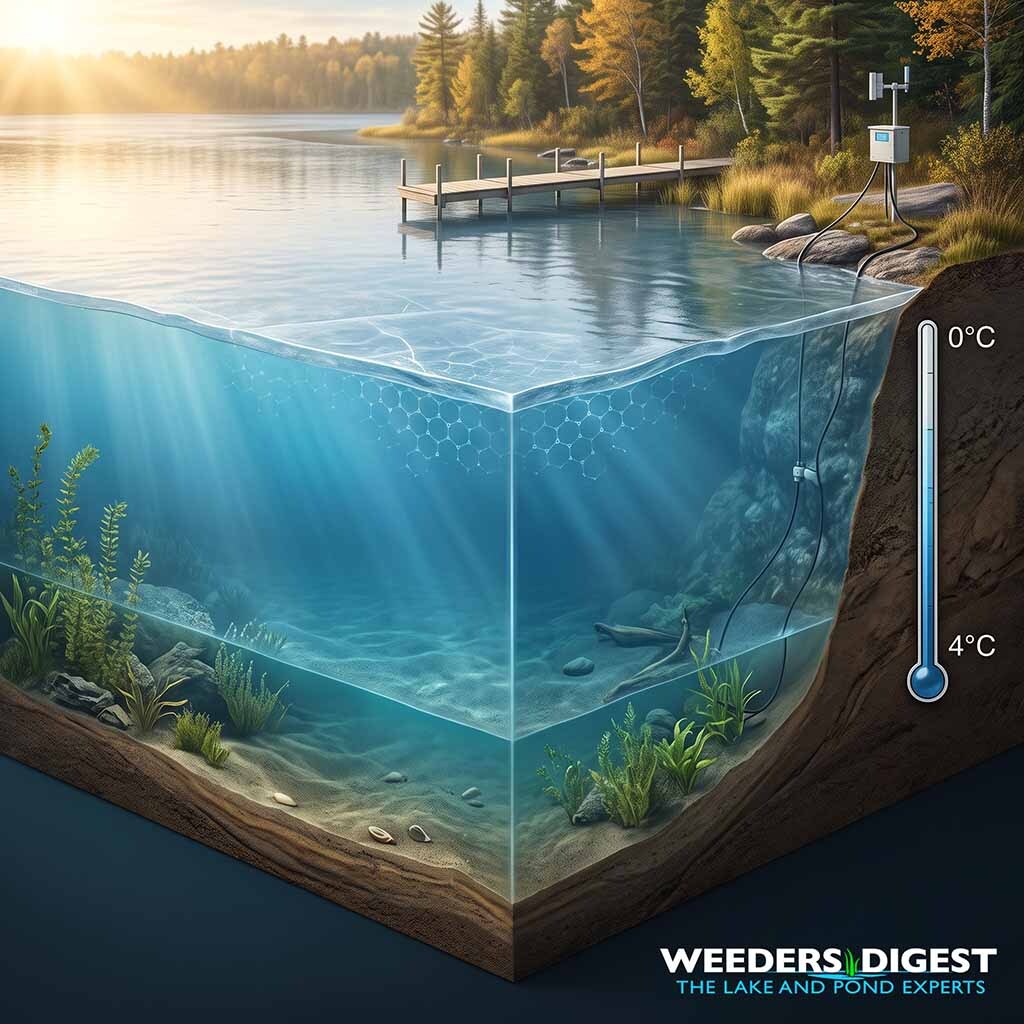
The mechanics driving this physical transformation center entirely on the anomalous expansion of freshwater. Unlike virtually all other liquids, which continuously contract and increase in density until reaching a solid state, water reaches its peak density of approximately 999.97 kg/m³ at 3.98°C (39.16°F). In temperate, dimictic lakes, autumn weather drives surface temperatures downward toward this threshold. As surface water reaches 3.98°C, it becomes heavier than the underlying layers and sinks downward via vertical convection, displacing lighter water upward until the entire water column achieves an isothermal state.
Once the entire lake volume reaches an equilibrium temperature of ~4°C, further cooling at the surface reverses the density relationship. Between 3.98°C and 0°C, hydrogen bonding forces water molecules into an open, tetrahedral crystalline lattice, causing water to expand and its density to drop from 999.97 kg/m³ down to approximately 999.84 kg/m³ in liquid form before falling sharply to ~917 kg/m³ upon solidifying into ice. Because this sub-4°C water is less dense than the water below, vertical convective mixing ceases completely.
This abrupt halt in convection forms a steep, stable negative thermocline (inverse stratification) where freezing 0°C water floats directly atop the denser 4°C water trapped along the lake bed. The sudden elimination of turbulence and buoyant plumes alters the internal hydrostatic pressure distribution across the lake bed. Because hydrostatic pressure is directly calculated as P=gh (where represents fluid density, g represents gravitational acceleration, and h is water depth), micro-variations in the density column directly adjust the pressure exerted on benthic sensors and bottom sediments.
Simultaneously, the onset of surface freeze-up eliminates atmospheric gas exchange and wind-driven shear stress. Once the initial skim of sheet ice forms across the perimeter, the water column shifts from an open-surface, wind-driven hydraulic system to a semi-confined reservoir. This rapid boundary capping traps residual hydrostatic energy, compresses dissolved gases, and seals benthic zones into an isolated winter regime until spring turnover occurs.
Our Recommendation for Managing Winter Waterfront Dynamics:
When inverse thermal stratification seals a lake under sheet ice, natural convective oxygenation and wind-driven water circulation come to a dead stop. In bays and around private shorelines, this stagnant, heavy bottom layer accelerates organic muck decomposition, traps volatile noxious gases, and promotes anoxic conditions that degrade aquatic ecosystems all winter long. Furthermore, static ice sheets exert lateral expansion forces capable of crushing permanent docks, riprap, and retaining walls.
To prevent cold-weather stagnation and shield critical shoreline structures, maintaining continuous localized water velocity is scientifically essential. Introducing targeted horizontal and vertical currents prevents inverse stratification from forming a solid, damaging freeze-over around docks while circulating oxygenated water into nutrient-rich bottom sediment. Exploring dedicated solutions such as our AquaThruster Muck & Weed Blower collection allows property owners to direct high-velocity laminar flow across the sediment bed before winter locks in, displacing soft muck and safeguarding waterfront investments against damaging winter freeze conditions.
Sources / References:
- International Institute for Sustainable Development (IISD) Experimental Lakes Area. "The Science of Thermal Stratification of Lakes." Freshwater Limnology Series. https://www.iisd.org/ela/blog/lakes-stratify-turn-explain-science-behind-phenomena/
- Soletta, I., & Branca, M. "Temperature and Density Inversion in Freshwater Bodies Prior to Glaciation." European Journal of Physics, ResearchGate Publication Archives. https://www.researchgate.net/figure/At-4C-the-water-reaches-its-maximum-density-and-remains-at-the-bottom-there-is-a_fig2_243715654
- Wetzel, R. G. Limnology: Lake and River Ecosystems. 3rd Edition, Academic Press.