

Why Does Your Ice Auger Bring Up Rotten Egg Smells? The Science of Winter Lake Anoxia
 |

Summary:
The sharp, rotten-egg sulfur odor emerging from your ice auger hole is caused by dissolved hydrogen sulfide gas (H₂S) venting from an oxygen-depleted lakebed. When solid ice and heavy snow seal a lake off from the atmosphere, atmospheric oxygen diffusion ceases completely while decomposing organic muck on the bottom continues to consume the remaining dissolved oxygen. Once conditions become strictly anaerobic, specialized bottom-dwelling bacteria turn to sulfur compounds for respiration, producing hydrogen sulfide as an inescapable metabolic byproduct.
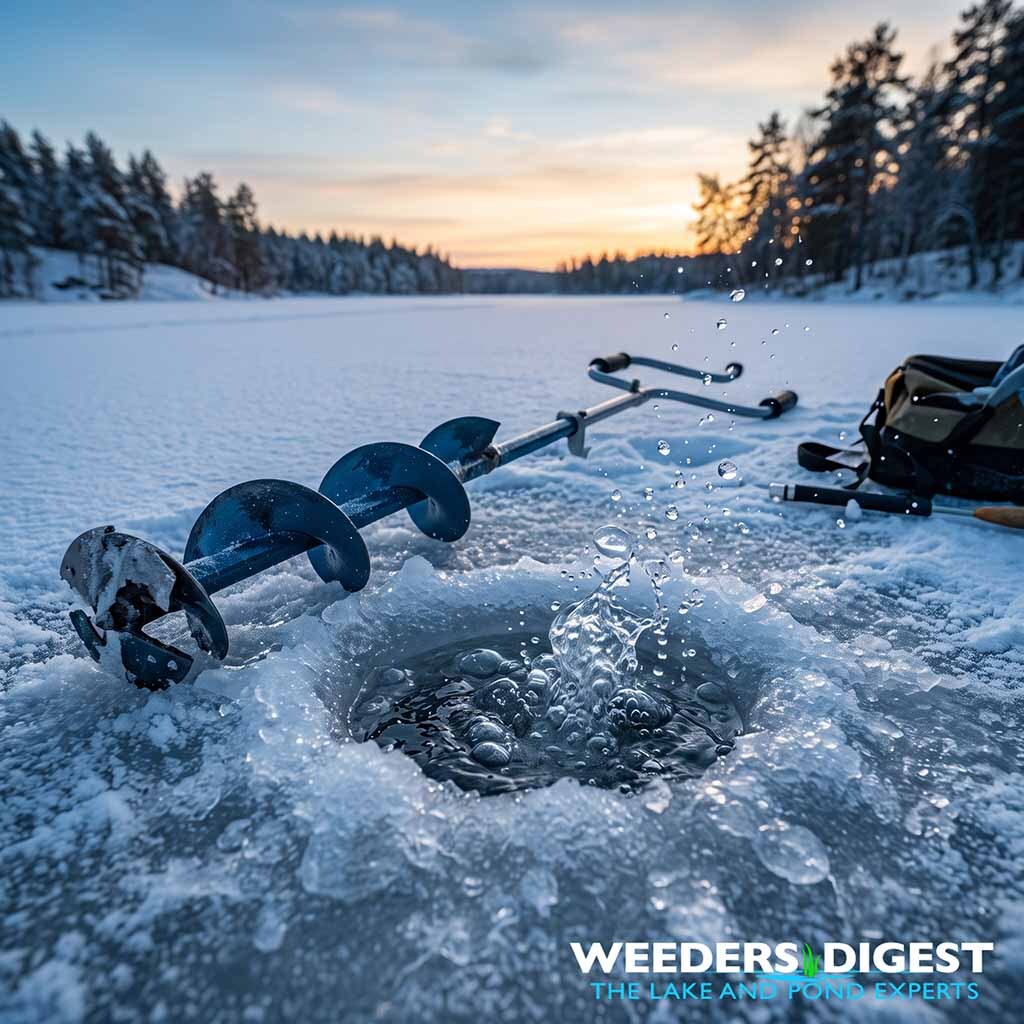
In our field observations across northern and midwestern lakes, our pond experts frequently notice this phenomenon when drilling over shallow bays, heavily mucked channels, or weed-choked flats late in the winter season. The moment the auger flutes break through the bottom of the ice sheet, hydrostatic pressure forces a sudden plume of trapped, dark, gas-saturated water straight up to the surface. It is an immediate reminder that while the surface appears frozen solid and static, the biological environment below is undergoing severe biochemical stress.
This sulfur burst is an early warning indicator that the surrounding water column is running critically low on oxygen, a condition that threatens local fish populations with winterkill if allowed to progress unchecked.
The Science Behind It:
In temperate dimictic and polymictic lakes, winter brings inverse thermal stratification: freezing water forms a rigid surface barrier, and dense 4°C water settles near the sediments. Surface ice blocks atmospheric gas exchange, while accumulated snow cover drastically cuts light penetration, frequently stopping sub-ice phytoplankton and macrophyte photosynthesis entirely. Under these closed-system conditions, sediment oxygen demand (SOD) from the decomposition of dead weeds, organic silt, and benthic muck drives dissolved oxygen (DO) depletion from the sediment-water interface upward.
As dissolved oxygen plummets below 1.0to2.0mg/L, aerobic microbes perish or go dormant, causing the benthic oxidation-reduction (redox) potential to collapse. Once redox levels drop below -100to-200mV, facultative and obligate anaerobic microorganisms take over sediment processing. Among these are sulfate-reducing bacteria (SRB), predominantly belonging to genera such as Desulfovibrio and Desulfotomaculum.
Instead of utilizing oxygen (O₂) as a terminal electron acceptor during the metabolic oxidation of organic matter, sulfate-reducing bacteria utilize dissolved sulfate ions (SO₄²⁻):
Drilling an ice hole suddenly punctures this pressurized seal. The pressure gradient forces gas-saturated water up through the auger cylinder, instantly off-gassing volatile hydrogen sulfide into the air where human olfactory senses detect it at concentrations as low as 0.5to1.0partsperbillion(ppb). When this occurs, it signals that the benthic substrate in that zone is overwhelmed by decaying organic matter and completely depleted of oxygen.
Our Recommendation for Managing Winter Anoxia & Benthic Muck:
Preventing winter anoxia and noxious sulfur gas production requires addressing the biological fuel feeding the reaction: dead aquatic vegetation and thick layers of organic muck. Once organic sediment accumulates along shorelines, bays, and boat slips, it creates a persistent biological oxygen demand that suffocates the benthic zone the moment ice forms overhead.
Breaking this biochemical cycle requires active water movement and sediment displacement before winter arrives. Continuous horizontal water circulation prevents organic debris from settling into static, decomposing layers. Utilizing continuous directional circulation tools—such as our AquaThruster Muck & Weed Blower collection—sweeps the lake floor clear of muck, leaves, and silty detritus while maintaining hard, clean bottom substrate. Removing this organic fuel reservoir eliminates the primary energy source utilized by sulfate-reducing bacteria, significantly lowering sediment oxygen demand, protecting winter water quality, and keeping your shoreline healthy year-round.
Sources / References:
- Frontiers in Microbiology – Reducing Processes in Sediments of an Eutrophic Lake: Turnover of Sulfur and Nitrogen Species (https://www.frontiersin.org/journals/microbiology/articles/10.3389/fmicb.2020.01158/full)
- Environmental Science: Water Research & Technology – Hydrogen Sulfide Production and Dissolved Oxygen Depletion in Subsurface Retention Environments (https://pubs.rsc.org/ew/article/3/4/686/566157/Emerging-investigators-series-hydrogen-sulfide)
- Michigan Technological University Limnology & Environmental Engineering Series – Anoxia, Redox Potential, and Hydrogen Sulfide Accumulation in Lake Stratification (https://pages.mtu.edu/~nurban/classes/ce4505/fall05/handouts/Limnology.pdf)