

Why Lake Ice Heaves Form and How They Move Multi-Ton Shoreline Boulders
 |

Summary:
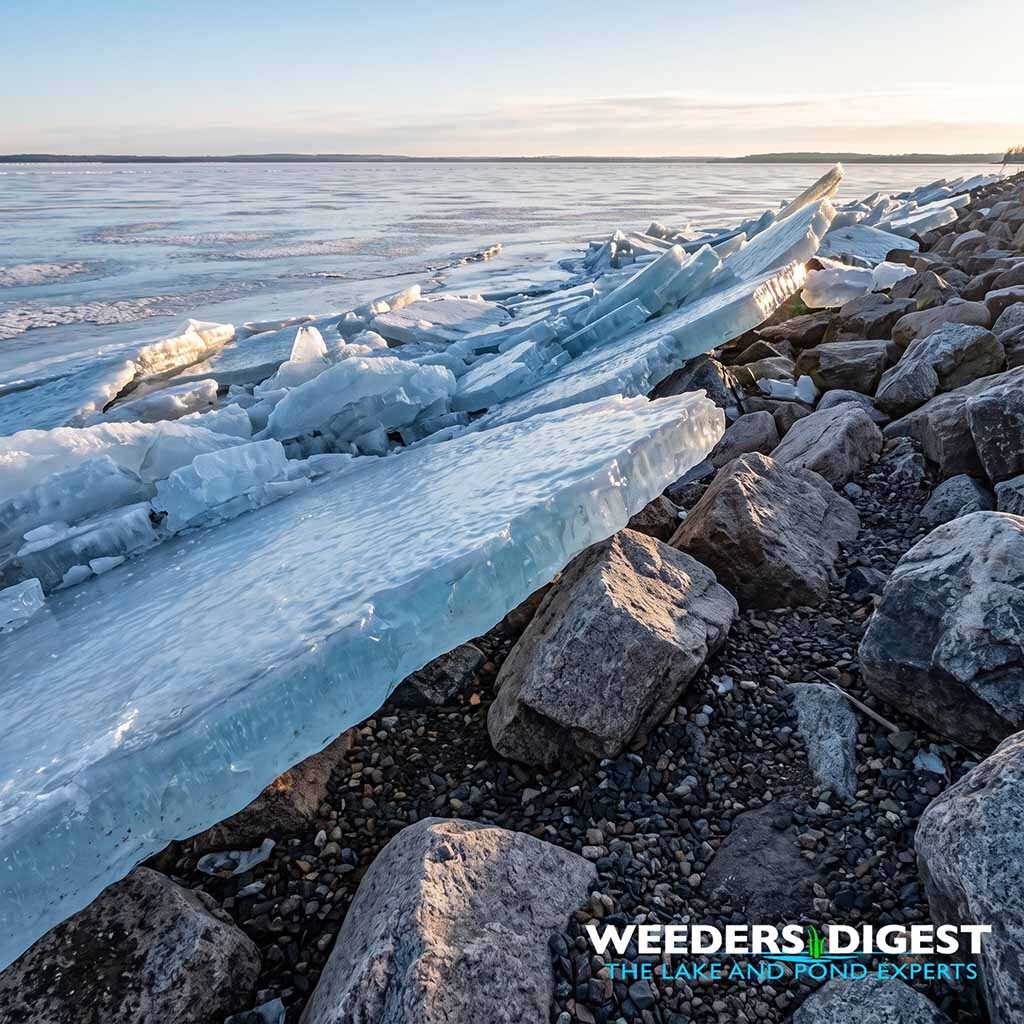
An ice heave—commonly referred to as an ice ridge, ice shove, or ice jacking—forms through cyclical thermal expansion and wind-driven drift that forces an expanding lake ice sheet up and outward into the littoral shoreline zone. When rapid temperature shifts or relentless gale winds act on thousands of surface acres of dense ice, the sheet expands with compressive forces that exceed the structural yield strength of solid earth. This relentless horizontal thrust acts like a hydraulic bulldozer, pushing mounds of lakebed sediment, snapping trees, and displacing multi-ton shoreline boulders as if they were pebbles.
In our work advising lakefront property owners and surveying northern lakes after spring breakup, our lake experts frequently see shoreline riprap walls completely dismantled and heavy crib docks shoved yards inland. What looks like static winter ice is actually a massive kinetic engine operating under immense physical pressure. When snow cover is thin, that energy has nowhere to dissipate except directly into your banks.
The Science Behind It:
The primary mechanism driving mid-winter ice heaving is the high linear coefficient of thermal expansion of freshwater ice, approximately 0.00005 per degree Celsius (5x10^-5 / °C). During periods of deep winter cold, the lake ice sheet contracts and develops tension fractures. Freezing lake water immediately wells up into these open fissures, solidifying and permanently adding new surface mass to the sheet. When ambient temperatures rapidly rebound—such as a jump from -20°C to 0°C—the ice sheet must expand. In a basin measuring 4 kilometers across, a 20°C temperature rise forces up to 4 meters (over 13 feet) of physical linear expansion across the frozen surface.
Because ice is structurally confined by the surrounding terrestrial basin, this thermal expansion creates massive internal lateral stress. According to cold-regions engineering research compiled by the UNESCO Encyclopedia of Life Support Systems (EOLSS), static and thermal ice-sheet thrust can generate horizontal forces capable of dislodging boulders up to 2 meters in diameter and bulldozing them across littoral zones into onshore rubble ramparts up to 7 meters high. When ice buckles, its compressive failure threshold easily overcomes the sliding friction and gravitational resistance of multi-ton granite riprap boulders.
During the late-winter and early-spring thaw, a second and often more catastrophic mechanism emerges: wind-driven ice pile-up, or dynamic ice shove. Research documented by the National Oceanic and Atmospheric Administration (NOAA) and limnological monitoring stations shows that once perimeter shore leads melt, a free-floating ice sheet covering hundreds or thousands of surface acres becomes unanchored. As sustained high-velocity winds (often exceeding 25 to 50 mph) sweep across open water fetch, wind drag transfers kinetic momentum directly to the colossal floating slab.
On large inland basins, an unmoored 6-inch-thick ice sheet can weigh upwards of several million to billions of tons. Discrete Element Method (DEM) mechanical modeling of land-ice pile-up dynamics demonstrates that the total mechanical energy expended during an onshore ice ride-up is 7 to 10 times the gravitational potential energy of the displaced debris. As this moving mass hits the shallows, the ice rides up the gentle lakebed slope, shearing retaining walls, plowing through nearshore sediments, and rolling massive shoreline boulders directly up into lakefront lawns.
Our Recommendation for Managing Ice Heave Damage:
While Mother Nature’s physical thermal expansion cannot be halted by retaining walls alone, the vulnerability of your nearshore zone is directly amplified by shallow sediment depth, stagnant nearshore zones, and unmitigated perimeter ice freezing. Shorelines with heavy, unmanaged organic muck beds freeze into dense, monolithic blocks that anchor tightly to the substrate, accelerating ice-jacking when the sheet expands.
To protect critical shoreline zones, docks, and littoral structure, lake and pond experts rely on continuous hydrodynamic water movement. Installing an active AquaThruster Muck & Weed Blower prior to freeze-up sweeps out loose organic muck and maintains a firm, stable sand-and-gravel bed. During the winter freeze, repurposing directional flow units or active de-icers creates a continuous thermal flow of warmer, bottom water (4°C) to the surface. This maintains an open buffer trench between the main lake ice sheet and your shoreline or dock pilings, preventing the mechanical lock that transfers destructive lateral expansion into your shoreline armor.
Sources / References:
- Respect Our Lakes (Government of Alberta Limnology & Water Quality Program): Understanding Ice Ridges and Ice Pushes (https://grouper-jaguar-zj4x.squarespace.com/s/RespectOurLakes-Ice-Ridges.pdf)
- UNESCO – Encyclopedia of Life Support Systems (EOLSS): Land–Ice Interaction: Ice Pile Up and Ride Up on Land (https://www.eolss.net/sample-chapters/c05/E6-178-58.pdf)
- National Oceanic and Atmospheric Administration / Weather Underground Surface Analysis: The Mechanics of Shoreline Ice Shoves and Kinetic Fetch Dynamics (https://www.wunderground.com/cat6/ice-shoves-the-force-of-nature-in-slow-motion)