

Why Late Summer Winds Redraw Your Shoreline: The Science of Seasonal Erosion
 |

Summary:
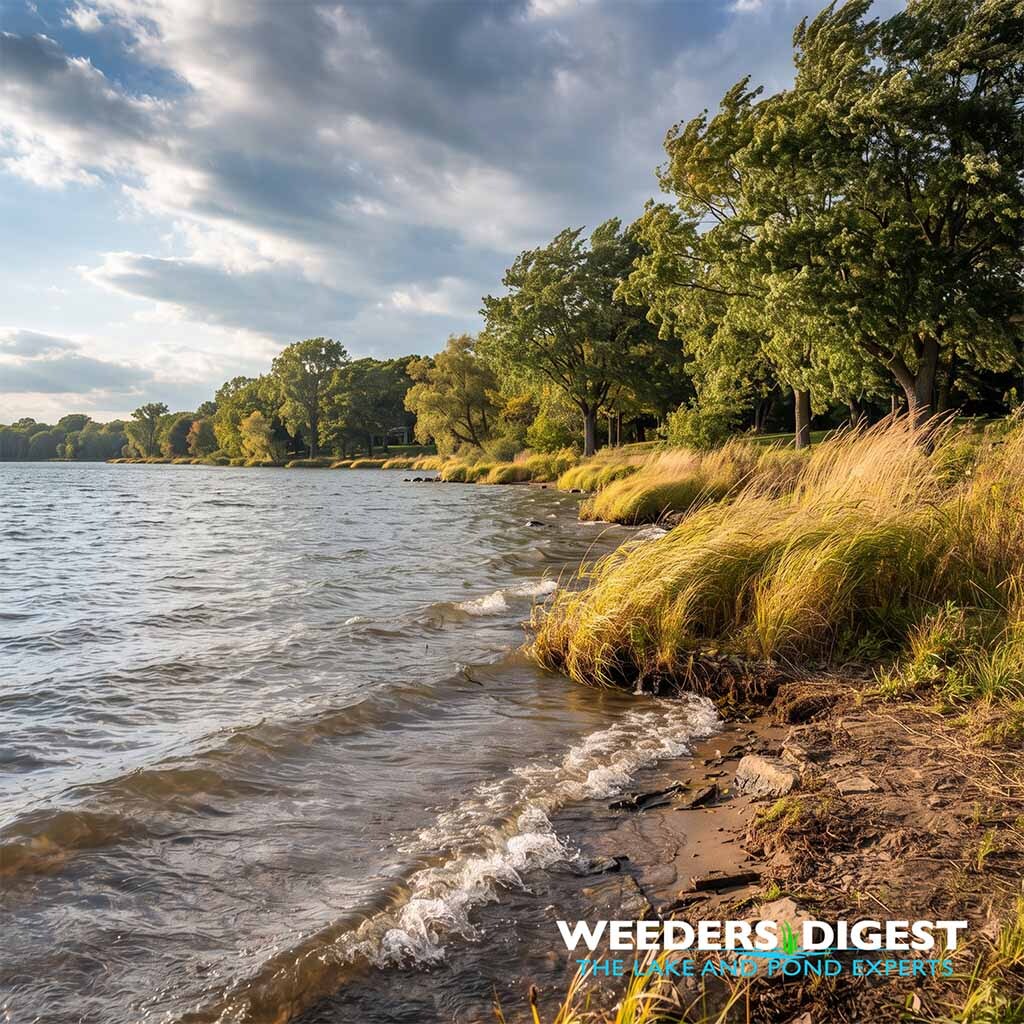
Late summer wind patterns dramatically alter the shape of our shorelines primarily due to seasonal shifts in prevailing wind direction, increased fetch, and weakened littoral vegetation that can no longer anchor shoreline soils against wave action. When summer transitions into late-season weather patterns, wind velocities often increase and blow consistently across larger open-water expanses, generating higher-energy wave action that constantly strips away unprotected banks. As our lake experts frequently observe during late-season walkabouts, property owners often notice sudden sediment slumping and bank recession right where native aquatic buffer zones have been thinned out. We understand how concerning it is to watch valuable waterfront property erode away as seasonal weather shifts put extra physical stress on your banks.
The Science Behind It:
The physical mechanics driving late-summer shoreline reshaping involve complex hydrodynamic processes operating at the interface between the pelagic zone and the terrestrial boundary. As seasonal temperature gradients shift between late August and September, atmospheric circulation patterns frequently alter local prevailing wind trajectories. These modified wind vectors sweep across longer open-water distances, known as fetch, allowing waves to accumulate greater momentum and kinetic energy before crashing against the littoral zone. According to research published in the Journal of Great Lakes Research examining hydrodynamic erosion forces, wind-driven wave action accounts for a significant majority of annual bank recession in shallow, wind-exposed lake basins during high-energy seasonal transition periods https://doi.org/10.1016/j.jglr.2018.02.005.
When high-energy waves impact the shoreline, the continuous hydraulic pressure liquefies loose bank materials, dislodging soil particles and suspending them in the nearshore water column. Research conducted by aquatic ecologists at the University of Wisconsin-Madison Center for Limnology highlights that late-summer declines in native emergent vegetation significantly exacerbate this vulnerability https://limnology.wisc.edu/research/littoral-zone-dynamics. During peak summer, dense stands of aquatic macrophytes such as bulrushes and cattails act as natural breakwaters, reducing incoming wave energy by substantial margins before it reaches the soil bank. However, by late summer, natural senescence weakens these vegetative stems, reducing their mechanical resistance to wave stress just as wind-induced hydrodynamic forces peak.
This seasonal mismatch between declining plant root stability and intensifying wave energy creates a critical vulnerability window for shoreline geometry. Undercutting occurs as wave action repeatedly scours the toe of the slope, destabilizing the overlying bank material until gravity forces gravitational slumping and mass wasting events. Furthermore, sustained late-summer winds generate wind-driven littoral currents and seiches that transport the newly suspended fine sediments away from the erosion site, redepositing them in deeper pelagic depositional basins. Understanding these coupled atmospheric and hydraulic mechanics allows lake and pond managers to accurately diagnose why late-summer wind shifts trigger accelerated bank loss across vulnerable riparian corridors.
Sources / References:
- Journal of Great Lakes Research: Hydrodynamic erosion forces and seasonal bank recession in wind-exposed lake basins — https://doi.org/10.1016/j.jglr.2018.02.005
- University of Wisconsin-Madison Center for Limnology: Attenuation of wave energy by littoral macrophytes during seasonal transitions — https://limnology.wisc.edu/research/littoral-zone-dynamics