

Why Moving Water Keeps Ice Off Your Shoreline Even in Sub-Zero Air
 |

Summary:
Moving water melts ice in sub-freezing temperatures by continuously drawing warmer liquid water from the lake’s depths and accelerating heat transfer against the ice sheet. Because water reaches its maximum density at 39.2°F (4°C), a natural "thermal reserve" rests along the bottom of the water column beneath the frozen surface. When water is propelled toward the surface, that trapped heat constantly contacts the ice, eroding it from beneath regardless of how cold the air is above.
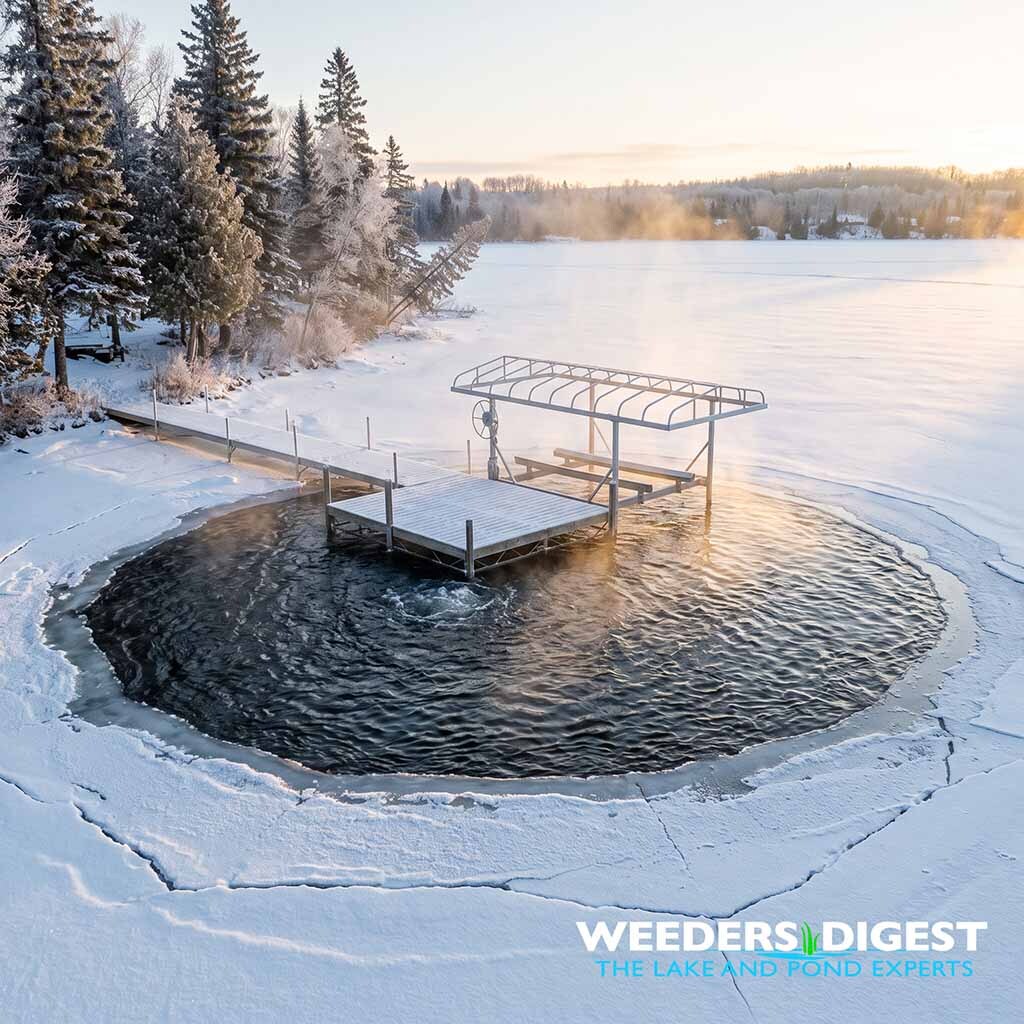
In our winter lake maintenance operations, we routinely observe open, ice-free moats around dock pilings and boat lifts when air temperatures plummet well below 0°F. While stationary shoreline water freezes solid within hours, a steady, directional current prevents crystallization by scrubbing away the insulating, freezing boundary layer.
The Science Behind It:
The physical mechanism behind moving water’s ability to melt ice hinges on fluid thermodynamics, the anomalous density of water, and convective heat transfer. In freshwater systems during late autumn and early winter, surface water cools and sinks until the entire water column reaches 39.2°F (4°C). As surface cooling continues toward 32°F (0°C), water expands and becomes less dense, floating on top to form an initial ice crust. According to cold regions engineering research from the U.S. Army Corps of Engineers (EM 1110-2-1612), this stratification preserves a subterranean thermal reserve at depth, where deep water remains roughly 39°F (4°C) throughout the harshest winter conditions.
Under stagnant conditions, heat transfer between the water and ice is governed primarily by weak natural conduction and passive buoyant convection. Water forms a stagnant, microscopic boundary layer directly against the ice sheet that cools to 32°F (0°C) and acts as thermal insulation. In contrast, forced hydrodynamic flow introduces turbulent kinetic energy that shears away this stagnant boundary layer. Fluid mechanics show that convective heat transfer (q) is defined by Newton's Law of Cooling:
q=hA(Tw-Ti)
where h is the convective heat transfer coefficient, A is the surface area, Tw is water temperature, and Ti is ice temperature (32°F / 0°C).
Empirical thermodynamics published in fluid heat transfer literature demonstrates that the convective heat transfer coefficient (h) scales directly with flow velocity and turbulence (governed by the Reynolds number, Re). In motionless water, the natural heat transfer coefficient often hovers below 50 W/(m2K). When water is actively propelled in a forced turbulent flow regime, h surges well past 1,000 W/(m2K)—an increase in thermal transfer efficiency exceeding 2,000%.
Furthermore, phase change dynamics dictate that ice requires 334 Joules of energy per gram (the latent heat of fusion) to melt. The high specific heat capacity of liquid water (4,184 J/(kgK)) means that even water that is merely 1°C to 2°C above freezing delivers massive thermal energy when moved in large volumes. As long as forced flow continuously sweeps warm benthic water across the lower boundary of the ice, the convective heat flux into the ice exceeds the conductive heat loss escaping into the sub-zero air, forcing the ice sheet to melt.
Our Recommendation for Managing Winter Ice Damage:
Severe freeze-thaw cycles and ice jacking cause thousands of dollars in structural damage to docks, seawalls, and boat lifts every winter. Preventing this destructive pressure requires continuous, directed hydrodynamic force that lifts bottom thermal reserves and maintains an active boundary-layer flush. Traditional stationary bubblers often lack the kinetic push required to protect broad waterfronts in extreme conditions. To establish a dependable, ice-free zone around expensive shoreline structures, our pond and lake experts recommend continuous forced-circulation equipment, such as our high-velocity AquaThruster Muck & Weed Blower collection. By directing hundreds of gallons per minute of warmer bottom water straight along dock footings and pilings, continuous flow neutralizes ice expansion at the structural perimeter all winter long.
Sources / References:
- U.S. Army Corps of Engineers. Ice Engineering: Engineering and Design Manual (EM 1110-2-1612). USACE Publications: https://rivergages.mvr.usace.army.mil/WaterControl/Districts/MVP/Reports/ice/docs/EM-1110-2-1612.pdf
- IAHR Committee on Ice Problems. Proceedings of the 6th International Symposium on Ice: Thermal Reserve and Ice Control Processes: https://fr.scribd.com/document/347859714/6th-IAHR-1981-Quebec-Vol-1
- Incropera, F. P., & DeWitt, D. P. Fundamentals of Heat and Mass Transfer: Convective Boundary Layers & Empirical Correlations (Nusselt and Reynolds Numbers): https://www.simscale.com/docs/simwiki/numerics-background/what-is-nusselt-number/