

Why Our Lakes Come Alive: Unraveling the Mystery of August Nighttime Crayfish Movements in the Shallows
 |

Summary:
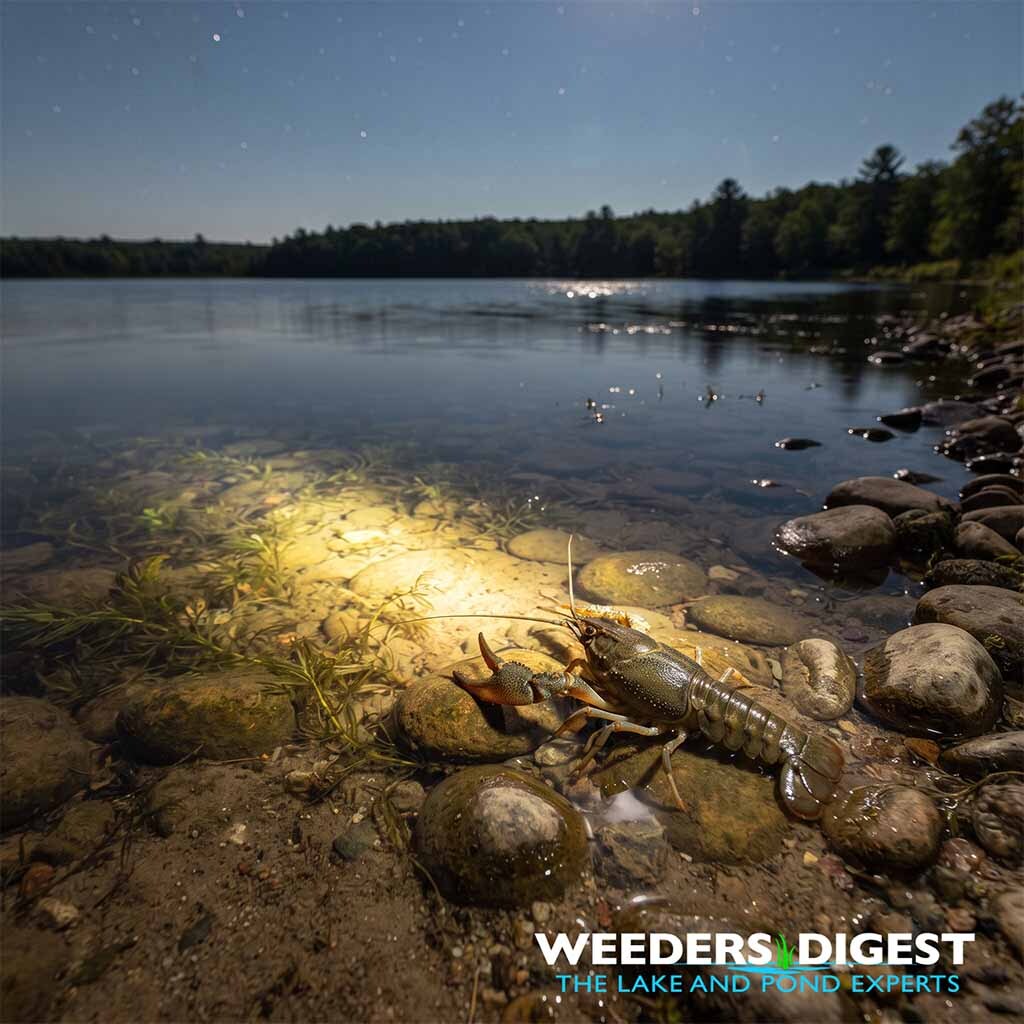
Crayfish become much more visible in the shallows during August nights primarily due to a combination of seasonal water temperature peaks, low-oxygen stress in deeper waters, and nocturnal foraging behaviors driven by high summer metabolic rates. When summer stratification peaks in late summer, deep basin waters often experience severe dissolved oxygen depletion, forcing aquatic organisms to seek relief. Our lake experts frequently observe this seasonal phenomenon firsthand during late-summer nighttime surveys, when flashlight beams catch hundreds of crayfish actively populating the littoral zone. This nocturnal migration allows benthic scavengers to maximize feeding efficiency while minimizing exposure to diurnal visual predators.
The Science Behind It:
The seasonal surge of crayfish activity in shallow littoral zones during late summer is a classic behavioral response driven by thermal stratification and metabolic demands. As surface waters absorb intense solar radiation throughout June and July, lakes develop a distinct thermal profile consisting of an epilimnion, metalimnion, and hypolimnion. By August, the hypolimnion—the deep, cold bottom layer—frequently experiences pronounced hypolimnetic oxygen depletion due to the microbial decomposition of organic matter. Research published in ecological journals examining decapod crustacean behavior indicates that when benthic dissolved oxygen concentrations drop below critical thresholds, mobile invertebrates must migrate horizontally and vertically to avoid hypoxia.
This physiological need for oxygen pushes benthic organisms out of deep basin muds and into the shallower, well-mixed littoral areas where wind-driven aeration maintains higher dissolved oxygen saturation. Furthermore, water temperatures in August reach their annual maximum, directly accelerating the metabolic rates of ectothermic organisms like freshwater crayfish. Elevated metabolism requires increased caloric intake, triggering heightened nocturnal foraging behavior. According to aquatic ecology studies investigating diel activity patterns in freshwater crayfish, these organisms exhibit strongly nocturnal habits during warm-water periods to exploit benthic periphyton, decaying macrophytes, and small macroinvertebrates while avoiding high-light predation by fish and wading birds.
In addition to thermal and respiratory pressures, reproductive and molting cycles heavily influence late-summer distribution. Adult crayfish often complete major molting phases during the warm summer months, a vulnerable period requiring them to seek structural refuge in shallow rocky zones or emergent vegetation where shelter is abundant and calcium carbonate is readily available for carapace hardening. Quantitative field studies on benthic community dynamics note that littoral population densities of crayfish can increase by over 200% in the littoral zone during peak August nights compared to spring baselines. This massive spatial shift transforms the shallow shoreline into a bustling feeding ground under the cover of darkness.
Understanding these complex ecological drivers provides valuable insight into the overall health and dynamic nature of pond and lake ecosystems. The annual August emergence is not a random occurrence, but a finely tuned behavioral adaptation ensuring survival against the physiological challenges of warm, stratified water columns. By recognizing the interplay between temperature, dissolved oxygen, and metabolic demand, our lake experts gain a clearer picture of how aquatic communities respond to seasonal environmental stress.
Sources / References:
Limnology: Lake and River Ecosystems by Robert G. Wetzel Journal of Crustacean Biology North American Lake Management Society (NALMS)