

Why Slush Ice Is a Hidden Hazard for Your Winter Waterfront and Navigation
 |

Summary:
Slush ice is a semi-solid, saturated slurry of spicular ice crystals, partially melted snow, and supercooled water that forms when open water freezes under turbulent atmospheric conditions or when heavy snowfall weighs down an existing ice sheet. Unlike solid, clear congelation ice ("black ice") that forms an orderly crystalline lattice, slush ice lacks a bonded structural sheet. Instead, it behaves as a hyper-viscous, non-Newtonian fluid. For boaters making late-season runs or winter navigators on snowmobiles and ATVs, slush ice is a deceptive, dangerous hazard. It conceals open water, severely diminishes load-bearing capacity, and rapidly adheres to mechanical components.
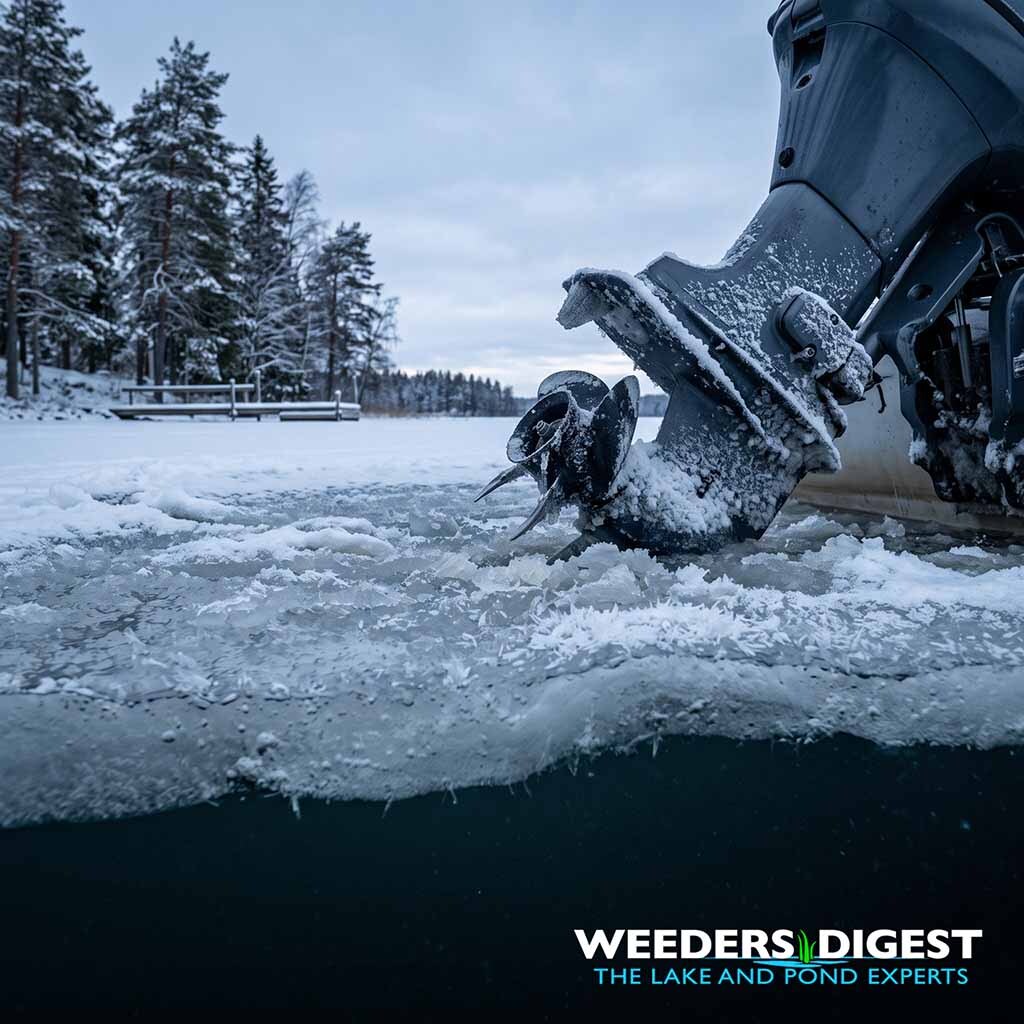
In our work evaluating early-winter shorelines and late-season watercraft retrievals, our lake and pond experts frequently encounter boaters stranded just yards from shore. They assume a few inches of visible surface slush can be pushed through, only to find their raw-water cooling intakes vacuumed full of adhesive ice granules, instantly overheating the engine while the hull is cemented in an impenetrable slurry.
The hazard compounds for overland winter travel. Heavy snowfall drives the existing ice downward below the hydrostatic waterline, forcing lake water upward through thermal cracks. This creates a hidden, insulated sub-surface slush zone trapped beneath a deceptive snow blanket. Navigators who step or drive onto what looks like solid white terrain can immediately break through into deep, freezing slurry that offers zero traction, bogs down equipment, and prevents rapid self-rescue.
The Science Behind It:
The limnological mechanics of slush ice originate from two distinct physical pathways: turbulent water supercooling (forming frazil ice) and hydrostatic depression of an existing ice sheet by snow loading (forming snow ice or white ice). When open water is exposed to sub-freezing air under strong wind or wave action, thermal stratification breaks down. Water supercools to temperatures between -0.01°C and -0.1°C throughout the top mixed layer rather than freezing into a quiescent, calm surface sheet. Under these conditions, microscopic discoid crystals measuring 1 to 4 millimeters across precipitate directly within the water column. As documented in lake ice classification research by the University of Minnesota Sea Grant, these crystals flocculate into a soupy suspension termed frazil or sludge ice.
Because frazil crystals are active and undergo rapid secondary nucleation, they exhibit extreme adhesive properties, readily sticking to underwater metal surfaces, propeller blades, and hull hulls. In studies published by the National Research Council Canada on frazil ice dynamics, intake blockages during supercooling events occur exponentially once ice concentrations reach as low as 1% to 2% volume in turbulent water, causing instantaneous cavitation and catastrophic heat-exchange failure in marine engines. The viscosity of this ice-water slurry increases dramatically as the solid fraction rises, generating severe hydrodynamic drag that robs small watercraft of steering authority and forward propulsion.
The second form of slush occurs over existing lake ice through isostatic imbalance. Ice has a specific gravity of approximately 0.917 g/cm³, meaning about 91.7% of an ice sheet rests below the water level. When a heavy snowpack accumulates on the surface, its mass exerts downward hydrostatic force. Once the weight of the snow exceeds the buoyancy of the ice sheet, the ice sheet is depressed below the lake's piezometric level. Cold lakewater is forced up through stress fractures, thermal expansion leads, and fish holes, soaking into the bottom layer of the snowpack to form a dense, liquid-slush sandwich.
Because fresh snow acts as an effective thermal insulator with a thermal conductivity as low as 0.05 to 0.15 W/(m·K), it blocks sub-zero atmospheric temperatures from penetrating down to freeze the saturated slurry. According to cold regions engineering guidelines and research published in integral structural safety indices, when slush ice freezes, it produces disorganized "white ice" laden with trapped air bubbles and macroscopic voids, which possesses only 50% of the load-bearing capacity of clear congelation "black ice" of identical thickness. An 8-inch layer composed of 4 inches of clear ice and 4 inches of refrozen slush possesses an effective structural strength equivalent to only 6 inches of clear ice. If left un-frozen under thick snow, the liquid slush layer offers zero shear strength, easily trapping heavy snowmobiles and exposing winter travelers to rapid hypothermia.
Our Recommendation for Managing Slush Ice and Winter Freeze-Up:
Maintaining open water around docks, pilings, and boat slips requires continuous, directional hydrodynamic displacement rather than static aeration. Because slush and frazil ice form when supercooled surface water remains trapped in quiescent bays or around structures, passive approaches allow slurry to pack against footings and freeze into damaging white ice collars.
To safeguard valuable shoreline infrastructure and clear late-season boat channels, our lake experts recommend establishing consistent, high-velocity directional flow using specialized underwater current systems like our AquaThruster Muck & Weed Blower collection. By sweeping dense, warmer 39°F (4°C) bottom water up toward the surface and projecting a continuous current along your dockline, these systems prevent the thermal supercooling required for frazil crystals to nucleate and bind. This continuous circulation prevents slush from consolidating, keeping your launch paths open, protecting your pilings from ice-jacking, and eliminating hazardous freeze-up around your waterfront property.
Sources / References:
- University of Minnesota Sea Grant. Lake and River Ice: Formation and Classification. https://seagrant.umn.edu/news-info/featured-stories/lake-river-ice-formation-classification
- National Research Council Canada. Prevention of water intake blockage by ice during supercooling events. NRC Publications Archive. https://nrc-publications.canada.ca/eng/view/ft/?id=86c4afc3-5513-449b-8e66-5e433e71bb4b
- Integral HSE & Cold Regions Engineering Standards. Ice Safety Guidelines and Ice Thickness Guidelines: Structural Bearing Properties of Clear vs. Snow Ice. http://www.integralhse.co.uk/ice-safety/