

Why Snow on Lake Ice Creates an Insulating Blanket That Slows Freezing Across Your Waterfront
 |

Summary:
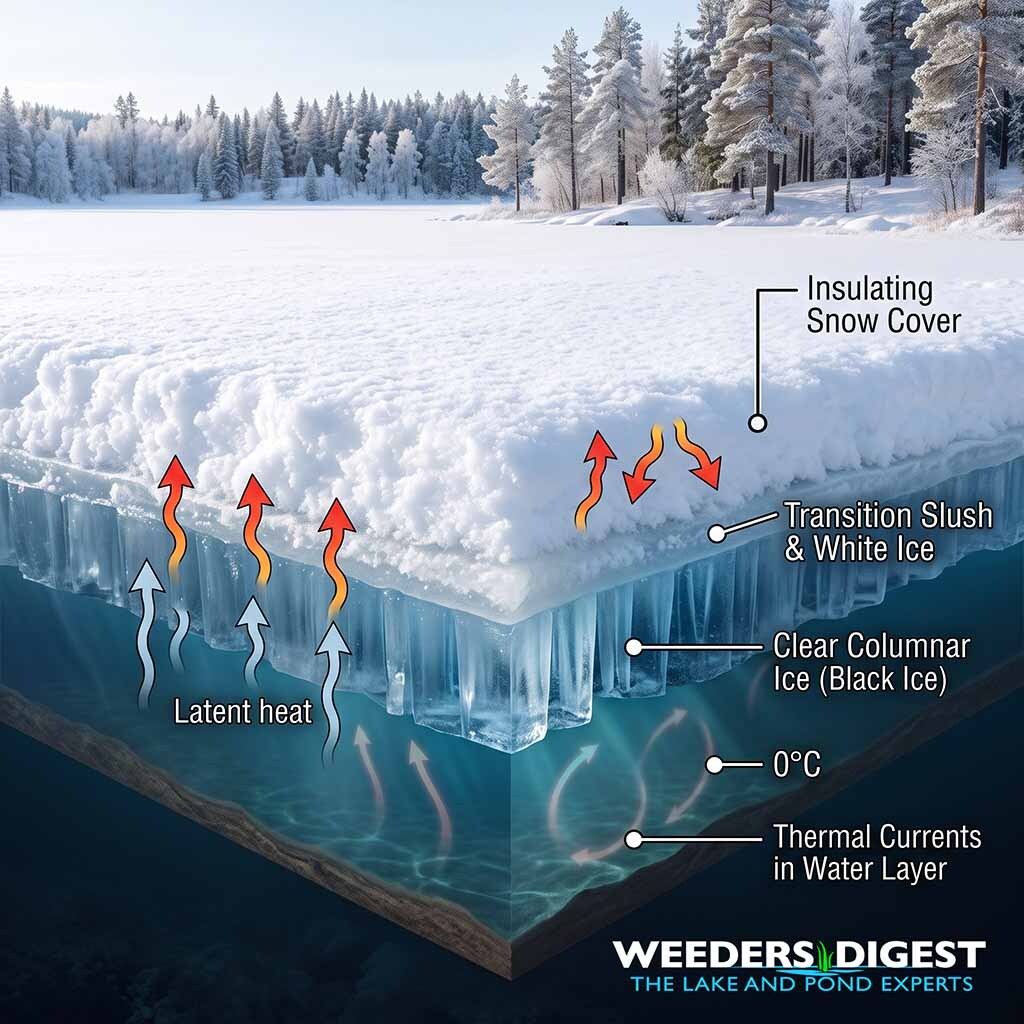
Snow acts as an insulating blanket on lake ice because its porous matrix traps vast pockets of motionless air, which drastically curtails the upward conduction of latent heat away from the water beneath. For lake ice to thicken at its base, sensible and latent heat from the underlying water column must escape directly into the sub-freezing winter atmosphere. When a thick blanket of low-density snow settles onto clear black ice, it severs this thermal conduit, trapping warmer residual water temperatures below and grinding downward congelation ice growth to an abrupt halt.
During mid-winter shoreline assessments across northern lakes, our lake and pond experts routinely observe this phenomenon firsthand: following a heavy blizzard, ice fishermen and dock owners often report pockets of dangerously thin, slushy "white ice" directly beneath deep snow drifts, while adjacent, wind-swept areas of bare ice remain significantly thicker, denser, and structurally solid.
Beyond simply reducing structural ice thickness, this insulating blanket alters the ecological dynamics of your entire water body throughout the winter. Because snow reflects solar radiation and slows thermodynamic exchange, it keeps bottom waters comparatively warm while blocking the light required for photosynthesis, setting the stage for dissolved oxygen depletion and winterkill in shallow bays.
The Science Behind It:
The physical mechanism governing lake ice accretion is strictly driven by Fourier's law of thermal conduction. In order for liquid water at the freezing front (0°C) to undergo a phase change into solid crystalline ice, it must release its latent heat of fusion (334kJ/kg). This thermal energy must be conducted upward through the existing ice sheet and dissipated into the boundary layer of the cold atmosphere. In a clear ice sheet devoid of snow cover, pure solid freshwater ice exhibits a relatively high effective thermal conductivity (k) of roughly 2.14 to 2.22 W m⁻¹ K⁻¹ at sub-freezing temperatures. This high conductive capability allows cold surface air to easily draw thermal energy out of the lake, driving rapid downward growth of columnar congelation ice (commonly known as "black ice").
The introduction of snow radically changes the system's thermal resistance. Uncompacted seasonal snow is not a monolithic solid; it is a porous, granular composite material consisting of an ice skeleton surrounded by interconnected air pockets. Because static air has an exceptionally low thermal conductivity (approximately 0.024 to 0.026 W·m⁻¹·K⁻¹, snow functions as an efficient thermal insulator. According to a benchmark review on seasonal snow physics published in the Journal of Glaciology by Sturm et al., the effective thermal conductivity of dry, uncompacted seasonal snow typically ranges from just 0.05 to 0.25 W·m⁻¹·K⁻¹, depending strictly on grain bonding and density. Quantitative modeling shows that solid freshwater ice is roughly 10 to nearly 40 times more thermally conductive than freshly fallen snow, meaning even a light accumulation creates an immense barrier to upward heat flux.
When several inches of snow blanket the ice sheet, the steepness of the vertical thermal gradient is heavily attenuated. Instead of the top of the ice mirroring an ambient air temperature of -20°C, the snow-ice interface is buffered and held much closer to the freezing point (0°C). With the thermal gradient flattened, the conductive rate drops dramatically, virtually arresting the downward growth of basal congelation ice. Research analyzing Arctic and temperate lake ice growth confirms that snow depth is the single greatest variable governing thermal resistance; an increase in snow cover by just a few centimeters can decrease basal congelation ice growth rates by more than 50% under identical sub-zero atmospheric temperatures.
Furthermore, heavy snow accumulation exerts significant hydrostatic weight upon the ice sheet. When the mass of the snow exceeds the buoyancy capacity of the ice, the ice sheet is depressed below the lake's hydrostatic water level. Lake water is subsequently forced upward through thermal fractures, expansion cracks, and perimeter fissures, saturating the basal snowpack to form a dense, water-logged slush layer. As documented in studies on snow-ice transformations in aquatic systems, once this slush layer refreezes from the surface downward, it produces granular, air-bubble-entrained "snow ice" or "white ice". Because white ice has higher microporosity, structural imperfections, and lower density (often between 840 and 890 kg⋅m⁻³ compared to 9.17 × 10² kg·m⁻³ for clear columnar ice), it possesses substantially lower mechanical compressive strength and presents deceptive, inconsistent load-bearing properties across the lake.
Our Recommendation for Managing Lake Ice & Winter Waterfront Protection:
Because snow insulation creates unpredictable ice conditions and variable load-bearing capacities, relying on winter freeze-up to protect your docks, pilings, and retaining walls is a major risk. Snow cover insulates the water beneath, but continuous wind drift and shifting temperatures lead to uneven freeze-thaw cycles, thermal ice expansion, and dangerous winter ice jacking that crushes permanent shoreline structures.
To mitigate physical damage to winter docks and boat lifts, our lake and pond experts recommend breaking the stagnant freezing cycle entirely with continuous, directional water movement. By strategically positioning an automated de-icer or utilizing the heavy-duty water movement capabilities found in our AquaThruster Muck & Weed Blower collection, lakefront owners can draw the warmer, dense water (4°C) residing at the lake bed upward toward the surface. This focused thermal current maintains a continuous, clear perimeter of open water around pilings and seawalls—preventing snow-slush freeze entrapment, relieving destructive lateral ice pressure, and safeguarding waterfront investments regardless of winter snow depth.
Sources / References:
- Sturm, M., Holmgren, J., König, M., & Morris, K. (1997). The thermal conductivity of seasonal snow. Journal of Glaciology, 43(143), 26-41. URL: https://www.cambridge.org/core/journals/journal-of-glaciology/article/thermal-conductivity-of-seasonal-snow/7888DCB1F06AFFC755B6D4D567833925
- MDPI Water Journal. (2023). Observations of Snow–Slush–Snow Ice Transformation and Mechanical Properties in Seasonal Aquatic Systems. Water, 15(13), 2360. URL: https://www.mdpi.com/2073-4441/15/13/2360
- Copernicus The Cryosphere. (2023). Temporospatial variability of snow's thermal conductivity on ice. The Cryosphere, 17(12), 5417-5437. URL: https://tc.copernicus.org/articles/17/5417/2023/