

Why the Ice Around Your Wooden Dock Posts Is Structurally Weaker
 |

Summary:
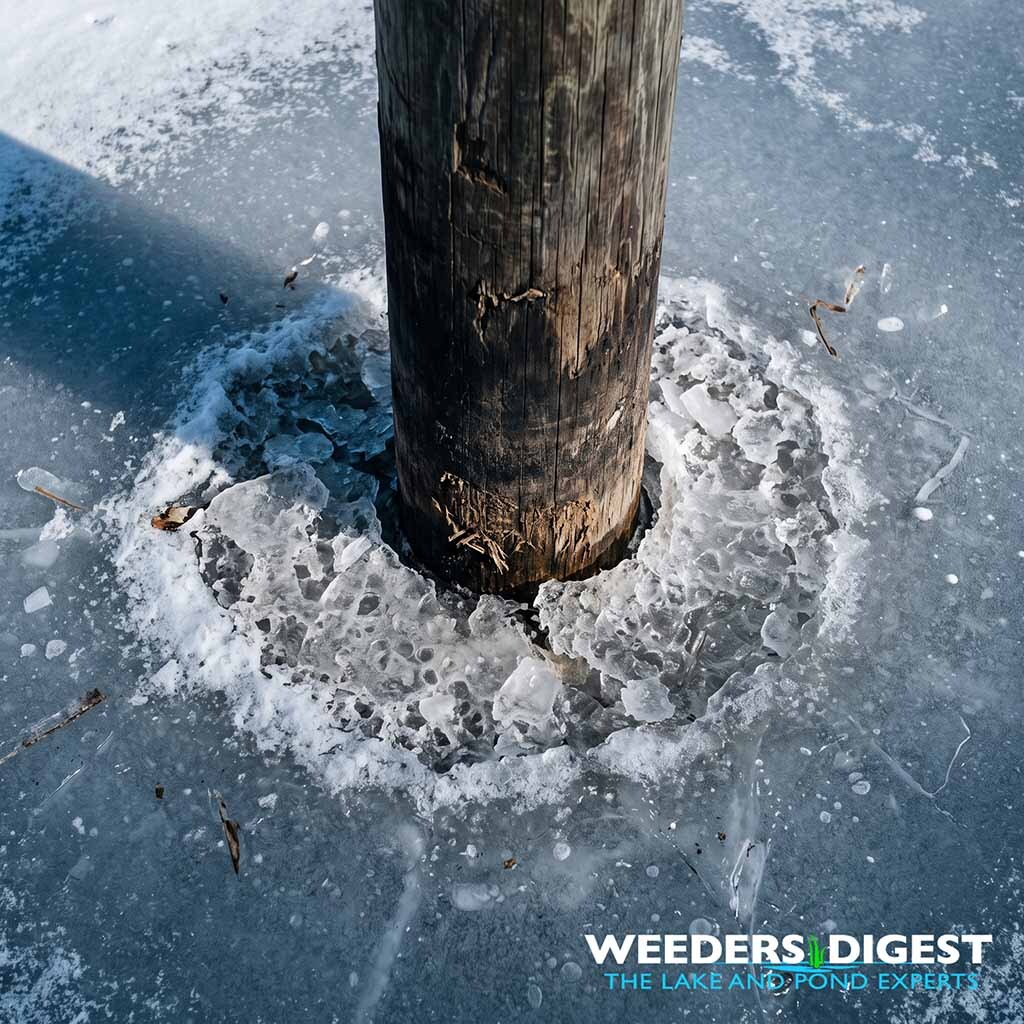
The ice immediately surrounding a wooden dock post is structurally weaker because the wood acts as a solar thermal collector and conductive channel, absorbing solar radiation and continuously discharging sensible heat into the adjacent ice interface. Natural, dark weathered timber possesses a substantially lower albedo than surrounding snowpack or clear freshwater sheet ice, allowing it to capture shortwave solar energy efficiently and re-radiate it outward. This persistent boundary-layer heat flux interrupts uniform, cohesive congelation ice formation, producing a brittle, porous, and air-entrained crystalline collar that exhibits significantly degraded load-bearing capacity compared to the open lake ice sheet.
In our winter field observations across northern freeze-thaw zones, our lake experts routinely encounter dock pilings wrapped in deceptive collars of slush, candled ice, and micro-fractured bridging sheets—even when the undisturbed ice sheet only four to six feet away measures twelve or more inches of dense, solid black ice. Shoreline posts absorb heat during clear, sub-freezing winter afternoons and retain substantial moisture throughout their vascular grain, creating an active thermal boundary zone that accelerates localized degradation and leaves waterfront timber uniquely susceptible to ice jacking, lateral expansion crushing, and fastener displacement.
The Science Behind It:
The localized degradation of ice adjacent to submerged wooden pilings is driven by fundamental disparities in radiative transfer, thermal properties, and crystalline microstructure. Clear congelation lake ice (commonly referred to as black ice) forms through vertical columnar crystal growth, yielding a surface albedo between 0.50 and 0.70, while fresh surface snow reflects between 80% and 90% of incoming solar radiation. In contrast, weathered timber pilings possess an albedo of approximately 0.15 to 0.25, absorbing up to 85% of incident shortwave solar radiation. Atmospheric optical research demonstrates that while pure ice has near-zero absorption in the visible spectrum, dark physical bodies absorb visible and near-infrared wavelengths rapidly, creating localized heat sinks.
This thermodynamic disparity is amplified by differences in material heat storage and boundary conduction. Saturated wood pilings act as active reservoirs of liquid moisture within their porous cellular structure. During clear, freezing daytime conditions, the internal core temperature of an exposed piling can rise 5°C to 12°C above ambient air temperatures through direct insolation. Because solid ice conducts heat away at roughly 2.22 W/(m·K) at 0°C, the piling continuously dumps latent and sensible heat along its lateral boundary layer. This localized heat flux maintains the contact zone near or above the 0°C melting threshold, triggering persistent micro-scale melting along the post's perimeter.
When ambient temperatures drop sharply overnight, this meltwater refreezes under unconstrained, turbulent conditions rather than organized columnar crystal orientation. This erratic diurnal thermal cycling creates "candle ice" or granular white ice, characterized by high void fractions, trapped air pockets, and unbonded interstitial liquid veins between crystalline boundaries. Mechanical structural analyses conducted by the U.S. Army Corps of Engineers Cold Regions Research and Engineering Laboratory (CRREL) demonstrate that candled or thermally degraded ice can lose between 60% and 80% of the compressive and flexural strength observed in solid, undisturbed columnar ice sheets of identical thickness.
Water also expands by approximately 9% upon phase transition from liquid to solid. As moisture inside the vascular cellular walls of the saturated wood freezes, it produces outward hoop stresses that disrupt physical bonding with the surrounding ice sheet. At the same time, daily water level fluctuations and wind-driven thermal expansion subject the sheet to significant dynamic movement. Because the ice collar directly touching the post is softer, warmer, and structurally compromised, it serves as a concentrated zone of shear failure. Rather than forming a stable mechanical cradle, the weakened collar shears erratically, subjecting the piling to uneven lateral thrusts, vertical lifting forces, and accelerated structural fatigue.
Our Recommendation for Managing Dock Ice Damage:
Because passive thermal absorption and crystalline degradation around submerged pilings create an erratic, structurally compromised collar, leaving permanent dock legs to the mercy of natural winter ice formations is a major risk for shoreline property owners. Unchecked freeze cycles, combined with the uneven shear stresses of weakened ice collars, are the primary drivers of ice jacking, twisted frames, and cracked pilings.
Preventing structural ice damage requires completely disrupting the static freeze interface by sustaining continuous hydrological circulation. By drawing denser, warmer 39°F (4°C) bottom water up toward the surface and directing it around pilings, you prevent the formation of destructive ice collars altogether. To safeguard permanent dock frameworks and shoreline footings throughout harsh winter conditions, our lake experts recommend establishing consistent directional flow with dedicated circulation units from our AquaThruster Muck & Weed Blower collection, which maintains an open-water perimeter around dock legs and prevents localized thermal fracturing and uplift.
Sources / References:
- Warren, S. G. (2019). Optical properties of ice and snow. Philosophical Transactions of the Royal Society A: Mathematical, Physical and Engineering Sciences, 377(2146), 20180161. https://doi.org/10.1098/rsta.2018.0161
- U.S. Army Corps of Engineers Cold Regions Research and Engineering Laboratory (CRREL). Ice Thickness and Strength for Various Loading Conditions. Technical Guidance Report. https://rivergages.mvr.usace.army.mil/WaterControl/Districts/MVP/reports/ice/ice_load.html
- Ashton, G. D., Ed. (1986). River and Lake Ice Engineering. Water Resources Publications. https://books.google.com/books/about/River_and_Lake_Ice_Engineering.html?id=xglYVjAsnt8C