

Why Your Dock's Water Gets Warmer and Dirtier in Late August
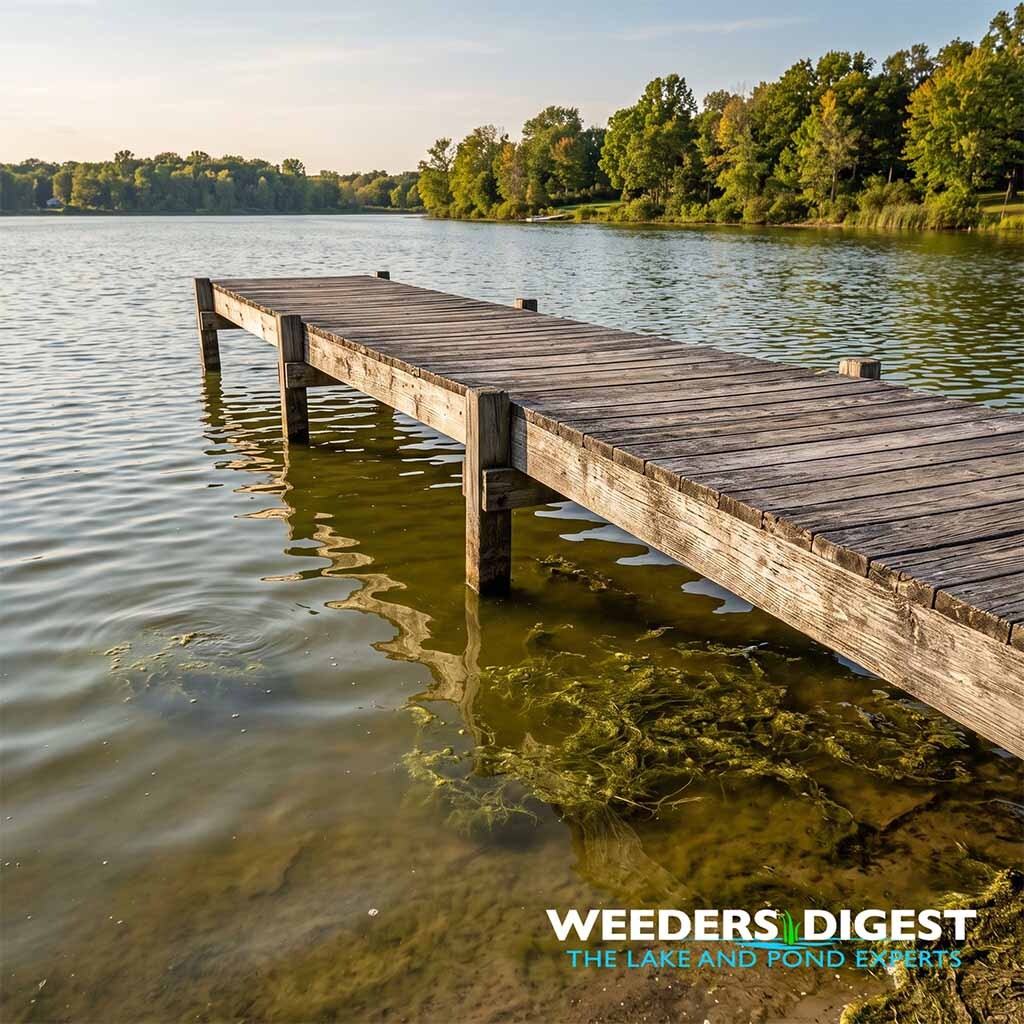 |

Summary:
The water near your dock gets warmer and dirtier in late August because the lake separates into distinct temperature layers that trap heat at the surface, creating an incubator for rapid algae growth while simultaneously pulling trapped nutrients from the bottom. As the summer progresses, the sun constantly heats the top layer of the lake. Because warm water is lighter than cold water, this heated layer simply floats on top of the cooler water below without mixing. By the time late August arrives, this stagnant, sun-baked surface water has reached its peak temperature for the year.
In our experience as lake and pond experts, late August is when we receive the highest volume of calls about sudden shoreline scum and murky water; it often looks like someone flipped a switch overnight, but it is actually the culmination of an entire summer of solar heating. All the microscopic plants, floating weeds, and organic runoff that have washed into the lake since spring are now trapped in this warm, shallow zone.
Because this warm surface water acts like a greenhouse, it accelerates the biological decay of organic matter and provides the perfect environment for algae to multiply at explosive rates. The combination of intense heat, trapped sediment, and flourishing algae patches gives the water that distinctly murky, dirty appearance just before the cooler winds of autumn arrive to mix the lake back together.
The Science Behind It:
The phenomena of late summer warming and deteriorating water clarity are primarily governed by a limnological process known as thermal stratification. As solar radiation intensely heats the lake surface throughout the summer months, the water column divides into three distinct density-dependent layers. The uppermost layer, the epilimnion, consists of warm, actively circulating water. Beneath it lies the metalimnion, characterized by a steep temperature gradient known as the thermocline, which acts as a physical barrier. At the bottom is the hypolimnion, a layer of dense, cold, and isolated water. By late August, the density difference between the epilimnion and hypolimnion is at its absolute peak, firmly locking the warm water and suspended particulates in the uppermost layer where docks are located.
This physical isolation of the epilimnion directly alters the biochemical stability of the aquatic ecosystem. As the epilimnetic water temperature rises, its capacity to hold dissolved oxygen diminishes. Research indicates that for every 1 °C increase in water temperature, the solubility of oxygen decreases by 1.6% to 2.8%. This reduction in dissolved oxygen, compounded by the biological oxygen demand of decaying organic matter, creates a highly stressed surface environment. Meanwhile, the isolated hypolimnion often becomes completely anoxic, or devoid of oxygen, as microbial decomposition consumes the remaining reserves.
The anoxic conditions at the bottom of the lake trigger a secondary chemical process known as internal nutrient loading. Without oxygen present at the sediment-water interface, chemical bonds holding phosphorus and iron together break down. This allows massive quantities of bioavailable phosphorus to release from the bottom sediment and eventually migrate upward. When this highly concentrated nutrient load reaches the warm, sunlit epilimnion, it fuels the explosive reproduction of phytoplankton and cyanobacteria, commonly referred to as harmful algal blooms.
Furthermore, this late-stage stratification contributes to an accumulation of suspended organic matter that severely degrades water clarity. Longitudinal studies on temperate lakes have demonstrated that prolonged summer stratification and warming trends significantly increase the presence of dissolved organic carbon (DOC). These analyses reveal that DOC concentrations have increased by an average of 1.11 mg/L across studied lakes over recent decades, a phenomenon referred to as lake browning. The combination of suspended DOC, hyper-abundant cyanobacteria, and floating detritus collectively scatters and absorbs light, transforming the once-clear nearshore waters into the murky, degraded state observed at the end of summer.
Sources / References:
- Dynamics of oxygen evolution in a thermally stratified reservoir under climate warming: https://d-nb.info/1387029371/34
- Concurrent warming and browning eliminate cold-water fish habitat in many temperate lakes: https://pmc.ncbi.nlm.nih.gov/articles/PMC10786301/