

Why Your Lake Bottom is Turning to Muck: The Science of Sediment Accumulation
 |

Summary:
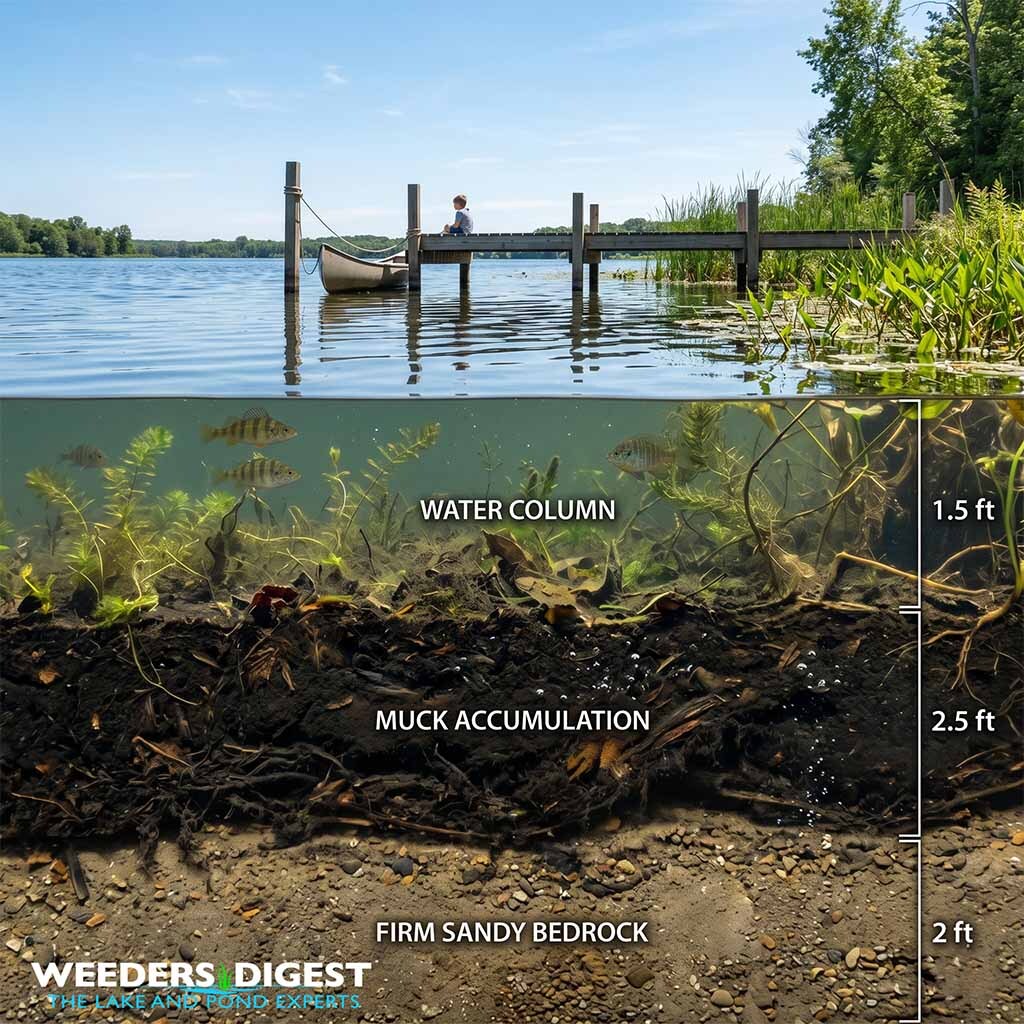
Muck accumulation occurs when organic matter such as dying aquatic weeds, algae, and windblown leaves enters a waterbody faster than naturally occurring bacteria can break it down. Over time, this excess organic material settles at the bottom of the lake or pond, creating a thick, oxygen-depleted layer of soft sediment. Instead of a firm, sandy bottom, property owners are left with a dark, foul-smelling sludge that degrades water quality and ruins recreational activities.
We regularly evaluate waterfronts that have been completely overrun by this soft sediment. When scoping out a muck removal project which inherently can be a big project and does require a lot of labor to execute properly. We often step into the shallow water and instantly sink past my knees into the black sludge. Homeowners frequently assume this muck is just a natural mud layer, but it is actually the direct result of years of accelerated organic loading and poor localized decomposition.
Understanding how and why this muck builds up is the critical first step in reclaiming a shoreline. When we can identify the specific inputs driving the accumulation, we can begin to formulate a highly effective strategy to physically remove or relocate the sediment, mitigate future buildup, and ultimately restore the natural, firm bottom of your lake.
The Science Behind It:
Lake sediment accumulation is fundamentally driven by the biological imbalance between the introduction of organic biomass and the benthic microbial community's capacity for decomposition. The scientific community distinguishes true "muck" from standard mineral soil by its exceptionally high organic content. According to limnological research documented by the University of South Florida Water Institute, muck typically consists of 20% to over 80% organic matter. This organic material originates from two primary classifications: allochthonous inputs, which are external materials transported into the water from the surrounding watershed such as leaves, grass clippings, and eroded topsoil, and autochthonous inputs, which are generated within the lake itself, including dying phytoplankton, submerged aquatic vegetation, and fish waste.
The rapid rate at which this organic matter accumulates in modern aquatic ecosystems is heavily influenced by anthropogenic, or human-driven, eutrophication. Eutrophication is the ecological process by which a waterbody becomes overly enriched with nutrients, primarily nitrogen and phosphorus, from watershed runoff. These excess nutrients trigger explosive biological productivity, leading to dense algal blooms and rampant aquatic plant growth. When these massive volumes of vegetation naturally die back at the end of their growing cycle, they sink to the benthic zone—the lowest ecological region of a waterbody.
Once this biomass settles at the bottom, the decomposition process begins. In a healthy, balanced lake, aerobic bacteria utilize dissolved oxygen in the water column to efficiently digest this organic detritus. However, as the volume of dead vegetation continuously increases, the aerobic bacteria consume oxygen faster than it can be naturally replenished. This biochemical oxygen demand drives the benthic zone into an anoxic, or completely oxygen-depleted, state. Without oxygen, decomposition is subsequently taken over by anaerobic bacteria. Anaerobic decomposition is vastly slower and far less efficient, resulting in the incomplete breakdown of plant matter and the release of hydrogen sulfide gas, which creates the characteristic "rotten egg" odor associated with lake muck.
The historical timeline of this accumulation strongly highlights the impact of modern watershed development. A comprehensive geological study on carbon burial and sediment accumulation published in the journal Geology (Dean & Gorham, 1998) found that since historical settlement and agricultural expansion, sediment accumulation rates in mid-latitude lakes have surged dramatically. The researchers noted that post-settlement accumulation rates average approximately 3 millimeters per year, which is roughly four times higher than the historical Holocene baseline rate. This stark quantitative increase illustrates exactly how modern nutrient loading has fundamentally altered lake bottom morphology across the country.
Over decades, this partially decomposed organic material compresses into a dense layer of gyttja—a nutrient-rich, dark mud. Because this gyttja is heavily saturated with legacy nutrients, it creates a detrimental feedback loop. The internal loading of phosphorus from the muck back into the water column during anoxic periods fuels subsequent generations of algae and weeds, which in turn die and create even more muck. Breaking this ecological cycle requires significant structural or physical intervention to disrupt the continuous deposition of autochthonous and allochthonous organic matter.
Sources / References:
- University of South Florida Water Institute. "A Beginner's Guide to Water Management—Muck: Causes and Corrective Actions." https://lake.wateratlas.usf.edu/upload/documents/MuckCircular.pdf
- Dean, W. E., & Gorham, E. (1998). "Magnitude and Significance of Carbon Burial in Lakes, Reservoirs, and Peatlands." Geology. https://digitalcommons.unl.edu/context/usgsstaffpub/article/1307/viewcontent/Dean_GEOLOGY_1998_Magnitude_and_significance.pdf