

Why Your Lake Is Overrun With Weeds This Summer: My Field Notes on Mild Winters
 |

Summary:
Mild winters drastically increase the density of summer aquatic weeds by reducing ice cover duration and preventing the deep sediment freezing necessary to kill off overwintering root systems. When a lake does not experience a prolonged, harsh freeze, aquatic plants—commonly known as macrophytes—do not fully die back, allowing them to start growing weeks earlier than normal in the spring. This early head start means that by mid-summer, the weed beds are thicker, spread further, and are much harder to manage.
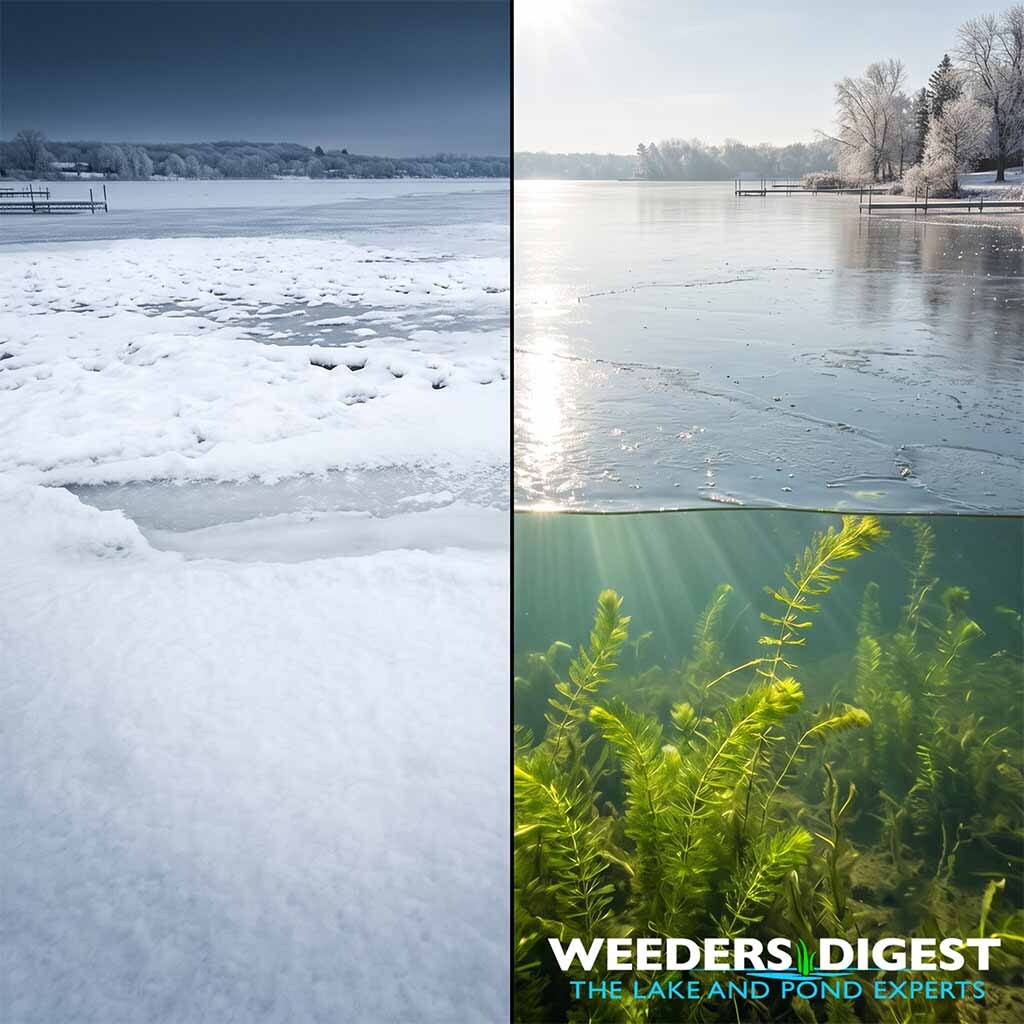
Without a thick layer of ice and snow blocking out the sun, light penetrates the water column all winter long. This allows hardy invasive species, such as curly-leaf pondweed, to actively photosynthesize and grow slowly beneath the surface instead of going completely dormant. By the time the water warms up, these plants have already established a massive root network, allowing them to outcompete beneficial native plants for space and nutrients.
As a Certified Lake Manager, my earliest spring field surveys immediately reveal the impact of a warm winter. I regularly drop underwater cameras into local lakes just days after a premature ice-out, only to find invasive weed shoots already several inches tall across the lake bed. When I see that vibrant green growth in early March, I know immediately that the property owners on that shoreline are going to face a severe, high-biomass weed explosion by July.
When these massive weed beds inevitably die back later in the summer, their decomposition consumes a tremendous amount of dissolved oxygen from the water. This rapid decay process not only creates thick, mucky bottom sediments but can also lead to hazardous fish kills and secondary algae blooms, disrupting the entire ecological balance of your waterbody.
The Science Behind It:
The density and proliferation of summer aquatic macrophytes (visible aquatic plants) are inextricably linked to the phenology of winter ice cover. In lentic (still water) ecosystems, a thick layer of ice combined with snow accumulation severely restricts the transmission of photosynthetically active radiation (PAR) into the water column. During a mild winter, the absence of this opaque barrier allows sunlight to continually reach the benthic zone (the lake bottom). This extended photoperiod permits overwintering aquatic flora to maintain baseline photosynthetic activity rather than entering total senescence, effectively advancing the biological spring.
Mild winters also fail to provide the mechanical and thermal control necessary to regulate perennial macrophyte populations. Many invasive and nuisance aquatic plants reproduce and survive the winter using specialized vegetative structures such as turions (hardened, dormant overwintering buds), rhizomes (horizontal underground stems), and tubers. According to agricultural and ecological extension research, including data from the Arkansas Cooperative Extension Service, bottom sediments must ideally be exposed to air for at least 6 to 8 weeks, with temperatures dropping below freezing (0°C / 32°F) for two weeks or more, to physically rupture and destroy these cellular structures. Mild winters rarely achieve this sustained thermal threshold, resulting in maximum viability for turions and rhizomes when spring arrives.
Furthermore, mild winter conditions fundamentally alter the biochemical nutrient cycling within the lake. Research published in the journal Knowledge and Management of Aquatic Ecosystems (2019) demonstrated that following mild winters, the water column retains significantly higher concentrations of both soluble and total nitrogen compared to seasons following historically cold winters. Because macrophytes acquire a substantial portion of their nutrients directly from the water column and shallow sediments during early growth phases, this elevated nitrogen availability acts as an immediate biological catalyst, accelerating biomass production before native competitors can establish themselves.
This shift in growth potential is being compounded by long-term climatological trends altering ice duration. Peer-reviewed environmental models, such as those detailed in MDPI River and Lake Ice Processes, indicate that over the last 35 years, spring ice loss has shifted to occur an average of five days earlier, with severe climate models predicting ice breakups could occur up to 43 days earlier by 2070. Similarly, research published in National Science Open (2024) tracking lake ice thickness and duration confirms that these reductions in ice cover actively increase the gross primary productivity (GPP) of aquatic ecosystems during what should traditionally be a dormant freeze period.
Ultimately, the compounding variables of increased early-season solar radiation, high turion survival rates due to inadequate sediment freezing, and elevated baseline nitrogen levels create an ideal environment for rapid macrophyte expansion. By the time water temperatures reach traditional summer peaks, the aquatic weed biomass has already exceeded the carrying capacity of the littoral zone, resulting in the dense, impenetrable vegetation mats observed in affected waterbodies.