

Why Your Lake Is Seeing New Weeds: The Northern Migration of Invasive Aquatic Plants
 |

Summary:
Changing climate patterns, specifically warming winters and longer growing seasons, are directly causing invasive aquatic weeds to migrate northward into lakes and ponds that were previously too cold for them to survive. For decades, northern waterbodies were naturally protected from southern tropical and subtropical nuisance plants by long, harsh winters and thick ice cover that acted as a thermal barrier, freezing out any hitchhiking species before they could establish a foothold. Now, as average temperatures rise and extreme cold snaps become less frequent, these invasive plants are surviving the winter, taking root, and outcompeting native vegetation in regions where they were once biologically incapable of existing.
As a Certified Lake Manager evaluating waterbodies across the Upper Midwest, I used to rely on our deep-freezing winters to act as a natural reset button, essentially killing off any accidental southern transplants dropped by migrating waterfowl or transient boaters; however, over the last several years, I am routinely identifying aggressive, warm-water vegetation thriving in northern lakes immediately following an unusually early spring ice-out. This shift has fundamentally changed how we monitor shorelines, as we are no longer just looking for the usual local suspects, but actively scouting for invaders that shouldn't mathematically be in our latitude yet.
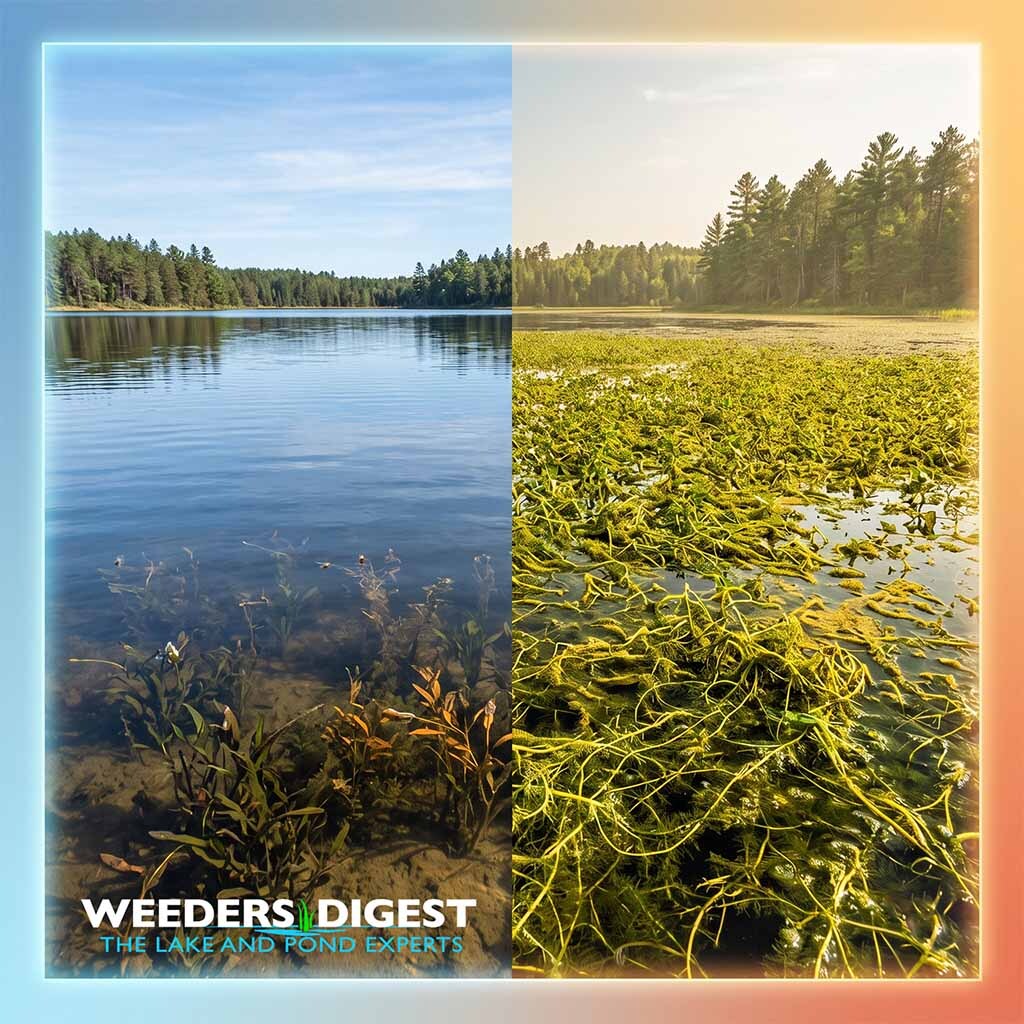
When these new invasive species move in, they do more than just clutter a shoreline. Because the native ecosystem has not evolved alongside them, there are no natural predators, insects, or diseases to keep their growth in check. They rapidly form dense, impenetrable mats that block sunlight from reaching the lake bottom, choke out the native plants that local fish rely on for habitat, and ultimately alter the entire biological balance of the waterbody.
The Science Behind It:
The fundamental mechanism driving the geographic expansion of invasive aquatic vegetation is a shift in the bioclimatic envelope, which is the specific set of ecological and climatic conditions—such as temperature ranges and water availability—necessary for a given species to survive and reproduce. Historically, latitudinal temperature gradients created strict physiological boundaries for plant life. However, as global mean surface temperatures steadily increase, these envelopes are expanding poleward. Aquatic environments are particularly sensitive to these shifts because water retains heat longer than air, and the reduction in both the duration and thickness of winter ice cover drastically alters the underwater thermal regime, providing a hospitable overwintering environment for non-native flora.
Recent quantitative research highlights exactly how sensitive these geographic boundaries are to winter temperature variations. In a 2023 study conducted by the U.S. Geological Survey, researchers analyzed an initial group of 81 highly transformative invasive plant species to measure their physiological responses to climate anomalies. The study successfully identified specific, quantifiable temperature thresholds for 40 cold-sensitive, tropical invasive species, concluding that even minor reductions in the severity of winter cold extremes are actively facilitating the northward range expansion of these plants across the United States. Without those critical, sustained freezing temperatures to induce mortality, populations easily bridge the gap between growing seasons.
Furthermore, climate change alters local phenology, which is the timing of seasonal biological events such as spring budding, germination, or ice-out. Invasive species generally possess a high degree of phenotypic plasticity, meaning they can rapidly adapt their growth cycles to changing environmental conditions much faster than native species. When warmer spring temperatures trigger an earlier ice-out, invasive macrophytes—aquatic plants growing in or near the water—break dormancy earlier than native species. This chronological head start allows the invaders to rapidly monopolize available sunlight and water column nutrients, creating a canopy that shades out native benthic, or bottom-dwelling, communities before they even begin their seasonal growth phase.
This dynamic is currently being observed in species like Nitellopsis obtusa, commonly known as starry stonewort, an aggressive macroalga spreading across the Upper Midwest. Research from the Minnesota Aquatic Invasive Species Research Center indicates that the invasion dynamics, abundance, and latitudinal spread of this species are heavily dictated by climatological factors, most notably the length of the growing season and average water temperatures. When seasonal ice clears earlier, the resulting extended photosynthetic period yields significantly higher biomass and geographic coverage, allowing the species to establish robust populations further north than historical models predicted.
The ecological consequence of this migration is a severe disruption of ecosystem services. As heat-loving invasive species colonize warming northern waters, they drive localized eutrophication by altering dissolved oxygen cycles and nutrient cycling. Dense monocultures of non-native vegetation restrict natural water flow and atmospheric gas exchange at the surface, which can lead to hypoxic (low oxygen) conditions below the canopy. Ultimately, the synergy between warming waters and introduced species creates a positive feedback loop: the changing climate stresses the native ecosystem, making it highly vulnerable to invasion, while the successful invaders further degrade the habitat's natural resilience.
Sources / References:
- Osland, M., et al. (2023). "Plant migration due to winter climate change: Range expansion of tropical invasive plants in response to warming winters." U.S. Geological Survey (DOI: 10.1007/s10530-023-03075-7). https://www.usgs.gov/publications/plant-migration-due-winter-climate-change-range-expansion-tropical-invasive-plants
- Minnesota Aquatic Invasive Species Research Center (MAISRC). "Managing Midwestern Aquatic Invasions in a Changing Climate." University of Minnesota. https://maisrc.umn.edu/ais-changing-climate