

Why Your Lake's Algae Disappears After a Storm: How Wind and Wave Action Disrupt Algae Mats
 |

Summary:
Wind and wave action disrupt algae mats by creating surface turbulence that physically breaks apart the colonies and overpowers their natural buoyancy, dragging them down into deeper, darker waters where they cannot photosynthesize. When the surface of a lake or pond remains flat and stagnant, certain types of algae—specifically planktonic cyanobacteria—float to the top and bind together into thick, floating scums. Once the wind picks up and waves begin to crest, this mechanical energy acts like a giant blender, scattering the cells across the water column and temporarily eliminating the visible surface bloom.
In my daily fieldwork as a Certified Lake Manager, I regularly encounter this phenomenon during the late summer months. A property owner will often call me in a panic on a Friday afternoon regarding a massive, neon-green algal scum coating their shoreline, only to be completely baffled when I arrive on Monday morning after a weekend of heavy winds to find the water's surface entirely clear. The algae did not magically die or leave the ecosystem; it was simply churned back into the water column by the physical agitation of the waves.
This natural mixing process is vital for the short-term aesthetic relief of a waterbody, but it is also a fundamental driver of aquatic health. When waves break up a stagnant algae mat, it prevents the scum from blocking sunlight from reaching submerged aquatic vegetation and helps facilitate gas exchange at the surface. Understanding how weather patterns influence these blooms can help you better anticipate when your waterbody is most vulnerable to aggressive algae formations.
The Science Behind It:
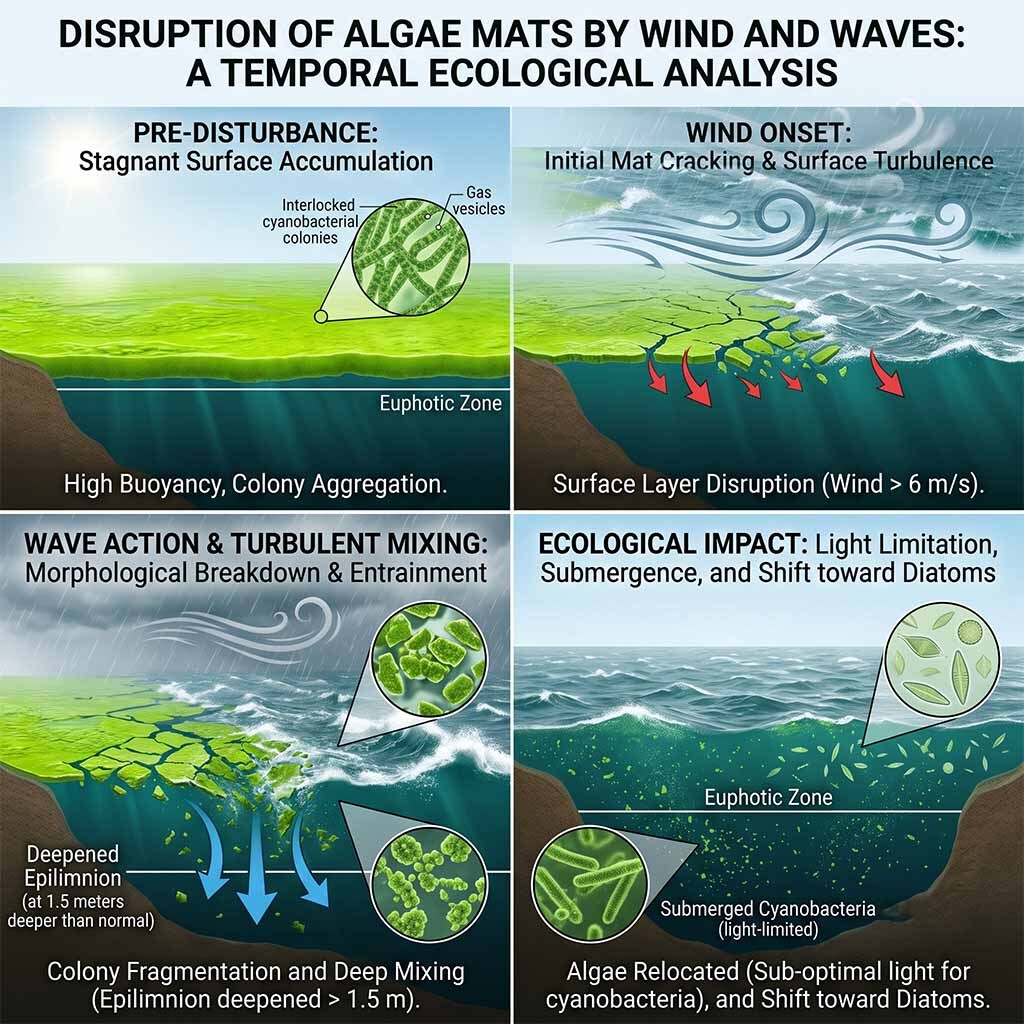
The mechanics of wind-induced algae disruption begin at the boundary between the atmosphere and the water, an area known as the biopolymeric surface microlayer. Under calm conditions, cyanobacteria (often referred to colloquially as blue-green algae) utilize intracellular gas vesicles to regulate their buoyancy, floating upward to maximize solar exposure in the euphotic zone—the upper layer of water where sunlight penetrates sufficiently for photosynthesis. Here, they excrete extracellular polysaccharides that increase colony size and create a highly stable surface slick. However, research published in the journal Biogeosciences demonstrates that this protective microlayer is highly vulnerable to physical disturbance, collapsing sharply when sustained wind speeds exceed 6 meters per second.
Once wind speeds surpass this critical threshold, the surface tension is broken, and wave action generates downward kinetic energy. This turbulence overpowers the upward lift of the cyanobacterial gas vesicles. According to a study detailed in the NOAA Institutional Repository regarding episodic wind events, sustained high winds exceeding 7.7 meters per second generate enough shearing force to not only break apart surface aggregations but also deepen the epilimnion—the warm, oxygen-rich upper layer of a stratified lake—by approximately 1.5 meters. This massive hydrodynamic shift fundamentally alters the vertical distribution of the biomass.
As the epilimnion deepens and turbulence increases, the algal colonies are entrained, or dragged, below the euphotic zone. In these deeper waters, the cyanobacteria experience sub-optimal light conditions, effectively halting their photosynthetic capabilities and preventing the rapid cellular division that sustains a bloom. Studies on shallow, eutrophic systems, such as those conducted on Lake Taihu by Wu et al., confirm that while mild breezes may push floating algae horizontally into concentrated shoreline scums, intensive mixing from strong wave action is required to forcefully submerge the colonies and shift the ecological advantage away from cyanobacteria toward diatoms and green algae that thrive in mixed water columns.
This physical disruption also mitigates localized hypoxia, which is the severe depletion of dissolved oxygen in the water. Dense, undisturbed algae mats prevent atmospheric oxygen from mixing into the water and eventually trigger massive bacterial oxygen consumption when the surface algae die and decay. By fracturing the surface mats, wave action increases the surface area of the water exposed to the atmosphere, enhancing the diffusion of oxygen while simultaneously scattering the decaying organic matter.
Ultimately, wind and wave action act as a primary regulatory mechanism in aquatic ecosystems. While the biomass remains within the lake following a wind event, the morphological breakdown of the colonies and their forced relocation into deeper, light-limited depths prevents the immediate ecological and aesthetic damages associated with unbroken surface mats.