

Why Your Lake's Weeds Explode During Extreme Heat: The Threat of Thermal Stratification
 |
Summary:
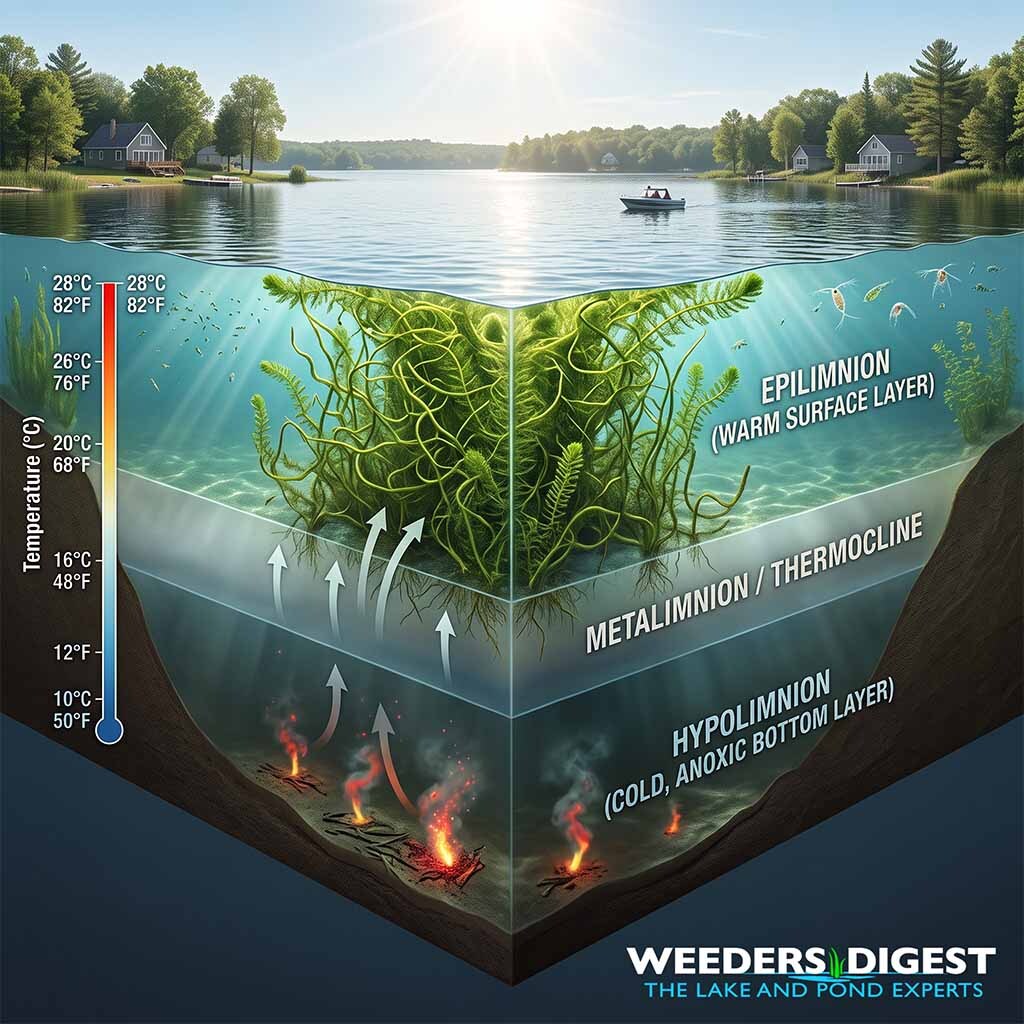
Extreme heat accelerates aquatic weed growth by intensifying a process called thermal stratification, which traps oxygen-depleted water at the bottom of your lake and forces a massive release of fertilizer-like nutrients into the warm, sunlit upper layers where plants thrive. When surface waters heat up rapidly during a heatwave, they become significantly lighter than the cool water below, creating a rigid barrier that prevents the lake from naturally mixing. Because oxygen cannot reach the bottom, the lakebed undergoes a chemical change that unlocks years of accumulated phosphorus, feeding aggressive weed growth from the roots up.
As a Certified Lake Manager, I often see this firsthand during the dog days of summer; when taking a temperature and dissolved oxygen profile in a client's lake, the surface water will be bath-warm, but dropping the probe just six feet down frequently reveals ice-cold, completely dead water. This sharp divide is the exact mechanism that turns a seemingly healthy pond into an overgrown marsh seemingly overnight.
This phenomenon effectively turns the bottom of your waterbody into a nutrient factory. Once those deep-rooted weeds tap into that freshly released bottom phosphorus, or when a strong storm finally forces those nutrients up into the warm surface layer, the water acts like a biological incubator. The combination of intense solar energy, high temperatures, and an unlimited food supply triggers an explosion of invasive weeds and algae that can choke out a lake in a matter of weeks.
The Science Behind It:
Thermal stratification is a fundamental limnological phenomenon driven by the physical properties of water, specifically the non-linear relationship between temperature and density. Water reaches its maximum density at exactly 4°C. During extreme summer heat, the surface layer of a lake, known as the epilimnion, absorbs solar radiation and rapidly warms, becoming significantly less dense than the cooler water below. This disparity in density establishes a sharp physical and thermal gradient called the metalimnion, or thermocline. Because the density difference is so profound, it acts as a physical barrier that prevents wind-driven mixing from circulating atmospheric oxygen down to the cold, dense bottom layer, which is known as the hypolimnion.
Once the hypolimnion is sealed off from atmospheric gas exchange, biological oxygen demand from decomposing organic matter in the benthic zone quickly consumes the remaining dissolved oxygen. This leads to anoxia, a complete depletion of oxygen at the lake bottom. Under typical oxygenated conditions, phosphorus is strongly bound to iron in the sediment. However, the anoxic environment alters the redox potential of the sediment-water interface, reducing ferric iron to ferrous iron. This chemical shift breaks the bond and triggers internal nutrient loading, releasing massive quantities of soluble reactive phosphorus directly into the water column where it becomes readily bioavailable to aquatic macrophytes and phytoplankton.
The exacerbation of these processes is directly linked to atmospheric warming and extreme heat waves. Recent hydrological studies highlight the severity of this warming trend and its impact on aquatic ecosystems. For instance, research published in the journal Water by Kim et al. (2021) demonstrates that in certain watersheds, lake surface water temperatures are increasing at rates two to three times higher than the surrounding ambient air temperatures. This disproportionate surface warming dramatically intensifies the Schmidt's stability index of a lake, strengthening the thermocline and significantly prolonging the seasonal duration of stratification and subsequent anoxia.
As internal phosphorus loading increases, the biological response in the epilimnion is immense. Benthic-rooted aquatic macrophytes utilize the newly available phosphorus from the sediment, while the elevated surface temperatures optimize their metabolic and photosynthetic rates. Furthermore, competitive advantages shift heavily toward harmful cyanobacteria. Modeling research on climate impacts in urban lakes conducted by Simmons et al. (2024) indicates that surface waters remaining above the 20°C (68°F) threshold for extended periods can lead to a 39.7% increase in the seasonal duration of cyanobacteria blooms, driven by hundreds of additional hours of optimal growing temperatures.
Ultimately, the synergy between prolonged thermal stratification, heat-induced internal nutrient loading, and accelerated metabolic rates creates an ecological feedback loop. High temperatures not only supply the chemical fuel required for massive biomass production but also provide the ideal physical environment for invasive aquatic weeds and harmful algal blooms to outcompete native flora, leading to severe ecological degradation and reduced aquatic biodiversity.
Sources / References:
- Kim, J., et al. (2021). "Effects of Long-Term Increases in Water Temperature and Stratification on Large Artificial Water-Source Lakes in South Korea." Water (MDPI). https://www.mdpi.com/2073-4441/13/17/2341
- Simmons, J., et al. (2024). "Climate Change Impacts on Water Temperatures in Urban Lakes: Implications for the Growth of Blue Green Algae in Fairy Lake." Water (MDPI). https://www.mdpi.com/2073-4441/16/4/587