

Why Your Lush Lawn is Fueling My Biggest Lake Weed Headaches
 |

Summary:
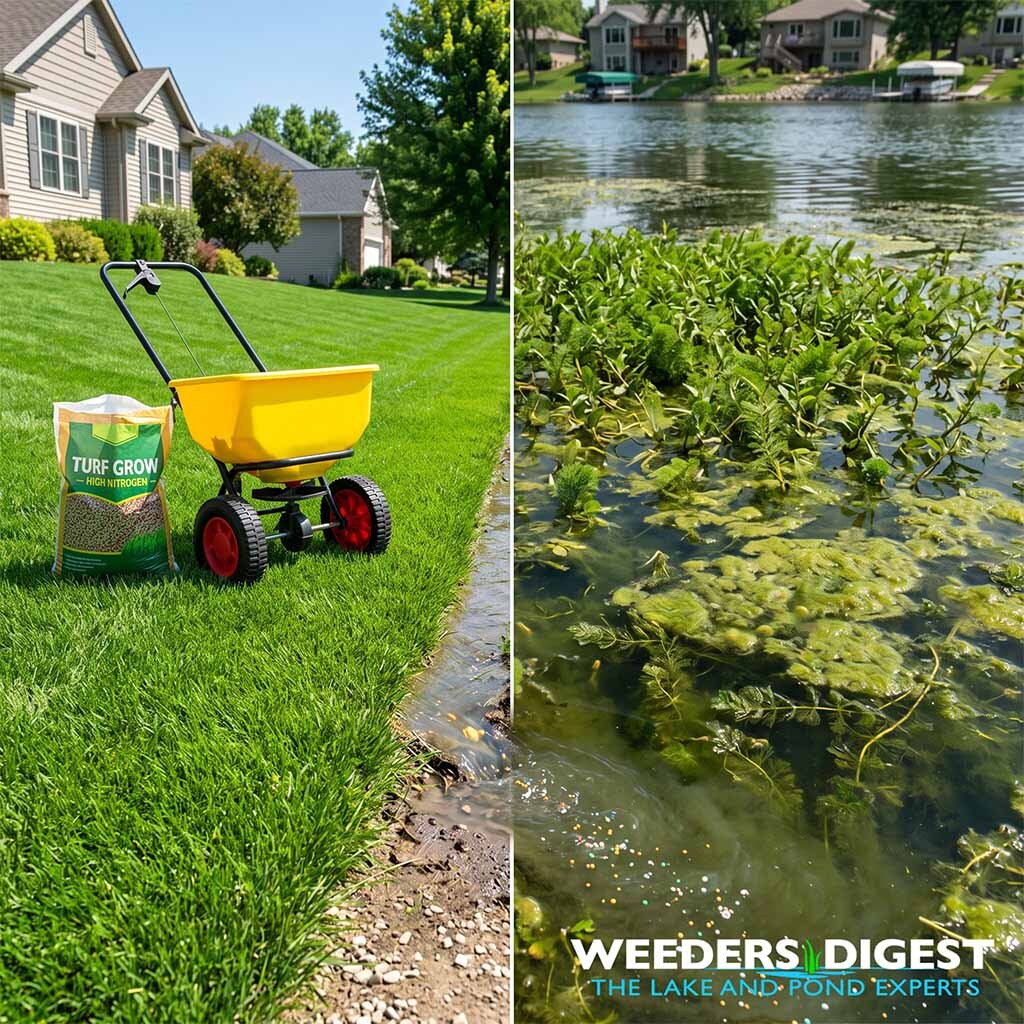
Lawn fertilizers rich in phosphorus and nitrogen directly fuel explosive weed and algae growth in suburban lakes when rain washes the unabsorbed surface nutrients into local waterways. While these chemical formulations are designed to make terrestrial grass lush, green, and vibrant, they act as an accidental super-food for aquatic vegetation, throwing the delicate biological balance of a lake completely out of order. Homeowners often apply far more fertilizer than their compacted suburban soil can possibly absorb, leaving the excess chemicals to hitch a ride on surface runoff right into our backyards' aquatic ecosystems.
In my years working as a Certified Lake Manager, I have seen this exact scenario play out on countless shorelines following heavy spring rains. I will often survey a neighborhood pond that looks perfectly clear in early May, only to return two weeks after a major storm and find the entire surface choked out by aggressive filamentous algae and curly-leaf pondweed. The culprit is almost always the perfectly manicured, heavily fertilized lawns sloping directly down to the water's edge without any natural buffer zone to catch the chemical runoff.
This nutrient runoff essentially creates an artificial greenhouse effect underwater. The excess nitrogen and phosphorus cause aquatic plants to grow at an unnatural, hyper-accelerated rate that the local ecosystem cannot manage. When these massive, sprawling weed beds eventually complete their life cycle, die, and decompose, the decay process consumes the water's dissolved oxygen, which can lead to severe fish kills and a foul-smelling, turbid lake environment. Understanding the direct pipeline between your backyard fertilizer spreader and the local lake is the crucial first step to reclaiming our recreational waters from invasive weed infestations.
The Science Behind It:
The fundamental mechanism driving fertilizer-induced aquatic weed infestations is a process known as cultural eutrophication. In a natural, biologically balanced aquatic ecosystem, the growth of phytoplankton, algae, and macroscopic aquatic plants (macrophytes) is naturally restricted by the limited availability of essential nutrients, primarily phosphorus and nitrogen. Phosphorus acts as the primary limiting nutrient in most freshwater systems, meaning that the total biomass of aquatic plant life is directly dictated by the amount of phosphorus available in the water column and the benthic sediments. When anthropogenic sources, such as synthetic residential lawn fertilizers, introduce unnaturally high concentrations of these elements into a watershed via stormwater runoff, this natural growth limitation is completely eradicated.
The quantitative impact of this artificial nutrient loading is staggeringly disproportionate. According to research data cited by the University of Illinois and Kansas State University Extension programs, the introduction of just one single pound of phosphorus into a freshwater body can generate up to 500 pounds of wet algae and aquatic weed biomass. Because commercial turf fertilizers are formulated with highly soluble, readily available forms of these nutrients designed for rapid terrestrial plant uptake, any fraction not immediately absorbed by the grass root system remains highly mobile. During precipitation events, stormwater rapidly carries these dissolved phosphates and nitrates across impervious suburban surfaces and compacted soils directly into adjacent lakes and drainage basins.
Once these external nutrients enter the lake, they become integrated into the internal nutrient cycle, making the resulting vegetative infestations incredibly difficult to reverse. Research from the Oklahoma State University Cooperative Extension Service highlights that phosphorus does not merely wash through a lake ecosystem; it actively cycles between the water column and the benthic sediments at the bottom of the lake. During periods of low dissolved oxygen—a condition often exacerbated by the decomposition of the very macrophytes the fertilizer initially fueled—phosphorus is released from the sediment back into the water, triggering secondary and tertiary algal blooms and weed growth surges long after the initial lawn runoff event has ceased.
Furthermore, this rapid influx of chemical nutrients selectively benefits highly aggressive aquatic plant species over native flora. Fast-growing macrophytes like Eurasian watermilfoil, hydrilla, and various species of filamentous algae have evolved mechanisms to quickly assimilate nutrient spikes, allowing them to rapidly form dense, monotypic canopies that block sunlight from reaching deeper waters. This shading effect suppresses the growth of beneficial, low-growing native benthic plants that provide crucial habitat for aquatic invertebrates and fish fry. Ultimately, the biochemical alteration of the lake's nutrient profile shifts the entire ecological state from a diverse, clear-water habitat to a turbid, weed-dominated environment characterized by severely depleted dissolved oxygen levels and reduced biodiversity.
Sources / References:
- University of Illinois Extension, Home, Yard and Garden Pest Newsletter. "Phosphorus Law Reminder for Illinois Turf Managers." https://hyg.ipm.illinois.edu/article.php?id=1106
- Kansas State University. "Stormwater Management" (Wildcat Creek Watershed). https://www.k-state.edu/nres/capstone/StormwaterManagementFinal_Fall2012.pdf
- Oklahoma State University Cooperative Extension Service. "Responsible Lawn Care: Protection for Your Creek or Lake." https://extension.okstate.edu/fact-sheets/responsible-lawn-care-protection-for-your-creek-or-lake