

Why Your Neighbor's Late Summer Algae Bloom Hasn't Reached Your Shoreline Yet
 |

Summary:
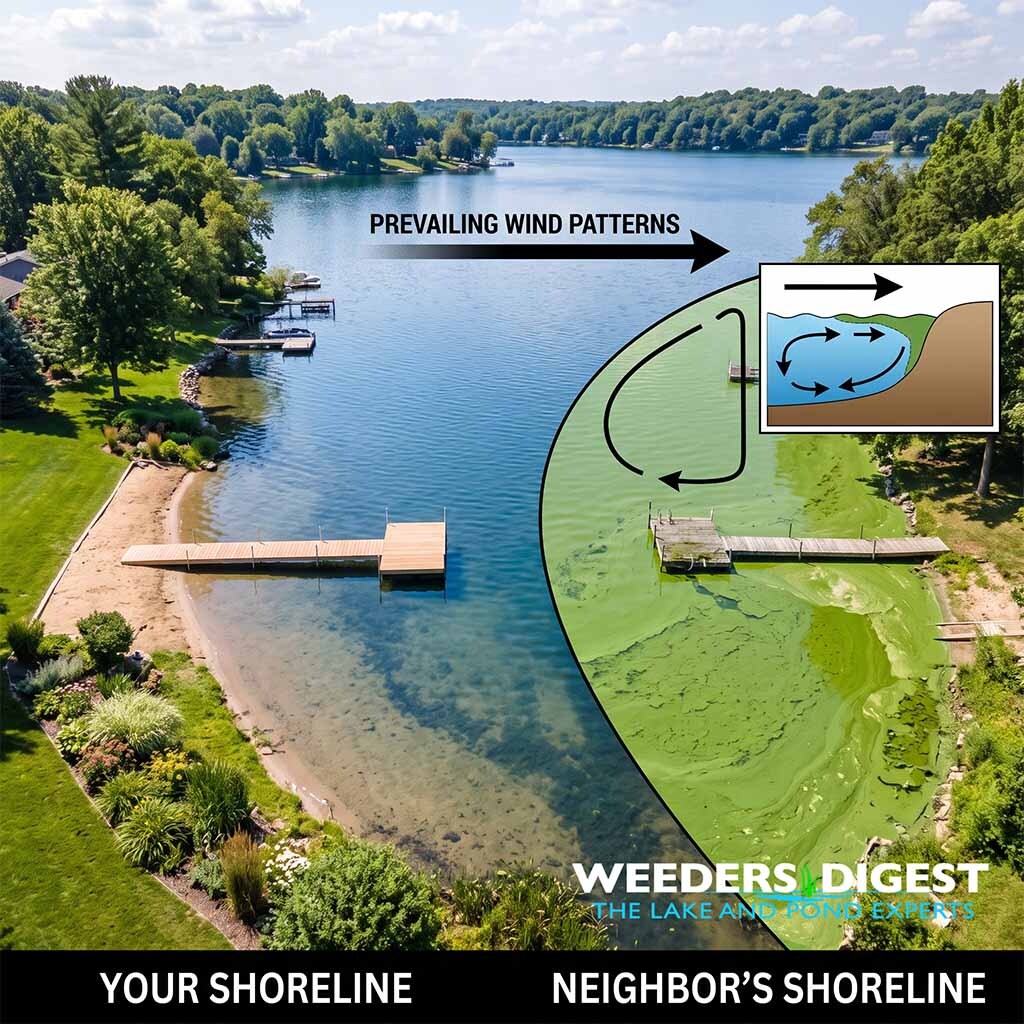
Your neighbor’s late summer algae bloom hasn't reached your shoreline yet because prevailing wind patterns, localized water currents, and uneven nutrient distribution have trapped the buoyant algae in an isolated pocket on their side of the lake. When algae—which are often actually microscopic bacteria—rise to the surface in the late summer heat, they become entirely at the mercy of the wind and the physical shape of the lake. If your neighbor lives in a downwind cove or an area with poor circulation, the wind pushes the surface algae directly into their shoreline, while the breeze actively pushes it away from yours.
We frequently see this highly localized phenomenon during our site visits as lake experts. For example, during a recent evaluation of a 500-acre residential lake, we observed thick, green mats of algae completely smothering the eastern shore where the wind had driven it, while the western shore just a few hundred yards away remained perfectly clear and swimmable. A lake is not a uniformly mixed bowl of water; rather, it is a complex environment comprised of distinct, invisible microclimates. Small differences in the shoreline's shape, water depth, and the presence of natural land barriers can dictate exactly where a surface bloom will settle and multiply.
Even the surface runoff from your neighbor's yard plays a significant role in this strict divide. If their property receives heavier runoff from lawn fertilizers, pet waste, or decaying leaves, the localized spike in phosphorus and nitrogen acts as an immediate fuel source for the bloom. Because late summer water is often warm and stagnant, these excess nutrients do not immediately disperse across the entire lake. Instead, they remain concentrated near the source, continuously feeding the algae right at your neighbor's dock while your adjacent shoreline is spared from the outbreak.
The Science Behind It:
The phenomenon of isolated algal accumulations is driven by a combination of hydrodynamic forces, lake morphology, and localized nutrient loading, all of which contribute to what limnologists refer to as spatial heterogeneity. Late summer blooms are predominantly composed of cyanobacteria, photosynthesizing prokaryotes that possess intracellular gas vesicles. These vesicles allow the cyanobacteria to regulate their cellular buoyancy, migrating vertically to the epilimnion—the warm, illuminated upper layer of a stratified lake—to maximize their rate of photosynthesis. Once concentrated at the water's surface, these buoyant colonies become highly susceptible to wind-driven advection, or the horizontal movement of the water mass.
Research demonstrates that wind patterns are the primary driver of algal bloom drift and spatial patchiness across a waterbody. According to a study published in Environmental Science & Technology that tracked lacustrine algal bloom drift via satellite, surface biomass can be rapidly transported downwind, with the depth of the drifting algal layer reaching up to approximately 1 meter in clear waters. When prevailing winds sweep across the lake's fetch—the unobstructed distance of water over which the wind blows—the surface water is relentlessly pushed toward the leeward shore. If a property is located on the leeward side of the lake's fetch, the wind physically concentrates the cyanobacteria against that specific shoreline. A study on Clear Lake, California, published in MDPI, highlighted this localized effect, noting that an extensive 30-kilometer fetch resulted in highly heterogeneous spatial distributions of phytoplankton, pushing massive concentrations of biomass exclusively into specific downwind arms of the lake.
In addition to wind advection, variations in localized nutrient availability dictate exactly where a bloom establishes and persists. Cyanobacteria rely heavily on phosphorus and nitrogen to synthesize cellular components. In lakes with irregular shorelines, coves, and shallow bays, nutrient loading is rarely uniform. Point-source runoff from a specific storm drain or non-point source runoff from a heavily fertilized lawn can create isolated pockets of nutrient-rich water. Because thermal stratification in late summer significantly reduces the vertical and horizontal mixing of the water column, these nutrients do not rapidly dilute. Consequently, cyanobacteria reproduce exponentially within these hyper-localized nutrient pockets, sustaining a dense bloom at one property while adjacent properties with lower localized nutrient inputs remain unaffected.
Finally, the localized depletion of dissolved oxygen plays a crucial role in fueling persistent shoreline blooms. When winds momentarily calm, isolated pockets of stagnant water can rapidly undergo profound chemical shifts. The MDPI research demonstrated that suboxic conditions—where dissolved oxygen is severely depleted—can develop within just a few hours during periods of calm winds. This sudden drop in oxygen at the sediment-water interface triggers an internal loading event, where phosphorus previously bound in the sediment is released back into the water column. If a neighbor's shoreline is shallow, sheltered from the wind, and subject to these rapid suboxic shifts, their local sediment is likely supplying a continuous, localized pulse of phosphorus directly to the bloom, anchoring it tightly to their property.
Sources / References:
- Satellite Tracking Reveals the Speed Up of the Lacustrine Algal Bloom Drift in Response to Climate Change: https://pubs.acs.org/doi/10.1021/acs.est.4c03391
- Spatial Structure and Temporal Dynamics in Clear Lake, CA: The Role of Wind in Promoting and Sustaining Harmful Cyanobacterial Blooms: https://www.mdpi.com/2073-4441/17/22/3265