

Why Your Pond Turned Green Overnight: The Physics of Duckweed and Watermeal Dominance
 |

Summary:
Duckweed and watermeal dominate pond surfaces because their microscopic size, specialized floating tissue, and rapid asexual reproduction allow them to instantly outcompete other aquatic plants for sunlight and space. These free-floating aquatic plants thrive in nutrient-rich, stagnant water, forming dense mats that completely shade out submersed vegetation. Because they float at the very top of the water column, they get first access to both atmospheric carbon dioxide and unhindered solar radiation, giving them a massive metabolic advantage over plants rooted in the pond bottom.
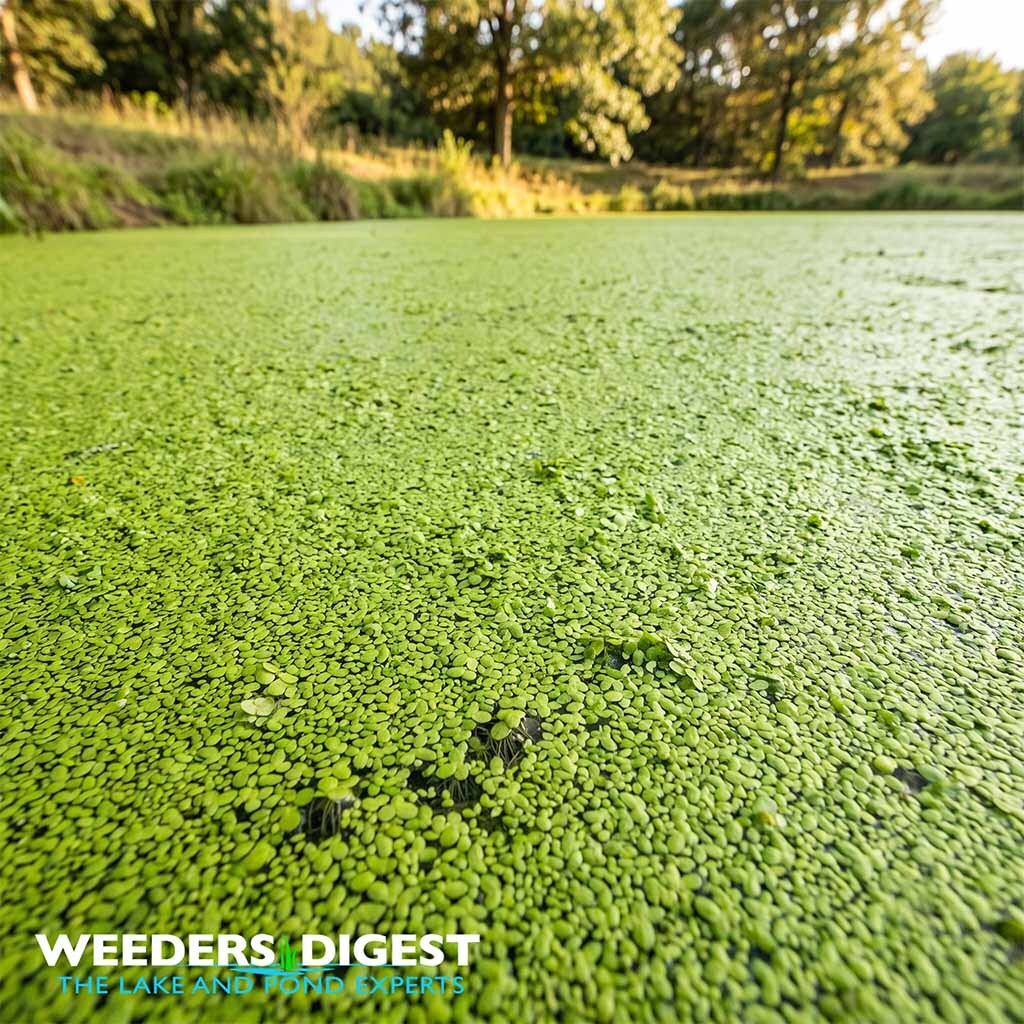
As a Certified Lake Manager, I've walked up to countless ponds that property owners swore were perfectly clear on a Friday, only to find the surface looking exactly like a golf course putting green by Monday morning. This visual shock is a classic hallmark of floating weed dominance in the field. When a waterbody's nutrient load spikes—usually from heavy rain washing in fertilizer runoff or an accumulation of decaying bottom muck—these tiny plants rapidly capitalize on the sudden abundance of nitrogen and phosphorus.
Once established, these plants manipulate the physical environment of the pond to favor their own continued survival. By covering the water's surface, they block wind action, which prevents natural wave formation and drastically reduces oxygen diffusion from the air into the water. This lack of oxygen eventually kills off the beneficial aerobic bacteria that would normally consume excess nutrients, trapping the pond in a vicious ecological cycle that constantly feeds the floating weeds while suffocating the aquatic ecosystem below.
The Science Behind It:
The ecological dominance of Lemna minor (duckweed) and Wolffia spp. (watermeal) is fundamentally driven by their anatomical simplicity and reliance on specialized aerenchyma tissue. Aerenchyma consists of spongy, air-filled internal cavities that provide permanent buoyancy, ensuring the plant remains locked precisely at the air-water interface. This physical positioning optimizes photosynthesis while maximizing the interception of photosynthetically active radiation (PAR). By remaining perpetually at the surface, these macrophytes completely bypass the light attenuation and turbidity issues that limit the growth of benthic and submersed aquatic vegetation.
According to extensive waterfowl food research documented by the USDA and AgEcon Search, Wolffia species hold the title of the smallest known flowering plants on Earth, measuring barely one thirty-second of an inch in diameter. Unlike duckweed, which possesses a tiny rootlet to draw nutrients from the upper water column, watermeal completely lacks a root structure. Instead, it relies on direct epidermal absorption to pull dissolved nitrogen and phosphorus right out of the water. This extreme morphological reduction strips the plant of heavy structural metabolic costs, allowing it to channel nearly all of its cellular energy directly into vegetative reproduction.
The exponential growth rate of these floating macrophytes is a mathematical function of their asexual reproduction mechanism, which occurs primarily through budding. Under optimal environmental conditions characterized by high ambient temperatures and severe eutrophication, duckweed biomass can double in just two to three days. This rapid reproductive cycle allows a microscopic cluster of fronds to completely blanket a multi-acre waterbody in a matter of weeks. The resulting thick surface mat alters the thermodynamic profile of the pond, trapping solar heat at the surface while leaving the deeper water strata thermally isolated, dangerously cool, and anoxic.
The physical resilience of these floating mats is highly formidable. Research from North Carolina State University investigating the mechanical harvesting and flow mechanics of duckweed mats highlights the immense physical cohesion of these surface layers. The university's study noted that duckweed fronds interlock and cluster to form tightly cohesive clumps that actively resist natural hydrodynamic dispersal from wind or minor water currents. Their data showed that a skimming apparatus required a minimum depth of 1.5 centimeters below the water surface just to consistently break the surface tension and overcome the physical resistance of the interlocking clumps, demonstrating how structurally robust a floating weed colony becomes once it achieves full canopy closure.
Ultimately, the physics of floating weed dominance is an exercise in absolute resource monopolization. By physically capping the waterbody, Lemna and Wolffia engineer a localized environment where light cannot penetrate, wind cannot mix the water column, and submersed competitors are starved of both energy and oxygen. Ecologically, successfully managing these outbreaks requires safely disrupting this resilient physical barrier and addressing the underlying chemical nutrient load that fuels their hyper-accelerated reproductive cycle.
Sources / References:
- Food of Game Ducks in the United States and Canada (USDA / AgEcon Search): https://ageconsearch.umn.edu/record/167376/files/tb634.pdf
- Harvesting Duckweed by Skimming (North Carolina State University): https://repository.lib.ncsu.edu/bitstreams/7f0ec3a9-dd3f-4547-b0e8-d881192ae8a3/download