

Why Your Water Looks Murky Even When There Hasn't Been Any Rain
 |

Summary:
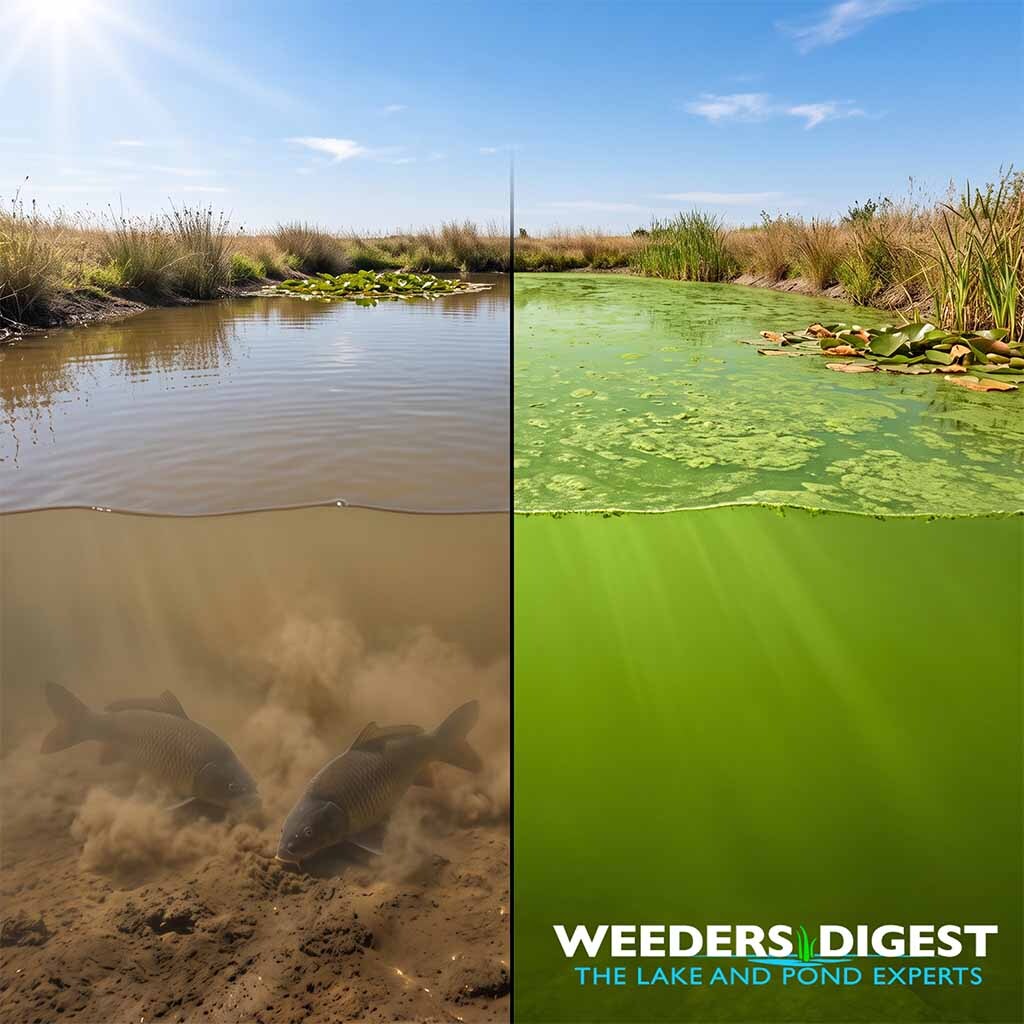
Your water looks murky even when there hasn't been any rain primarily because microscopic algae blooms, bottom-dwelling fish, or wind-driven wave action are actively suspending particles in the water column. While most property owners associate muddy water with recent storm runoff, a lake or pond is a highly dynamic environment where biological and physical forces operate beneath the surface regardless of the weather. When our water turns a cloudy green, brown, or milky color during dry spells, it indicates that internal factors are disrupting the clarity of the aquatic ecosystem.
We often receive calls from frustrated homeowners who wake up to a sudden brown or green hue in their pond after weeks of dry, sunny weather. As aquatic technicians, one of the most common field observations our team makes during site visits is the presence of common carp or bullheads actively foraging along the bottom. These bottom-feeding fish root through the sediment for food, kicking up fine clay and silt that can remain suspended in the water column for weeks, completely independently of rainfall. We also frequently encounter microscopic algae populations that explode during dry, warm conditions, turning the water into what looks like a thick, green soup.
Understanding the root cause of this cloudiness requires looking beyond the weather forecast. Whether the issue stems from an overabundance of dissolved nutrients fueling algae or physical disturbances constantly stirring the lakebed, the water clarity is ultimately a reflection of what is happening within the ecosystem itself. By identifying whether the murkiness is caused by biological growth, animal activity, or natural water chemistry, our specialists can better determine the true health and balance of the waterbody.
The Science Behind It:
To understand dry-weather murkiness, we must examine the concept of turbidity, which is the scientific measurement of water cloudiness caused by suspended particles. Turbidity reduces the depth to which sunlight can penetrate the water, directly impacting aquatic ecosystems by limiting photosynthesis for submerged plants. In the absence of rain-driven sediment runoff, turbidity is typically driven by biological or chemical factors, most notably phytoplankton. Phytoplankton are microscopic, free-floating algae that thrive in warm, nutrient-rich environments. According to literature from the Washington State University Extension, during severe algae blooms, each ounce of water can contain millions of microscopic algae cells. In massive numbers, plankton algae can rapidly color the water brown, yellow, pea-soup green, or even red during warm seasons, drastically reducing water clarity without any external soil input.
When phytoplankton are not the primary cause of murky water, the culprit is often suspended inorganic sediment, such as fine clay or silt, continuously stirred by physical forces. Wind and wave action on shallow lakes create turbulent currents that reach the benthic zone—the ecological region at the lowest level of a body of water. This physical turbulence lifts loose sediment back into the water column. Furthermore, bioturbation, which is the disturbance of sedimentary deposits by living organisms, plays a massive role. The Purdue University Extension notes that the feeding strategies of some fish species, like common carp and bullheads, actively resuspend silt particles and create persistently muddy ponds.
The chemical composition of the water also dictates how long these particles stay suspended. Clay particles are incredibly small and naturally carry a negative electrical charge, meaning they repel each other and resist settling to the bottom. In waterbodies with low natural alkalinity and hardness—meaning a lack of positively charged ions like calcium and magnesium—these clay particles can remain suspended indefinitely, creating a persistent, muddy appearance. The Mississippi State University Extension Service points out that chemical flocculants are often required when natural settling is impossible; specifically, they note that applying 1,300 to 3,000 pounds of gypsum per surface acre of water can successfully introduce the calcium necessary to bind these negatively charged particles and clear severe clay turbidity.
Finally, dissolved organic substances can alter water appearance without the presence of actual suspended solids. As terrestrial and aquatic vegetation decomposes, it releases tannins and other dissolved organic compounds into the water column. These compounds can stain the water a deep reddish-brown or tea color, significantly reducing light penetration. This phenomenon, often referred to as colored dissolved organic material (CDOM), is a natural part of the decay process. While the water may appear heavily polluted or murky, the visual change is simply a chemical staining rather than physical sediment or algae, but it remains a critical factor in overall ecosystem light dynamics.
Sources / References:
- Mississippi State University Extension Service: Muddy Water (https://extension.msstate.edu/natural-resources/fisheries/pond-and-lake-management/muddy-water)
- Purdue University Extension (FNR-567): More than just a puddle: Understanding the pond ecosystem for better management (https://www.extension.purdue.edu/extmedia/FNR/FNR-567.pdf)
- Washington State University Extension: Aquatic Vegetation (https://rex.libraries.wsu.edu/view/pdfCoverPage?instCode=01ALLIANCE_WSU&filePid=13332955790001842&download=true)