

Your Complete Guide to Starry Stonewort: Inside the Complex Cellular Structure of an Invasive Macroalga
 |

Summary:
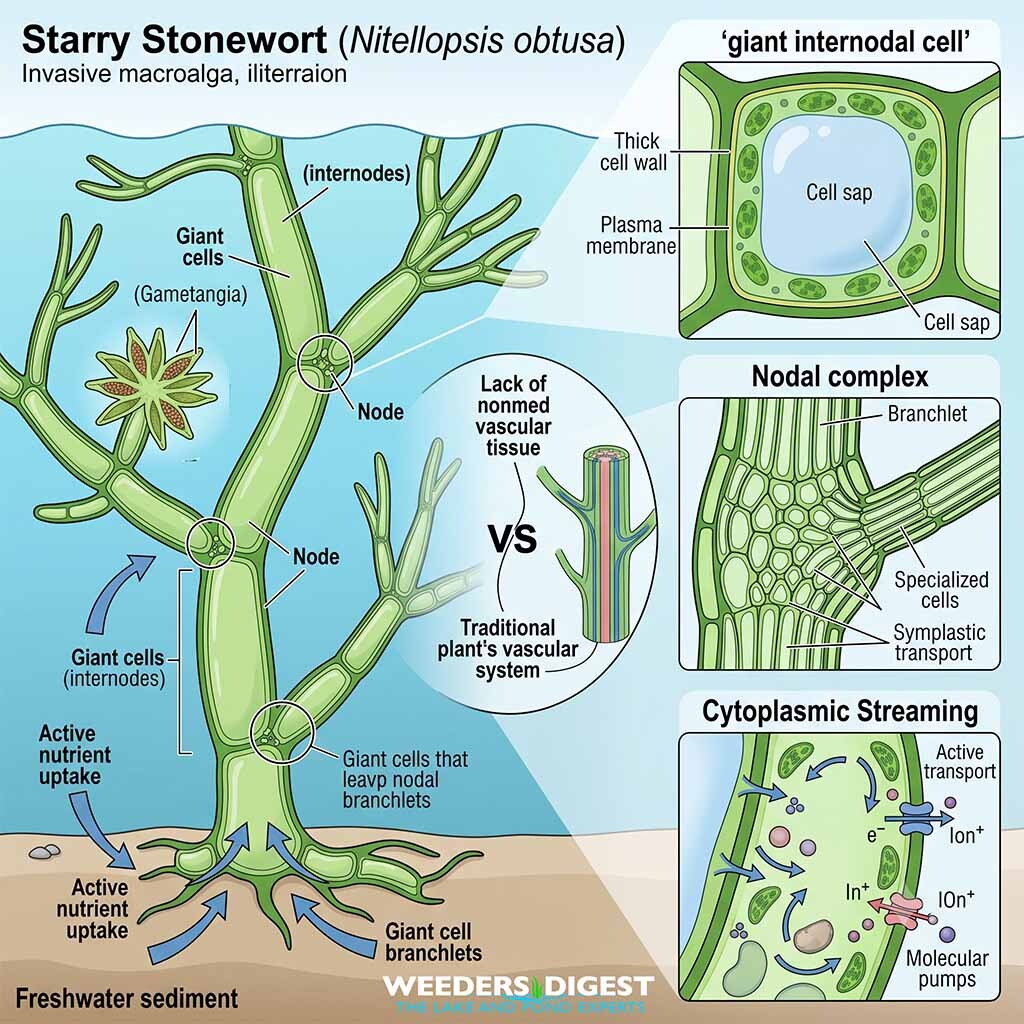
Starry stonewort is a highly aggressive, invasive macroalga equipped with giant, single-cell structures and specialized root-like star-shaped bulbils that allow it to rapidly overtake freshwater ecosystems. While it looks and acts like a typical underwater weed, it actually lacks a true vascular system and relies on a remarkably primitive yet efficient cellular network to absorb nutrients directly from the water column. This unique biological makeup is exactly why it forms massive, dense underwater meadows that choke out native vegetation and ruin recreational waterways.
As a Certified Lake Manager, I have spent countless hours pulling vegetation rakes through infested waters, and the sheer weight of a starry stonewort mat is always staggering compared to native weeds. When you snap one of its stems in the field, it doesn't break like a terrestrial plant; it literally pops like a tiny water balloon because the "stem" is actually one continuous, pressurized giant cell. This structural resilience, combined with the fact that it grows continuously from tiny hidden bulbils buried in the mud, makes it incredibly frustrating for lakefront property owners to manage.
Understanding the cellular mechanics of this invader is the first step in comprehending why it is so difficult to control. Because starry stonewort operates differently than native aquatic plants like milfoil or pondweed, traditional management timelines and methods often fall short. It requires a targeted approach that directly addresses how its massive cells transport energy down to the sediment layer for winter storage, ensuring the organism survives even harsh seasonal changes.
The Science Behind It:
Nitellopsis obtusa, commonly known as starry stonewort, belongs to the family Characeae and possesses a highly specialized macroalgal cellular architecture that sets it apart from vascular macrophytes. Unlike true plants that utilize complex xylem and phloem networks to transport water and nutrients, characean algae rely on cytoplasmic streaming within giant internodal cells to distribute resources. Research demonstrates that a single internodal cell of Nitellopsis obtusa can grow to an astonishing length of approximately 30 centimeters and a diameter of 1 to 2 millimeters. This massive cylindrical cell contains a large central vacuole that occupies 90 to 95 percent of the mature cell's total volume, surrounded by a thin, active layer of cytoplasm that efficiently moves metabolic resources (Manusadžianas et al., 2021).
The evolutionary efficiency of this invasive macroalga is most evident in its primary method of asexual reproduction and energy storage: the bulbil. These small, star-shaped rhizoidal structures form at the sediment-water interface and serve as critical overwintering propagules. A recent study quantifying carbohydrate allocation in Nitellopsis obtusa revealed that these bulbils can store starch up to 73 percent of their total dry biomass, providing immense energetic reserves that fuel rapid spring growth. The same study noted that dense colonies of the macroalga are capable of producing an extraordinary 156,944 bulbils per square meter of lakebed sediment, ensuring the population's persistence even when the above-ground vegetative biomass is completely removed (Carver et al., 2023).
From an ecophysiological standpoint, the robust nature of the internodal cell walls and the protective cellular architecture of the bulbils make chemical management exceptionally difficult. Studies assessing the efficacy of current control methods have shown that bulbil viability remains incredibly high following standard algaecide treatments. In field trials monitoring treated areas, researchers documented up to 86 percent bulbil viability in sediments treated only with algaecides (Glisson et al., 2018). The high osmotic pressure maintained within the giant internodal cells allows the alga to survive significant environmental stressors, while the sheer density of the starch-packed bulbils buffers the organism against long-term chemical degradation.
Furthermore, the plasma membrane and tonoplast—the inner membrane surrounding the central vacuole—of Nitellopsis obtusa exhibit unique electrophysiological properties that facilitate survival in varying water chemistries, including elevated salinity and conductivity. The action potentials generated within these giant cells regulate the opening and closing of ion channels, enabling rapid physiological adaptation to localized environmental changes. This complex interplay between gigantism at the cellular level, massive starch allocation in reproductive structures, and resilient membrane electrophysiology provides the invasive macroalga with a formidable competitive advantage over native aquatic flora.