

Your Guide to Balancing Predator-Prey Dynamics in Dense vs. Cleared Aquatic Weed Beds
 |

Summary:
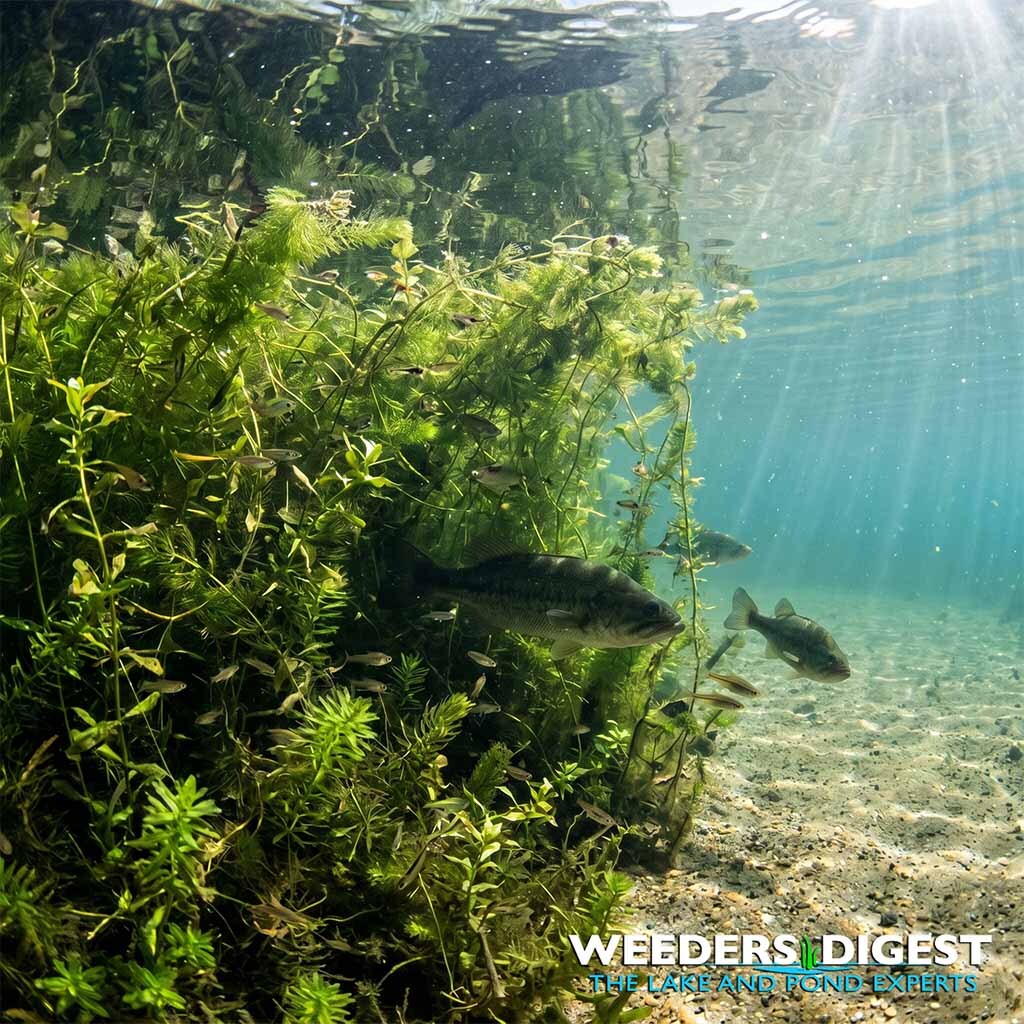
Managing the density of aquatic vegetation in your lake or pond is the most critical factor in controlling how predatory fish interact with their prey. In simple terms, dense weed beds act as a protective refuge for smaller fish and invertebrates, while cleared areas create "hunting grounds" where larger predators can more easily track and capture their food. When your lake is entirely choked with thick weeds, predators often struggle to find enough food because their prey is too well-hidden, which can lead to stunted growth in your predator population. Conversely, if you clear away too much vegetation, you remove the necessary shelter that allows your forage base to survive and reproduce, eventually leading to a collapse in the food chain.
I have spent many hours out on the water conducting fish surveys, and I’ve learned that the most successful, balanced ponds are those that mimic "edge habitats." I often see the best fishing results in areas where there is a distinct transition—or "edge"—between a patch of submerged plants and an open-water lane. By maintaining a mosaic of both dense structure and open space rather than choosing one extreme, you create an environment where predators can effectively forage without wiping out the entire population of young fish. Finding this middle ground ensures that your pond maintains both a healthy population of prey and a thriving, active group of trophy-sized predators.
The Science Behind It:
The relationship between structural complexity and predation efficiency is a fundamental driver of aquatic ecosystem stability. Submerged macrophytes—or underwater plants—provide essential physical architecture that alters the foraging success of piscivorous (fish-eating) predators. Research indicates that as habitat complexity increases, the search and pursuit time for predators rises significantly because the dense vegetation impedes swimming behavior and restricts the predator’s ability to visually detect or physically reach its target. In a study exploring habitat complexity in shallow water ecosystems, it was observed that the proportional consumption of prey was significantly greater in areas with 0% structural complexity compared to those with 50% or higher complexity, where the plants acted as a highly effective buffer against predation.
This dynamic is driven by the concept of "refugia." When aquatic vegetation is too dense, prey fish, such as bluegill, utilize the plant beds to avoid predation from larger species like largemouth bass. While this protection allows prey populations to survive, excessive cover can lead to an ecological trade-off. If the entire littoral zone is saturated with dense weeds, the metabolic costs for predators increase; they must expend more energy to hunt, often resulting in lower growth rates and reduced overall population health. Quantitative findings from experimental mesocosm studies have demonstrated that higher complexity (75% to 100% cover) significantly decreases the capture efficiency of predators, which can suppress the natural trophic cascade that keeps a pond ecosystem in balance.
The optimal strategy for pond management revolves around creating heterogeneity. Predators, particularly ambush-style hunters, naturally occupy the edges of these weed beds, where they can wait for prey to move from the cover into the open. By selectively clearing lanes or thinning dense vegetation, managers can create these artificial edges, which concentrate both predators and prey in specific, manageable zones. This manipulation of the environment directly influences the "functional response" of the predator—a technical term describing the intake rate of a predator in relation to the density of its prey. By adjusting the density of the weeds, one effectively toggles the predator’s ability to maintain a balanced consumption rate without causing a population crash.
Ultimately, the goal is to maintain a level of plant density that supports the biological needs of the prey fish while still allowing predators enough access to harvest the surplus. High-density plant beds are necessary for the recruitment of young fish, yet they must be balanced by open-water zones to allow for the movement of larger piscivores. Maintaining this balance prevents the ecosystem from shifting into a state of either total predator starvation or total prey overpopulation, both of which are common in poorly managed or overgrown systems.