

Your Guide to Grass Carp: Mastering Stocking Rates for Clearer Water
 |

Summary:
Effective aquatic weed control using grass carp depends entirely on matching the fish population density to the specific biomass of the weeds in your pond. As a general baseline, many management programs recommend stocking between 5 and 25 triploid grass carp per acre, depending on the severity of the vegetation coverage. If your pond is heavily choked with weeds, higher densities are often necessary to achieve a noticeable reduction, whereas lower densities serve as an excellent preventative measure for ponds that are currently healthy.
In my years managing private and public water bodies, I have learned that the "one-size-fits-all" approach rarely works in the field. I often see homeowners stock too few fish, expecting them to clear an entire pond in a matter of days, only to be disappointed. The reality is that grass carp are a long-term strategy, not a quick fix. You have to account for the size of the fish at the time of stocking—larger fish are better at surviving predators like largemouth bass, but they consume vegetation at different rates than fingerlings. Successful management requires observing how quickly the fish are reducing the plant cover and being prepared to supplement that population as the fish age and their metabolic efficiency changes.
The Science Behind It:
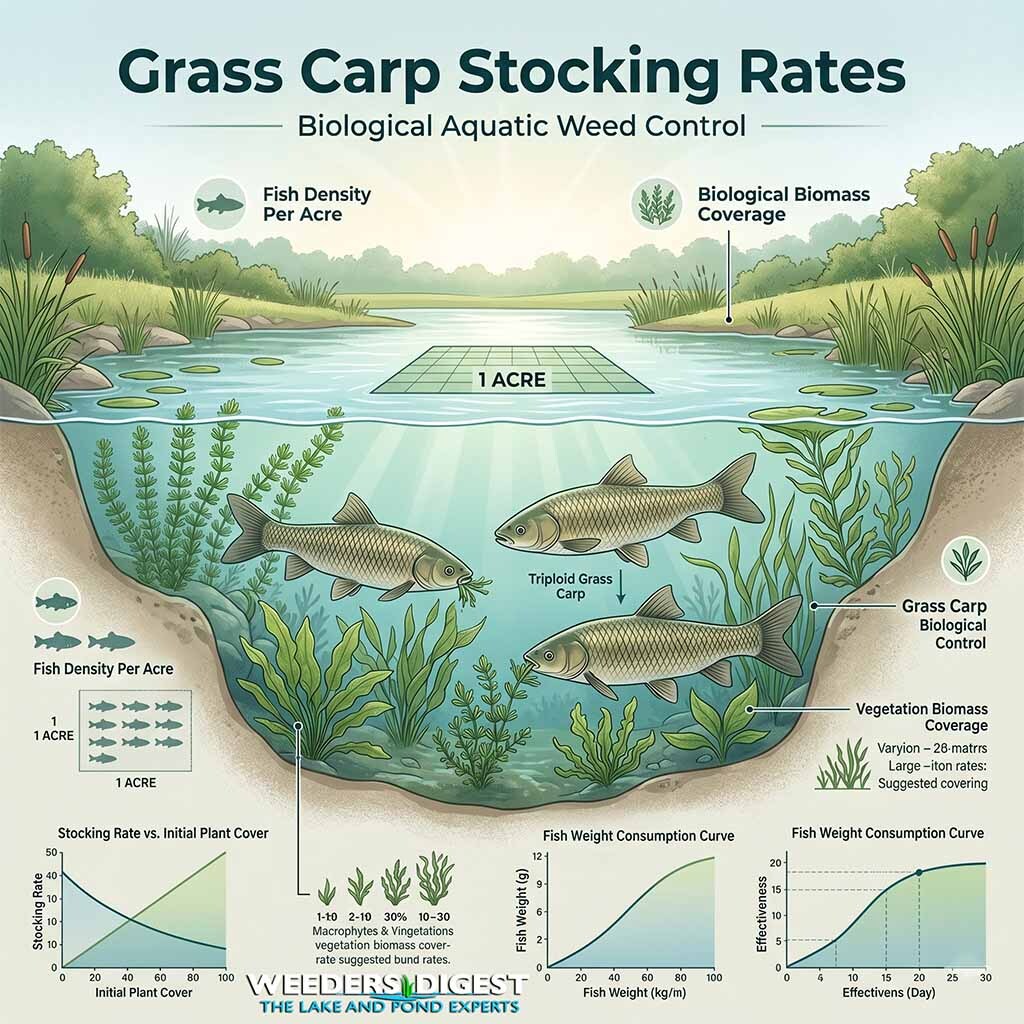
The efficacy of Ctenopharyngodon idella, or the grass carp, as a biological control agent is rooted in its highly specialized herbivorous physiology. Unlike many other fish species that rely on a varied diet, the grass carp is an obligate herbivore that, when mature, can consume between 30% and 100% of its own body weight in fresh vegetation daily under optimal conditions. This high rate of consumption is made possible by a specialized digestive tract and pharyngeal teeth designed to shred submerged macrophytes. Research indicates that the stocking rate required to suppress aquatic vegetation is inversely proportional to the individual fish size; for instance, historical data demonstrates that a stocking density of 100 fish per hectare (ha) is required when the average fish weight is 200 grams, whereas that number drops to 30 fish per hectare when the average fish weight reaches 2,000 grams.
Biological control success is fundamentally a balance of energy intake versus environmental resistance. Because grass carp are selective feeders, they will target their most palatable submerged species—such as Hydrilla verticillata or various Potamogeton species—before moving on to less preferred vegetation. This selectivity means that in a pond with high plant biomass, the "weeding" effect may not be observed immediately. Studies have shown that when stocking density is increased, the weeding effect is recognized more rapidly, though excessive density can lead to total vegetation removal, which may negatively impact the pond's overall ecological health by removing essential habitat for other aquatic organisms.
Managers must also account for the metabolic shift that occurs as the fish age. While juvenile grass carp exhibit high growth rates and significant vegetation consumption, their efficiency as weed controllers tends to diminish as they reach sizes of 30–35 pounds. At this stage, they are far less effective at managing nuisance vegetation. Consequently, a successful long-term management plan often involves an initial stocking phase followed by annual supplemental stocking, typically at about 20% of the initial population, to maintain a consistent level of control.
Finally, the use of sterile, triploid grass carp is standard practice to prevent the establishment of self-sustaining, potentially invasive populations. Through the process of chromosome manipulation, these fish are rendered incapable of reproduction. Maintaining this biological barrier is critical for preserving the integrity of local watersheds. Effective management is therefore a site-specific calculation that weighs the target plant species, the current surface area coverage, and the risk of predation, ensuring that the grass carp remains a precise tool for sustainable ecosystem health.