

Your Shoreline Stability: The Hidden Driver of Pond Weed Overgrowth
 |

Summary:
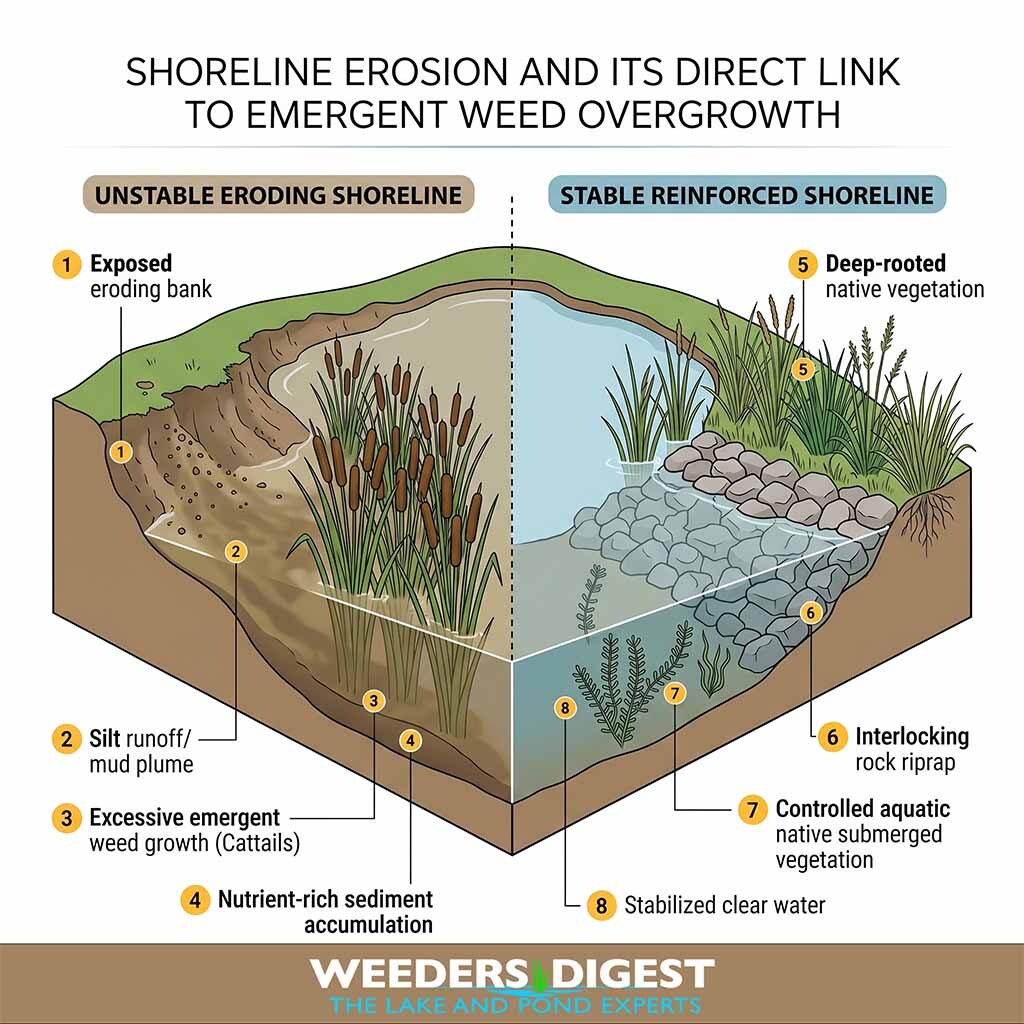
Shoreline erosion is a primary, often overlooked contributor to the rapid and aggressive overgrowth of emergent aquatic weeds in your pond or lake. When your shoreline degrades, soil and organic matter are washed directly into the water, carrying a heavy load of phosphorus and nitrogen that acts like a high-octane fertilizer for aquatic vegetation. This process essentially converts a stable, balanced shoreline into an expanding nursery for unwanted weeds, as the newly deposited, nutrient-rich sediment creates the perfect shallow-water habitat where these plants thrive.
As a Certified Lake Manager, I frequently walk the perimeter of ponds where homeowners struggle with what they perceive as an "uncontrollable" weed problem. In nearly every case, the site visit reveals significant bank instability—exposed soil, "undercutting" where the turf meets the water, and sediment plumes visible after even light rainfall. When we address the root cause by stabilizing the bank with native deep-rooted vegetation or structural reinforcements, the "weed" problem often stabilizes on its own because we have effectively turned off the nutrient tap that was fueling the overgrowth.
The Science Behind It:
The relationship between shoreline erosion and emergent macrophyte (weed) proliferation is driven by the principles of nutrient loading and sedimentation in the littoral zone. The littoral zone—the shallow, nearshore area of a lake where sunlight can penetrate to the bottom—is the most biologically productive part of any water body. When shorelines erode, they contribute significantly to allochthonous input, which is the movement of organic matter and nutrients from outside the aquatic system into the water column.
Research conducted by the University of Waterloo on large lake systems highlights that coastal erosion is a critical, often underestimated source of phosphorus. Their mass balance modeling demonstrated that coastal erosion alone can account for approximately 15% of the total phosphorus input to a lake, directly fueling nuisance plant growth in littoral zones. Phosphorus is typically the limiting nutrient in freshwater systems; when it is suddenly introduced in excess via eroding soil, it bypasses traditional watershed management controls and creates localized spikes in fertility.
The physical impact of this sediment is equally detrimental. Erosion introduces fine particulate matter that settles in the shallow margins of the pond, creating a soft, nutrient-rich substrate. Studies on invasive macrophytes, such as Myriophyllum aquaticum, have shown that plants growing in nutrient-rich sediments exhibit significantly higher relative growth rates—sometimes over 3 times the branching and root production—compared to those in nutrient-poor conditions. The accumulation of these sediments creates an ideal anchoring point for rhizomatous species, which are highly efficient at scavenging these localized nutrient pockets.
Furthermore, as sediment enters the water, it alters the light attenuation and turbidity of the nearshore environment. While excessive, permanent turbidity can eventually inhibit some species, the periodic pulse of nutrient-laden sediment during storm events provides the necessary chemical "kick-start" for rapid colonization. Once established, these emergent weeds further trap suspended solids, exacerbating the localized buildup of sediment and creating a self-reinforcing cycle of expansion. By failing to stabilize the shore, the pond owner inadvertently creates a continuous, high-fertility environment that shifts the ecological balance in favor of fast-growing, aggressive emergent vegetation.
Sources / References:
- University of Waterloo, Water Institute: Mass balance modeling of phosphorus in Lake Erie littoral zones
- New Mexico State University, Cooperative Extension Service: Managing Aquatic Weeds - Circular 681
- K & M.A.E. Journal: Eutrophic water or fertile sediment: Factors affecting invasive macrophyte expansion