

My Boat Lift is Moving Sand: How Shoreline Structures Alter Your Lakefront
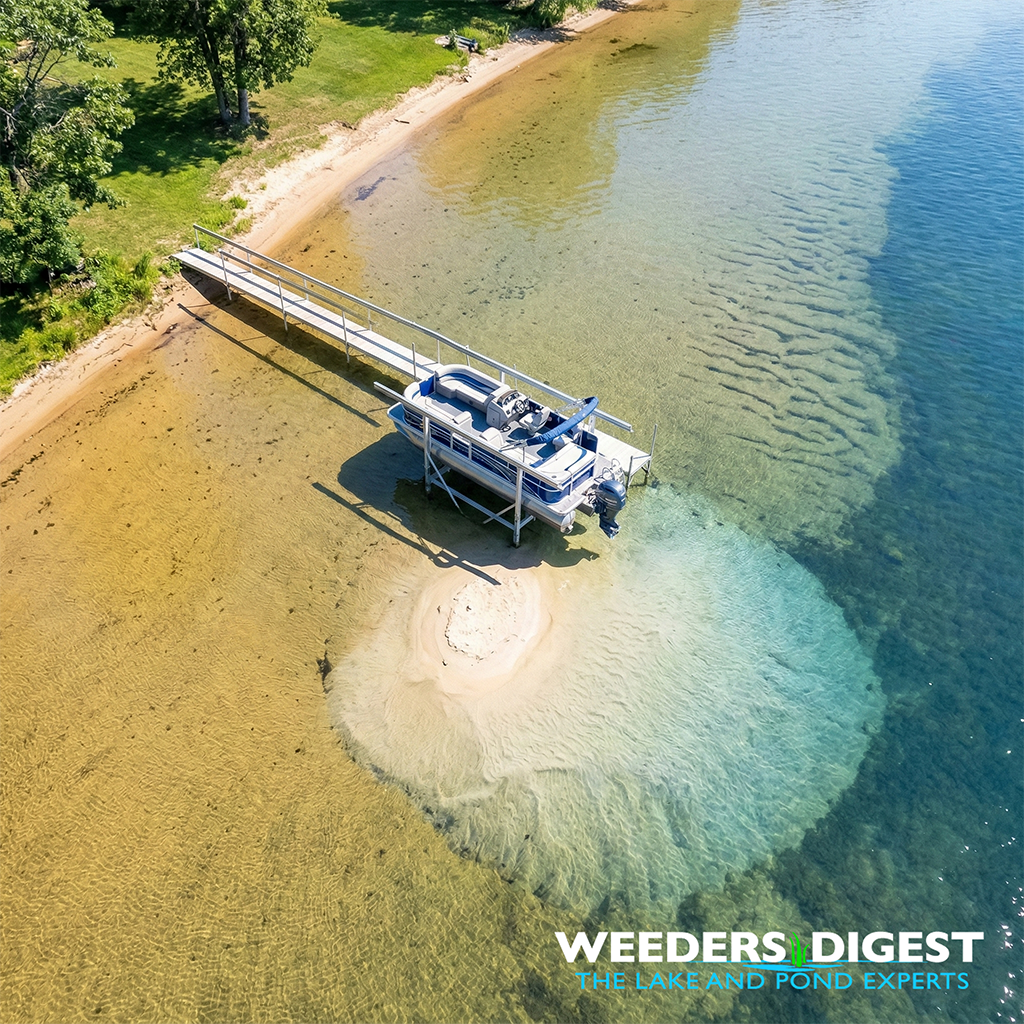 |
Summary:
When you install a boat lift or a permanent dock, you aren't just adding a convenient spot to park your watercraft; you are essentially placing a new obstacle in a complex, moving underwater highway. Lakes and ponds are dynamic systems where water is constantly shifting sand, silt, and organic debris along the shoreline. This process, often driven by wind and wave action, is what keeps your beach looking a certain way or causes muck to accumulate in specific corners.
When a boat lift is placed in the water, it disrupts the natural flow of these currents. Even though the structure might look minimalist with its thin legs and open frame, it creates a "baffle" effect. This causes the water to slow down as it passes through or around the lift. Because slower-moving water cannot carry as much weight as faster water, the sand and sediment it was carrying suddenly drop to the bottom. Over time, you might notice a mound of sand forming under your lift while other areas of your shoreline begin to erode.
Furthermore, the presence of a boat and its lift can change how waves interact with the lakebed. Large waves hitting the structure can create turbulence that scours the bottom, pushing fine sediment into deeper water and leaving behind coarser rocks. This is why some lakefront owners find that their once-sandy bottom becomes "mucky" or "rocky" after a few seasons of lift use. Understanding these changes is the first step in managing a healthy, stable shoreline that works with nature rather than against it.
The Science Behind It:
The alteration of sediment transport by nearshore structures is primarily a function of hydrodynamic interference and the disruption of longshore drift. Longshore drift is the geomorphological process consisting of the transportation of sediments along a coast or lake shoreline at an angle to the shoreline, which is dependent on prevailing wind direction and swash/backwash cycles. Scientific observations in lacustrine environments indicate that even permeable structures like boat lifts introduce a drag coefficient that reduces the velocity of the approach flow. According to research on coastal engineering and small-scale pier structures, this reduction in velocity decreases the shear stress exerted on the lakebed, leading to the localized deposition of suspended solids.
Hydrodynamic modeling suggests that the vertical supports of a boat lift generate localized turbulence and eddy currents. These micro-vortices can lead to "scour holes" immediately adjacent to the structural pilings while simultaneously facilitating "shadow zones" of accretion directly behind or beneath the lift frame. The research published in the Journal of Great Lakes Research highlights that anthropogenic structures in the littoral zone—the near-shore area where sunlight reaches the bottom—frequently interrupt the natural "river of sand." This interruption forces a re-equilibration of the shoreline, often resulting in updrift accumulation and downdrift erosion.
Furthermore, the presence of the watercraft itself on the lift acts as a significant windbreak and wave attenuator. During high-wind events, the hull of a boat positioned on a lift reflects a portion of wave energy back toward the open water or redirects it downward. This redirected energy can intensify bottom-water velocities, resuspending fine-grained silts and organic matter (autochthonous carbon). Once resuspended, these finer particles are often transported to deeper, lower-energy profundal zones, a process known as sediment focusing.
The cumulative impact of multiple lifts along a single stretch of shoreline can lead to significant morphological changes in the littoral shelf. Over several seasons, the sorting of grain sizes—whereby fine particles are removed and heavier or larger particles remain—can alter the benthic habitat. This shift in substrate composition from fine sand to coarse gravel or, conversely, the trapping of anaerobic muck in low-flow pockets, directly influences the colonization of macroinvertebrates and the growth patterns of submerged aquatic vegetation.
Sources / References:
- https://fw.mnsu.edu/globalassets/college-of-science-engineering-and-technology/biology/water-resources-center/reports/shoreline-stabilization-handbook.pdf
- https://www.journals.elsevier.com/journal-of-great-lakes-research