

My Lake Is Suffocating: How Nitrogen and Phosphorus Are Fueling Your Weed and Algae Problems
 |

Summary:
Excessive runoff of nitrogen and phosphorus from your surrounding property is the primary driver behind the massive weed and algae blooms choking your lake. When these two nutrients enter a waterbody in high volumes—a process known as nutrient loading—they act as a super-charged fertilizer. Instead of growing a healthy, balanced aquatic ecosystem, this overabundance selectively feeds aggressive, opportunistic nuisance plants and toxic blue-green algae, stripping the water of its clarity and balance.
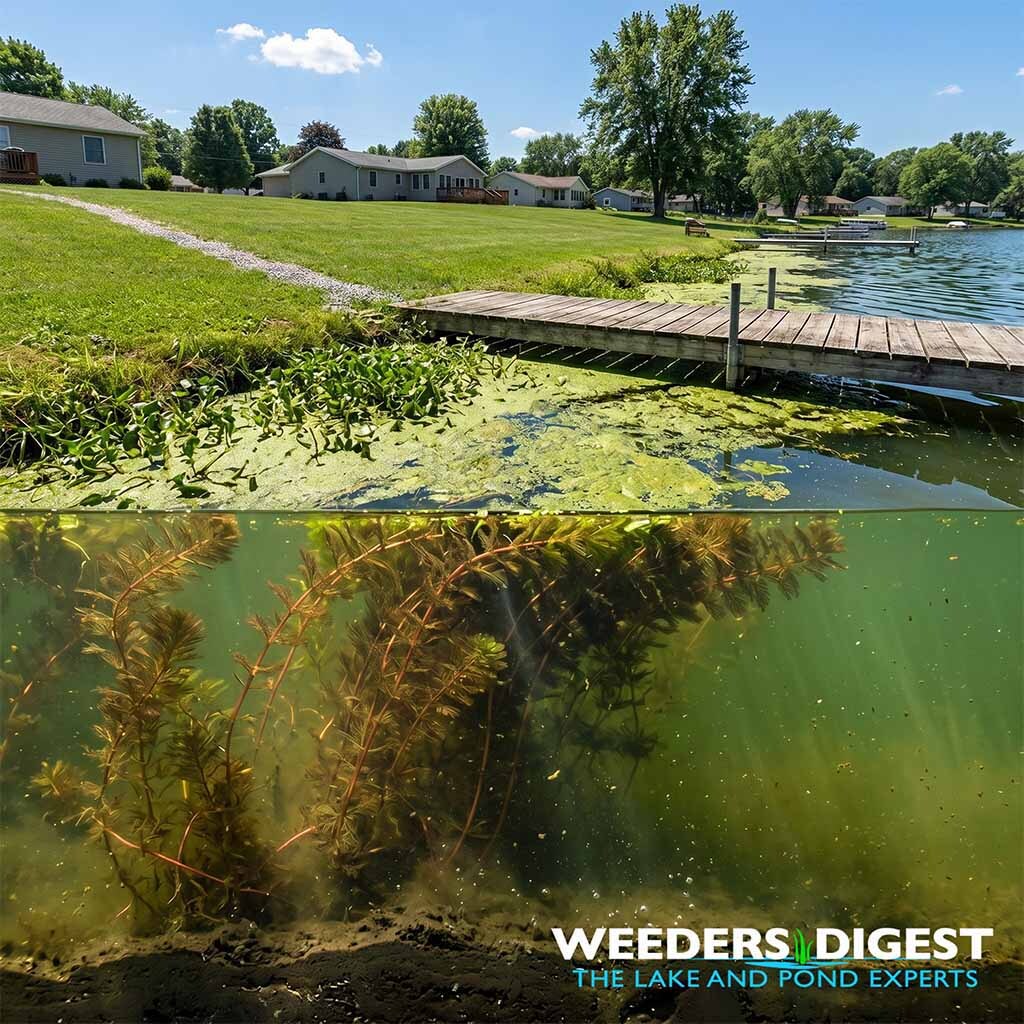
If you have noticed your shoreline becoming impassable due to thick mats of stringy green mass or curly-leaf pondweed, your waterbody is experiencing accelerated eutrophication. We have stood on dozens of residential docks where homeowners ask why their clear water vanished over a single season. We often point out into the water to show them the visual shift: the transition from a diverse, native plant community to a monoculture of invasive weeds. This shift is almost always preceded by invisible, heavy pulses of stormwater carrying lawn fertilizers, pet waste, or septic plume directly into the basin.
Understanding this dynamic is the first step toward reclaiming your waterfront. While it is tempting to view aquatic weeds as an isolated problem, they are actually the visible symptoms of a deeper metabolic imbalance within the water column and underlying sediment.
The Science Behind It:
In freshwater ecosystems, the growth of biological organisms is governed by Liebig’s Law of the Minimum, which states that growth is dictated not by the total resources available, but by the scarcest resource, known as the limiting nutrient. Historically, phosphorus has been considered the primary limiting nutrient in freshwater lakes, meaning that the natural scarcity of phosphorus kept plant and algal growth in check. However, contemporary limnological research, published in journals like Knowledge and Management of Aquatic Ecosystems (2026), demonstrates that many shallow lakes experience a dynamic shift from exclusive phosphorus limitation to a dual nitrogen and phosphorus co-limitation status, particularly during peak summer growing seasons.
When anthropogenic activities introduce high concentrations of total phosphorus (TP) and total nitrogen (TN) via watershed runoff, the structural mechanics of the lake undergo a profound transformation. Research detailed in Frontiers in Plant Science (2025) outlines specific, critical nutrient thresholds where aquatic ecosystems cross a tipping point. Long-term empirical data from this research identifies that a collapse of desirable, submerged native plant communities frequently occurs when in-lake concentrations breach threshold levels of 1.2 milligrams per liter for total nitrogen and 0.13 for total phosphorus.
Once these thresholds are surpassed, the lake shifts from a clear-water, macrophyte-dominated state to a turbid, phytoplankton-dominated state. Microscopic algae and cyanobacteria multiplying in the upper water column reduce light penetration. Submerged native macrophytes require an underwater light intensity of at least 1% of surface photosynthetically active radiation (PAR) to survive. As the water clarity drops—often measured as a sharp decrease in Secchi disk depth—these beneficial bottom-growing plants suffocate from lack of sunlight, leaving a void that is quickly occupied by canopy-forming invasive weeds like Myriophyllum spicatum (Eurasian watermilfoil), which aggressively stretch to the surface to capture light.
Furthermore, managing this problem is complicated by a mechanism known as internal nutrient loading. Over decades of external loading, excess phosphorus binds to iron particles and accumulates in the bottom sediments. During the summer, microbial decomposition depletes dissolved oxygen at the lake bottom, creating an anoxic (oxygen-depleted) environment. This lack of oxygen triggers a chemical release, unlocking the bound phosphorus from the sediment and sending it back up into the water column. This internal recycling can sustain massive weed and algae blooms even if all external sources of pollution are completely eliminated, locking the lake into a self-perpetuating cycle of degradation.
Sources / References:
- Frontiers in Plant Science (2025): "Integrating water depth to predict the threshold of collapse and recovery of submerged macrophytes for lakes with large depth gradients"
- https://www.frontiersin.org/journals/plant-science/articles/10.3389/fpls.2025.1541394/full
- Knowledge and Management of Aquatic Ecosystems (2026): "The long-term change in phytoplankton nutrient limitation following external nutrient loading reduction in a subtropical shallow lake"
- https://www.kmae-journal.org/articles/kmae/full_html/2026/01/kmae250126/kmae250126.html
- University of Florida IFAS Extension: "Rethinking the Role of Nitrogen and Phosphorus in the Eutrophication of Aquatic Ecosystems"
- https://ask.ifas.ufl.edu/publication/SG118