

My Lake Isn’t Your Lake: Why Your Neighbor’s Water Remedy Might Ruin Your Shoreline
Summary:
If you have ever wondered why the treatment that cleared up your neighbor’s pond left yours looking like pea soup, you are not alone. It is a common frustration for many property owners. The reality is that a lake is far more than just a basin of water; it is a complex, living organism with its own unique "DNA." From the types of soil at the bottom to the way the wind blows across the surface, dozens of invisible factors dictate how your water behaves.
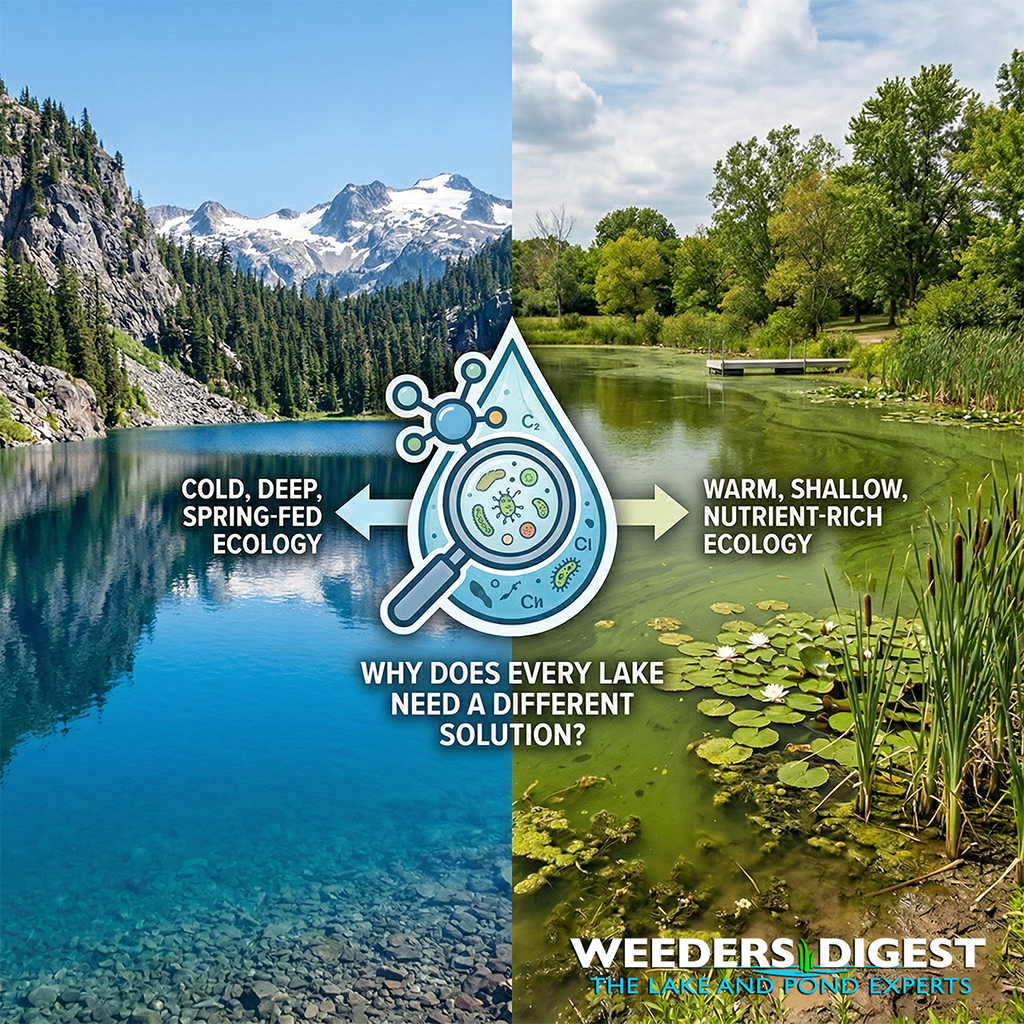
Treating every lake with a one-size-fits-all approach is a bit like a doctor prescribing the same medication to every patient regardless of their symptoms. What works for a deep, spring-fed lake in the mountains will likely fail—or even cause harm—to a shallow, stormwater-fed pond in a residential valley. To find the right solution, we have to look beyond the surface and understand the specific personality of your particular body of water.
The solution to a water quality issue must be tailored to the specific nutrient profile and biological makeup of the site. Factors such as the surrounding land use, the age of the water body, and even the local climate play massive roles. When we ignore these nuances, we often end up wasting time and money on treatments that the lake’s natural chemistry simply rejects.
By shifting our mindset from "applying a product" to "managing an ecosystem," we can achieve much clearer, healthier water. It starts with recognizing that your lake has its own set of needs that are entirely distinct from the pond down the road. Understanding this individuality is the first step toward long-term restoration and enjoyment of your waterfront.
The Science Behind It:
The heterogeneity of freshwater ecosystems is driven largely by the concept of the watershed-to-lake ratio and the specific geomorphology of the basin. According to research published in Limnology and Oceanography, the chemical composition of a lake is a direct reflection of its catchment area’s geology and land use. For example, a lake surrounded by limestone will have high alkalinity and buffering capacity, whereas a lake in a granite-dominated basin will be poorly buffered and highly susceptible to pH swings. These baseline chemical differences dictate how the water column interacts with both internal and external nutrient loading, particularly phosphorus and nitrogen.
The physical structure of the lake, specifically its bathymetry and thermal stratification patterns, further complicates the management strategy. In deep lakes, the formation of a thermocline creates a barrier between the oxygen-rich epilimnion and the nutrient-dense, hypoxic hypolimnion. As noted in studies by the North American Lake Management Society (NALMS), internal loading—where phosphorus is released from bottom sediments under anoxic conditions—requires vastly different intervention strategies than external loading from surface runoff. A solution involving surface-applied algaecides may be effective in a polymictic (frequently mixing) pond but utterly useless in a stratified lake where the primary driver of the bloom is deep-water nutrient recycling.
Biological interactions, or "trophic cascades," also vary significantly between water bodies. The presence or absence of specific phytoplankton, zooplankton, and fish species determines how nutrients move through the food web. Research in Freshwater Biology indicates that the efficacy of biomanipulation or chemical nutrient inactivation is highly dependent on the existing biological community. For instance, the introduction of certain aerobic bacteria or the use of lanthanum-modified clay to lock up phosphorus will yield different results depending on the sediment’s organic matter content and the prevalence of benthic-feeding fish like common carp, which can physically disrupt the sediment-water interface.
Furthermore, the hydraulic residence time—the average time water spends in the basin—is a critical variable in determining the success of a restoration plan. A "flushing" lake with a high turnover rate may naturally dilute pollutants, whereas a "closed" system with no outflow will accumulate salts, metals, and nutrients over decades. Management techniques such as alum (aluminum sulfate) applications must be calculated based on specific water chemistry parameters like dissolved organic carbon (DOC) and total suspended solids (TSS), which are never identical across different sites. Consequently, a site-specific diagnostic evaluation is the only scientifically sound method for developing an effective aquatic management prescription.
Sources / References:
- North American Lake Management Society (NALMS): https://www.nalms.org/
- Journal of Limnology and Oceanography (ASLO): https://aslo.org/lo/