

My Lake’s Mucky Secrets: Why Northern Waters Feel So Much Softer Underfoot
Summary:
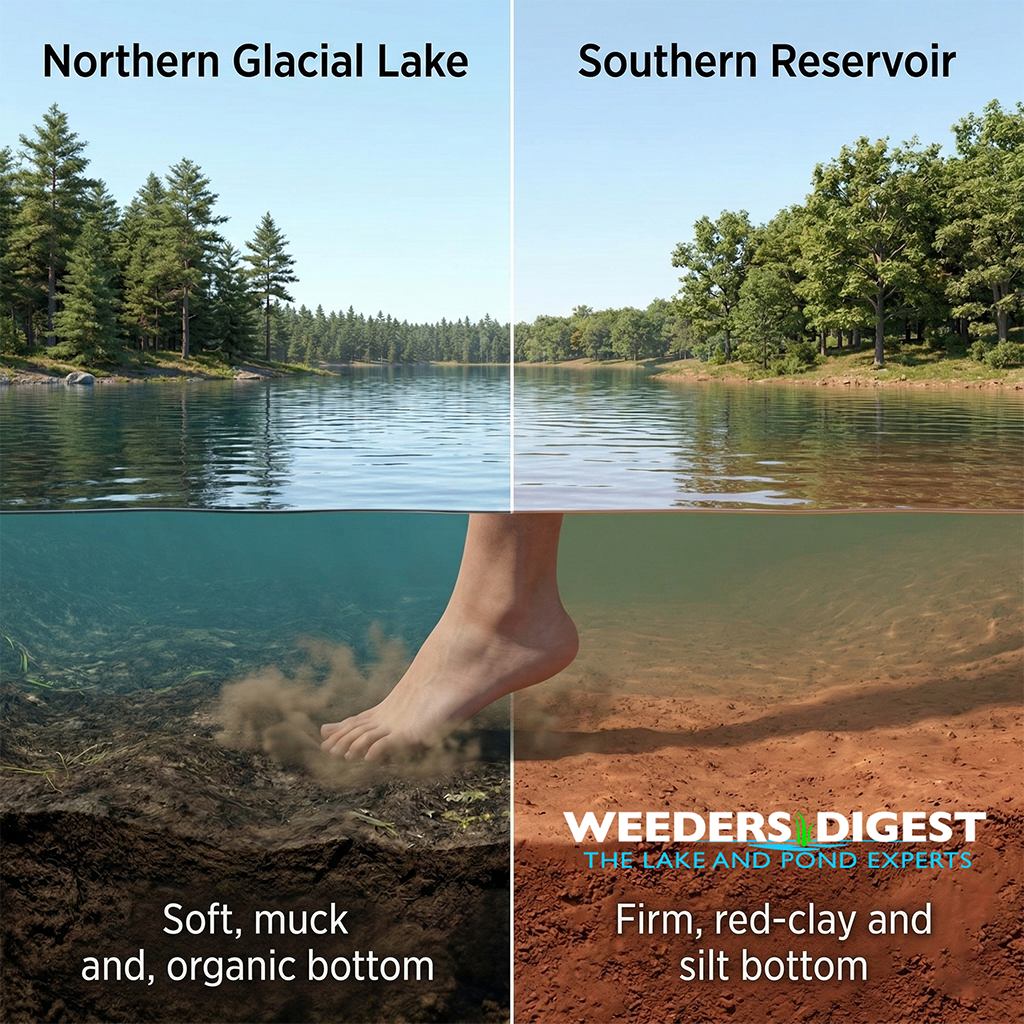
If you have ever spent a summer in the North and another in the South, you have likely noticed a striking difference the moment you step off the dock. In many northern lakes, your toes sink into a thick, velvety layer of "muck," while southern waters often greet you with firmer, sandier, or more compacted clay bottoms. This isn't just a trick of the mind; it is the result of thousands of years of geological and biological history playing out differently across our landscapes.
The soft texture found in northern lakes is largely due to the way they were born. Most of these bodies of water are "glacial babies," carved out by retreating ice sheets roughly 10,000 years ago. Because the North has a shorter growing season and colder water, the organic material—like leaves, pine needles, and algae—doesn't break down as quickly as it does in the warm South. This leads to a slow, steady buildup of fine, organic "ooze" that stays fluffy and soft because it hasn't been compressed by the same heavy river silts common in southern systems.
In contrast, many southern "lakes" are actually man-made reservoirs. These are younger, and because they are often formed by damming rivers, they are constantly fed by heavy mineral sediments like clay and silt carried by the current. These minerals are much denser and pack down tighter than the light, airy organic matter found in the North. Additionally, the southern heat speeds up decomposition, meaning there is less "raw" organic muck left over to create that characteristic soft feeling.
Ultimately, the bottom of your lake is a reflection of its age and the environment surrounding it. Whether you are dealing with the deep organic cushions of the North or the firm clay of the South, you are feeling the literal foundation of an ecosystem that has been shaped by glaciers, rivers, and the relentless march of time.
The Science Behind It:
The disparity in lake substrate composition between northern and southern latitudes is a function of "paraglacial" sedimentation and the thermodynamic regulation of organic decomposition. Northern lakes, primarily those located in the glaciated regions of North America, are typically natural depressions formed during the Pleistocene epoch. According to Church (1972), these systems undergo a transition from high-mineral "drift" movement to a long-term state where autochthonous organic matter becomes the primary contributor to the benthic profile. Because these basins often lack high-energy fluvial (river) inputs, the resulting sediment is dominated by "gyttja"—a fine-grained, nutrient-rich organic mush composed of algae, plankton remains, and macrophyte debris.
Thermal stratification plays a critical role in preserving this soft texture in the North. In dimictic northern lakes (those that "turn over" twice a year), the hypolimnion—the bottom-most cold layer—remains at a constant, near-freezing temperature for much of the year. Research from the IISD Experimental Lakes Area highlights that this cold environment significantly inhibits microbial respiration and the rate of aerobic decomposition. As a result, organic matter accumulates faster than it can be fully mineralized, creating a deep, low-density layer of soft sediment that lacks the structural compaction found in mineral-heavy substrates.
Conversely, southern water bodies are frequently artificial impoundments or "reservoirs" created within the last century. These systems are characterized by high trap efficiency for allochthonous sediments—inorganic materials like silt and clay transported from the surrounding watershed by rivers. As noted by Morris and Fan (2010), reservoir sedimentation is often dominated by these dense mineral particles, which settle and compact under their own weight to form a firm, cohesive bottom. The "Mud Bowl" phenomenon described in reservoir studies refers to the accumulation of these mineral silts, which are physically much harder than the organic gyttja of natural northern lakes.
Finally, the metabolic rates of southern ecosystems are accelerated by warmer mean annual temperatures. Higher microbial activity ensures that organic inputs are rapidly broken down into carbon dioxide and dissolved nutrients, leaving behind a higher ratio of inorganic minerals. While northern lakes act as long-term carbon sinks (Mendonça et al., 2017), southern reservoirs process organic matter more aggressively, resulting in a benthic environment that is geologically "younger" and physically more resistant to the "sink-in" effect experienced by those wading in northern glacial waters.
Sources / References:
- https://wpg.forestry.oregonstate.edu/sites/default/files/seminars/Church_1972_Paraglacial.pdf
- https://www.iisd.org/ela/blog/lakes-stratify-turn-explain-science-behind-phenomena/
- https://www.engr.colostate.edu/~pierre/ce_old/classes/CE716/ResSedHandbook1_01.pdf