

My Quest for Truth: Is Your Lake Advice Real Science or Just Water-Side Folklore?
Summary:
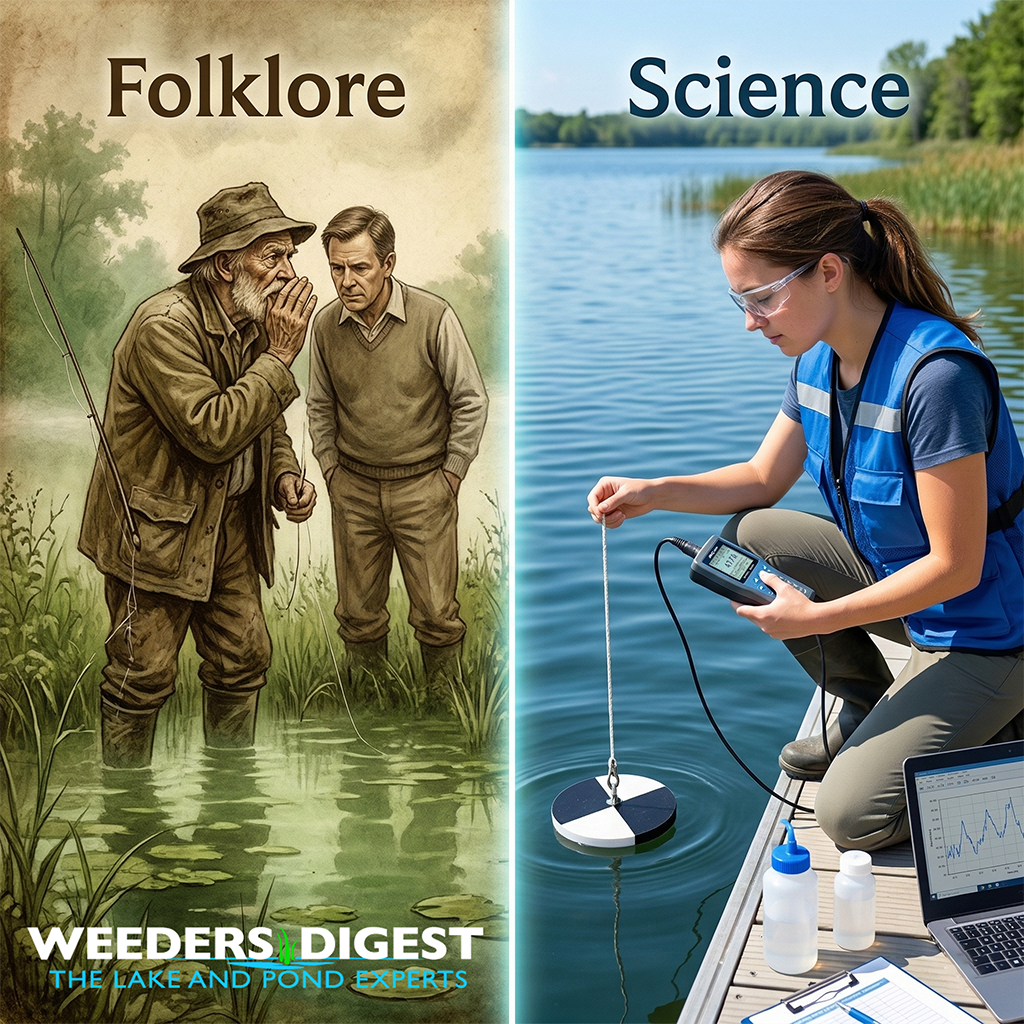
As a lake manager, I often hear "tried and true" advice from well-meaning neighbors that sounds more like a tall tale than a biological fact. Distinguishing between genuine aquatic science and lake folklore is essential because following the wrong advice can lead to expensive mistakes, damaged ecosystems, or even toxic algae blooms. While folklore often relies on anecdotal evidence—the "it worked for my grandfather" approach—science relies on measurable data and the complex interactions of physics, chemistry, and biology.
To tell the difference, you first have to look at the source of the claim. Folklore tends to offer "silver bullet" solutions, such as the idea that adding a specific common household chemical will instantly clear your water. Science, on the other hand, acknowledges that every body of water is a unique living system. What works for a deep, spring-fed glacial lake in the north will rarely work for a shallow, man-made retention pond in the south.
Another red flag for folklore is the promise of a permanent fix. In the world of limnology, we know that lakes are constantly aging through a process called eutrophication. True science focuses on managing these natural cycles rather than claiming to stop them forever. Understanding that your lake is a dynamic environment, not a static swimming pool, is the first step in moving from myth to management.
When you are standing on your dock listening to local lore, ask yourself if the advice considers the "why" behind the water's behavior. If the explanation sounds too simple to be true, it likely is. Real lake management involves testing the water, identifying specific species of plants or algae, and understanding the nutrient load of the sediment. That is the bridge between a neighborhood rumor and a healthy aquatic legacy.
The Science Behind It:
The distinction between limnological fact and anecdotal folklore is grounded in the rigors of the scientific method and the peer-review process. Limnology, the study of inland waters, integrates biological, chemical, and physical variables to understand ecosystem function. According to research published in Limnology and Oceanography, the complexity of "trophic cascades"—where changes at the top of the food web affect the bottom—highlights why simplified folklore often fails to predict actual lake behavior. Folklore frequently ignores these multi-trophic interactions, leading to unintended consequences such as secondary nutrient spikes after a perceived "fix."
Empirical data collection is the primary differentiator. While folklore relies on visual observation (e.g., "the water looks green"), scientific assessment utilizes standardized metrics such as Secchi disk depth for transparency, Chlorophyll-a concentrations for biomass, and Total Phosphorus (TP) levels to determine the trophic state index. As noted by the North American Lake Management Society (NALMS), phosphorus is often the limiting nutrient in freshwater systems; therefore, any management strategy that does not quantify nutrient loading is speculative rather than scientific.
Furthermore, the "shifting baseline syndrome" often plagues lake folklore. This occurs when individuals perceive the state of the lake from their own youth as the natural "ideal," ignoring the long-term geological and anthropogenic stressors that have altered the basin over decades. Peer-reviewed studies in Freshwater Biology emphasize that historical data and sediment core analysis provide a more accurate baseline for lake restoration than oral histories, which are prone to cognitive bias and memory degradation.
The peer-review process itself acts as a filter that folklore cannot pass. Scientific findings must undergo rigorous scrutiny by independent experts to ensure that conclusions are supported by evidence and that the methodology is reproducible. This systemic verification ensures that management techniques, such as the application of alum for nutrient inactivation or the use of specific bio-manipulation strategies, are based on high-probability outcomes rather than coincidental success stories common in localized folklore.
Sources / References:
- North American Lake Management Society (NALMS) - Lake Management Myths
- University of Florida IFAS Extension - Common Misconceptions About Management of Aquatic Ecosystems