

My Secret to a Firmer Shoreline: Does Throwing Rocks Actually Work?
Summary:
When you look at a soft, mucky shoreline, it is natural to think that tossing a few armloads of stones into the water will help solidify the ground. The idea is simple: if the bottom is too soft, adding hard material should create a stable floor. Many homeowners have tried this "do-it-yourself" approach hoping to create a better entry point for swimming or to stop the slow creep of erosion. It feels like a productive way to reclaim your waterfront, but the reality of how water and soil interact is often more complicated than it appears on the surface.
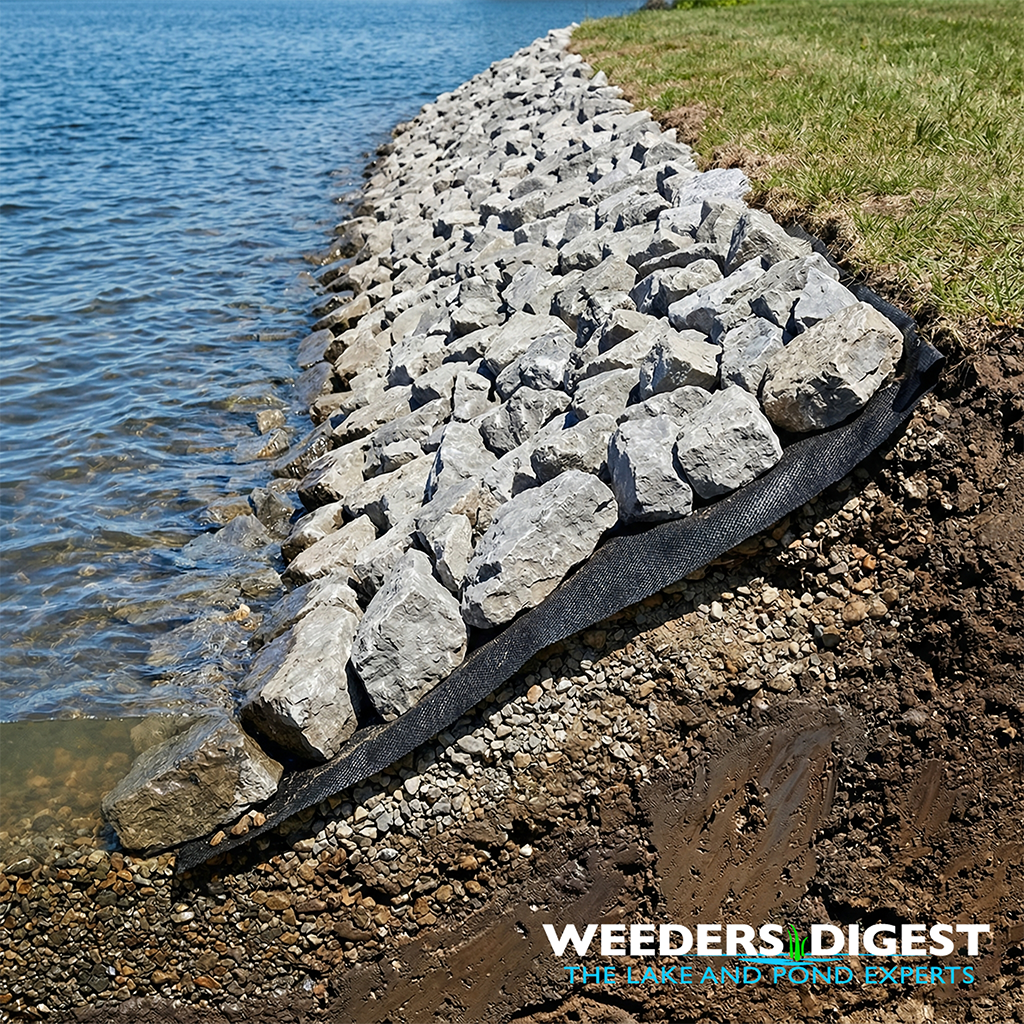
While adding rocks—a process technically known as "riprap" or substrate enhancement—can indeed help stabilize a bank, simply throwing random stones into the lake rarely produces the long-term results you are looking for. Without a plan, those rocks often end up sinking into the very muck you are trying to cover, disappearing beneath the silt over a few seasons. To truly firm up a shoreline, you have to understand the relationship between the weight of the stone, the soft sediment beneath it, and the energy of the waves hitting your property.
The Science Behind It:
The efficacy of utilizing stone for shoreline stabilization is governed by the principles of geotechnical engineering and fluid dynamics. In aquatic ecosystems, the boundary between the terrestrial and benthic zones is often composed of unconsolidated fine-grained sediments or organic "muck." When a high-density object, such as a fieldstone or cobble, is placed atop these saturated, low-shear-strength soils, a phenomenon known as "subsidence" occurs. Without a transitional layer to distribute the load, the downward gravitational force of the rock exceeds the bearing capacity of the soft sediment, causing the stone to vertically migrate into the substrate until it reaches a more consolidated layer.
Effective shoreline armoring requires the deliberate application of riprap, which functions by dissipating wave energy and protecting the underlying soil from hydraulic lift. According to research published by the University of Minnesota Extension, successful stabilization depends on the "interlocking" nature of the stones and the use of a filter layer. Angular stones are superior to rounded "river rocks" because their irregular edges lock together, creating a singular, heavy mass that resists displacement by ice heaving or high-energy wave action. If the stones are merely "thrown" and remain loose, they fail to provide the structural integrity needed to withstand the constant ebb and flow of the littoral zone.
Furthermore, the introduction of stone without a geotextile fabric or a graded gravel filter often leads to "piping." This is a process where water moves behind and beneath the rocks, washing away the fine soil particles and eventually causing the rock layer to collapse or "slump" into the lake. Research from the Journal of Soil and Water Conservation emphasizes that the "critical shear stress" of the shoreline must be elevated by the addition of properly sized aggregates to prevent the detachment of soil particles. Simply adding a thin layer of rock does not change the fundamental slope stability; it merely masks the erosion occurring underneath.
From a biological perspective, the addition of rock can significantly alter the littoral habitat. While it may provide a firmer base for human activity, it changes the interstitial spaces available for benthic macroinvertebrates and can shift the local pH or nutrient loading if the stone type is not chemically inert. Therefore, firming a shoreline is not merely a matter of adding mass, but a complex calibration of stone size (D50 gradation), slope gradient, and the underlying soil's physical properties to ensure the intervention remains on the surface rather than becoming part of the deep sediment profile.
Sources / References:
- University of Minnesota Extension: Stabilizing your shoreline to prevent erosion
- Michigan Department of Environment, Great Lakes, and Energy: Shoreline Protection Resources