

My Squishy Shoreline: Why Does Lake Muck Release That Rotten Egg Smell?

Summary:
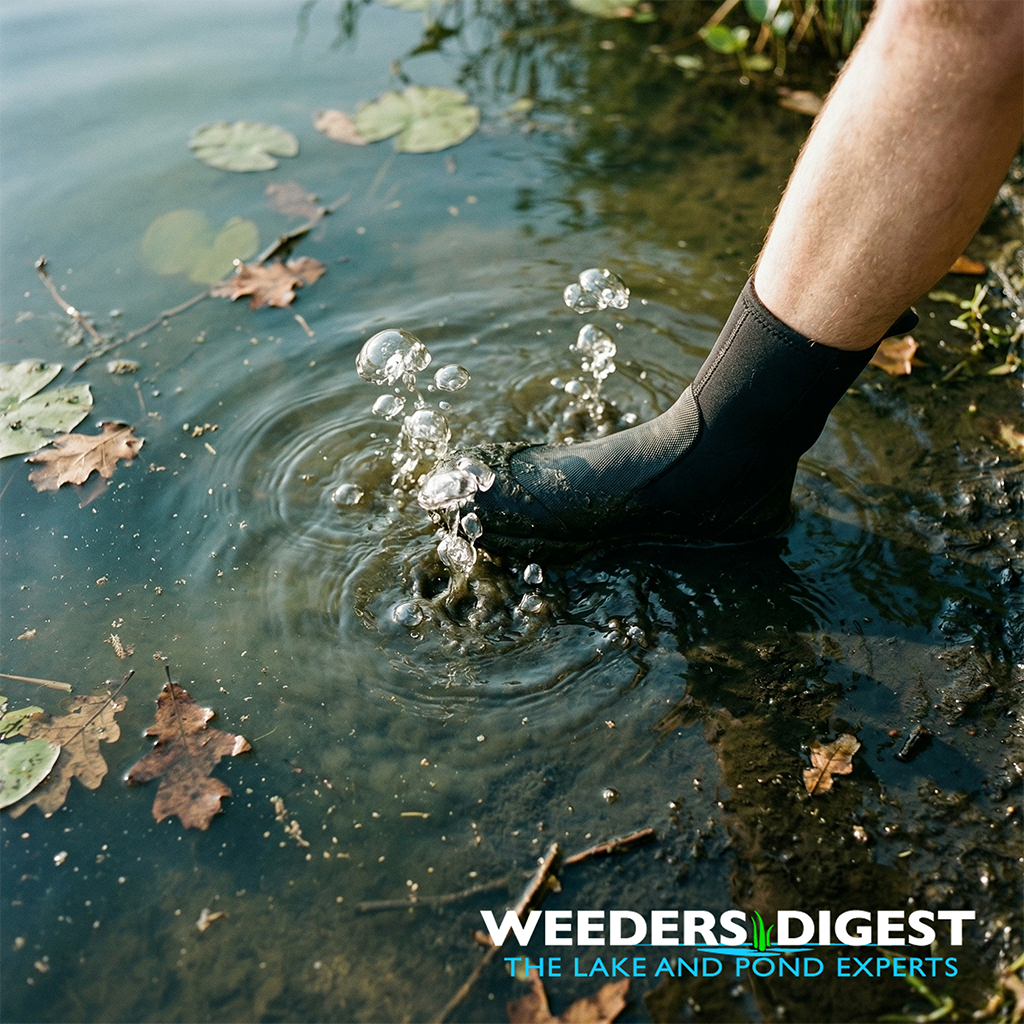
Have you ever waded into the edge of your pond only to have a flurry of bubbles erupt around your feet, followed quickly by a sharp, stinky scent? It is a common experience for anyone with a soft-bottomed shoreline. That "rotten egg" smell is actually a gas produced by tiny organisms living deep within the mud. As layers of dead leaves, grass clippings, and fish waste settle at the bottom of a water body, they create a thick, oxygen-free environment known as muck.
When you step into this muck, you are physically compressing the sediment and providing an escape route for gases that have been trapped beneath the surface. The bubbles you see rising to the top are a mixture of gases, but the one responsible for that signature stench is hydrogen sulfide. It is a natural byproduct of decomposition in environments where oxygen is scarce.
While the smell can be quite unpleasant, it is a very common biological process in mature lakes and ponds. Essentially, your footsteps are acting like a key, unlocking pockets of gas that have been brewing in the underwater soil for weeks or even months. Understanding what is happening beneath your toes can help you better manage the health and "breathability" of your shoreline.
The Science Behind It:
The phenomenon of gas release from benthic sediments is primarily driven by anaerobic respiration and the stratification of redox zones within the lakebed. In aquatic ecosystems, organic matter undergoes decomposition via microbial action. In the presence of dissolved oxygen, aerobic bacteria break down this matter efficiently. However, in the deep, compacted layers of "muck" or sapropel, oxygen is depleted faster than it can be replenished by diffusion from the water column. According to research published in Limnology and Oceanography, this creates an anoxic environment where specialized microorganisms, specifically sulfate-reducing bacteria (SRB) like Desulfovibrio, take over the decomposition process.
These anaerobic bacteria do not use oxygen as an electron acceptor; instead, they utilize sulfate ($SO_4^{2-}$) found in the water and sediment. The chemical byproduct of this metabolic pathway is hydrogen sulfide ($H_2S$). Because $H_2S$ has low solubility in water under certain pH and temperature conditions, it often accumulates in the interstitial spaces of the sediment. Alongside hydrogen sulfide, methanogenic archaea often produce methane ($CH_4$) through the degradation of organic acetates or the reduction of carbon dioxide. These gases coalesce into pressurized bubbles trapped by the cohesive, fine-particulate nature of the muck.
When a physical disturbance occurs—such as a human footprint or a shifting anchor—the structural integrity of the sediment matrix is compromised. This creates a path of least resistance, allowing the pressurized bubbles to migrate upward through the water column in a process known as ebullition. Research from the Journal of Geophysical Research: Biogeosciences indicates that ebullition is a significant mechanism for gas transport in shallow freshwater systems, often bypassing the traditional slow diffusion process.
The distinct odor associated with this event is due to the extremely low odor threshold of hydrogen sulfide, which humans can detect at concentrations as low as 0.00047 parts per million. While methane is odorless, the $H_2S$ serves as a potent chemical signature of the active anaerobic digestion occurring in the benthic zone. The volume of gas released is typically proportional to the depth of the organic accumulation and the rate of nutrient loading in the water body, which fuels the microbial "engine" within the muck.
Sources / References:
- https://aslopubs.onlinelibrary.wiley.com/journal/19395590
- https://agupubs.onlinelibrary.wiley.com/journal/21698961