

The Invisible Guardians of My Lake: Why Bacteria are the Secret to a Healthy Shoreline
 |
Summary:
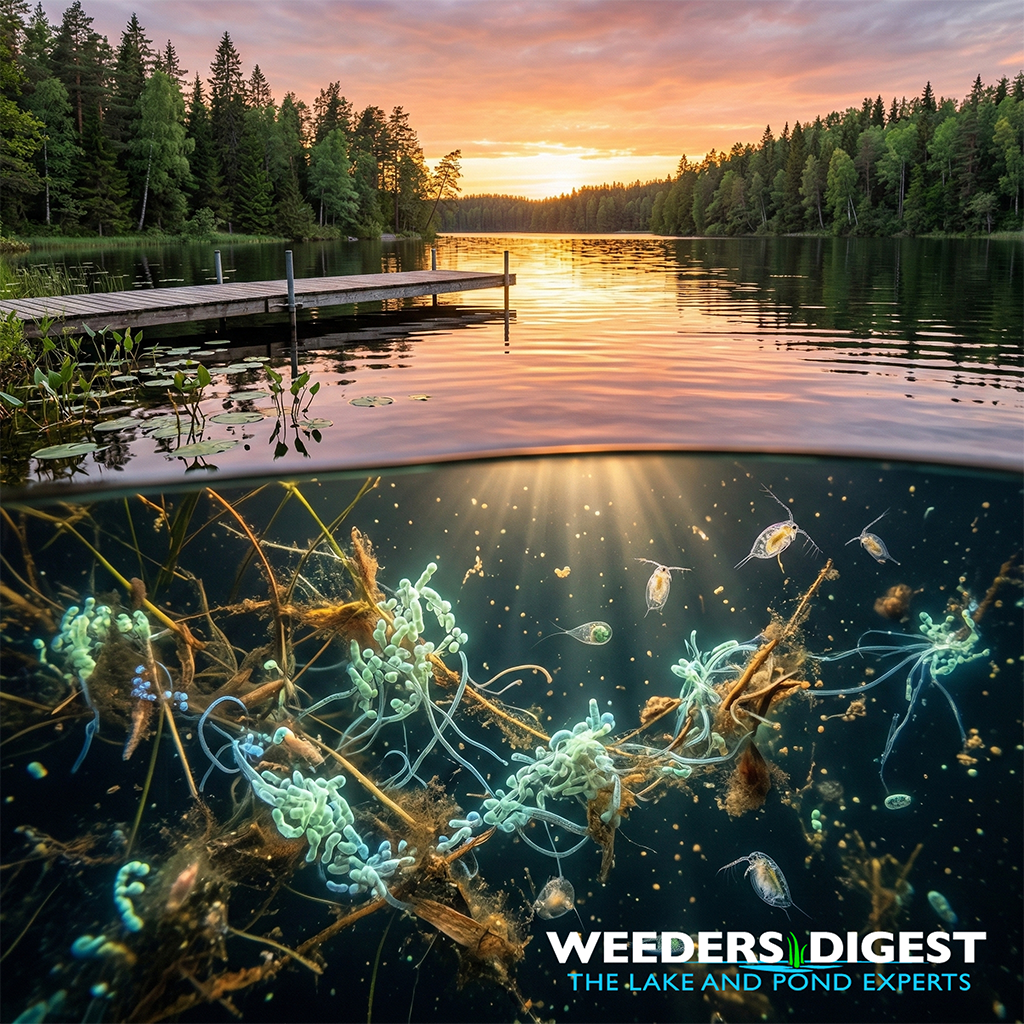
In my years of managing lakes and ponds, I’ve found that many people think of bacteria as "germs" that make the water dirty. In reality, your lake couldn't survive without them. Think of bacteria as the lake's invisible cleaning crew and kitchen staff. They are responsible for breaking down all the "trash" in the water—dead leaves, fish waste, and old algae—and turning it back into the nutrients that feed the rest of the food chain.
Without these microscopic powerhouses, your lake would quickly fill up with muck and debris, and the water would become stagnant and lifeless. They act as the ultimate recyclers, ensuring that energy doesn't just sit at the bottom of the lake but gets reused by everything from tiny plankton to the prize-winning bass you’re hoping to catch.
However, just like a garden, a lake needs the right kind of bacteria in the right balance. While most are beneficial, some can signal problems with water quality or runoff. My job as a lake manager is to ensure your water has a healthy microbial community that supports clear water and a vibrant habitat rather than a mucky mess.
The Science Behind It:
Bacterial communities are the primary drivers of biogeochemical cycling in freshwater ecosystems, serving as the "hub" of carbon, nitrogen, and phosphorus transformations. Heterotrophic bacteria are the principal mineralizers of organic compounds; they decompose complex organic matter—sourced from both within the lake (autochthonous) and the surrounding landscape (allochthonous)—into inorganic constituents. This process, known as mineralization, is critical for releasing bound nutrients back into the water column where they can be utilized by primary producers like phytoplankton (Yadav et al., 2018).
A cornerstone of aquatic ecology is the "microbial loop," a pathway where bacteria take up dissolved organic matter (DOM) that is otherwise inaccessible to larger organisms. By incorporating this DOM into their own biomass, bacteria effectively "repackage" energy. This biomass is then consumed by bacterivorous protozoans (flagellates and ciliates), which are in turn eaten by zooplankton. This loop ensures that a significant portion of a lake's total energy budget is funneled back into the higher trophic levels, including fish (Newton et al., 2011).
In the nitrogen cycle, bacteria play specialized and indispensable roles that maintain water quality. Nitrifying bacteria, such as Nitrosomonas and Nitrobacter, oxidize toxic ammonia (a byproduct of fish waste and decomposition) into nitrite and then into nitrate, which is more readily absorbed by plants. Conversely, in the low-oxygen (anoxic) environments of deep sediments, denitrifying bacteria convert nitrates into nitrogen gas, which safely exits the lake into the atmosphere. This natural "self-purification" process prevents the over-accumulation of nutrients that leads to harmful algal blooms and eutrophication.
Furthermore, recent genomic research has highlighted that lake bacteria are not just passive decomposers but active competitors. Bacteria often compete with algae for phosphate, especially in nutrient-limited environments. This competition can dictate which species of algae thrive, directly influencing the lake's clarity and the potential for toxic cyanobacteria blooms. The stability of these bacterial networks is highly sensitive to environmental factors like temperature and phosphate levels, making the microbiome a primary indicator of overall lake health.
Sources / References:
- Newton, R. J., et al. "A Guide to the Natural History of Freshwater Lake Bacteria." Microbiology and Molecular Biology Reviews.
https://journals.asm.org/doi/10.1128/mmbr.00028-10 - Yadav N, Kour D, Yadav AN. "Microbiomes of freshwater lake ecosystems." J Microbiol Exp.
https://www.researchgate.net/publication/335962279_Microbiomes_of_freshwater_lake_ecosystems