

The Shape of Your Shoreline: How Slope Dictates Where Muck Settles in Your Pond

Summary:
When you look at your shoreline, you might see a beautiful transition from land to water, but beneath the surface, the angle of that slope is working like a conveyor belt for organic debris. Over the years, I have seen many homeowners frustrated by "muck"—that soft, dark, smelly sludge—accumulating in specific areas of their waterfront. The steepness of your shoreline is one of the primary factors determining whether that debris stays near the edge or slides into the deep.
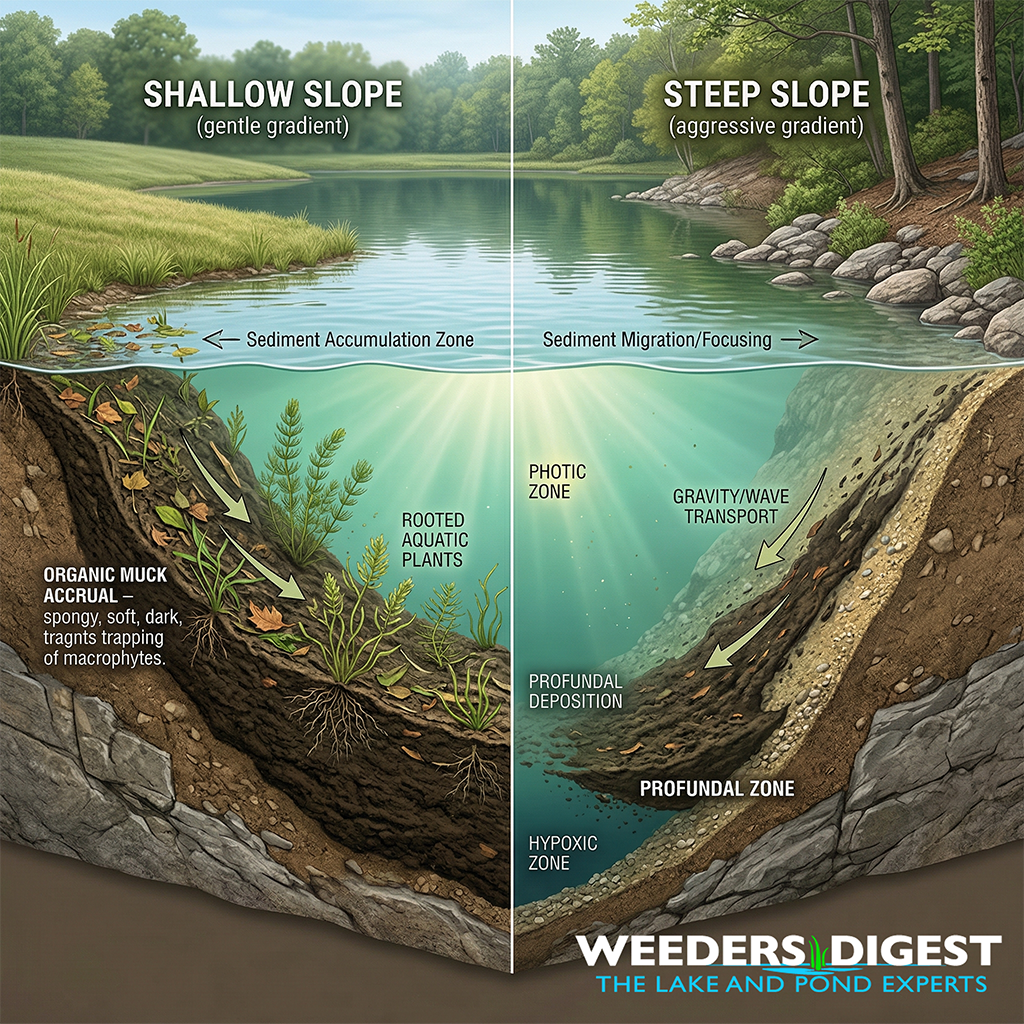
In a perfectly flat or very shallow entry, wave action and gravity don't have much "pull." This means leaves, grass clippings, and dying aquatic plants tend to settle exactly where they fall, creating a thick, spongy layer right where you want to walk. Conversely, a steeper drop-off acts like a slide, encouraging those materials to migrate further out toward the center of the pond.
Understanding this relationship is crucial because muck isn't just an aesthetic issue; it’s an active biological zone. Where it gathers, it begins to rot, consuming oxygen and releasing nutrients that can fuel even more weed growth. By recognizing how the physical "geometry" of your pond influences these deposits, you can better predict where the most maintenance will be required over the coming seasons.
The Science Behind It:
The accumulation of organic matter, colloquially known as muck, is governed by the principles of sediment transport and the energy dynamics of the littoral zone. In aquatic ecosystems, the slope of the basin—specifically the underwater gradient—regulates the "settling velocity" and the lateral movement of particulates. According to research published by the University of Florida's IFAS Extension, steeper slopes facilitate the downward migration of fine organic sediments through a process called sediment focusing. In this phenomenon, gravity and wind-induced turbulence move lighter, flocculent materials from the high-energy shallow areas toward the lower-energy, deeper basins of the water body.
The physical slope affects the "critical shear stress" required to resuspend and move debris. On a steep shoreline, even minor wave action generated by wind or watercraft can easily dislodge accumulated organic matter, sending it down the slope. However, in shallow-sloped or littoral shelves, the energy from surface waves is often dissipated before it can effectively move heavier organic loads. This leads to an "accrual zone" where the rate of deposition of autochthonous (internal) and allochthonous (external) organic matter exceeds the rate of decomposition or transport.
Furthermore, the slope influences the colonization of macrophytes, which act as biological "traps" for muck. As noted in studies by the Minnesota Department of Natural Resources, shallow slopes provide a larger surface area within the photic zone, encouraging the growth of rooted vegetation. These plants create a friction rug that slows water velocity, causing suspended solids to drop out of the water column. Over time, the decay of these very plants adds to the thickness of the muck layer, creating a feedback loop where shallow slopes progressively shallow further due to organic buildup.
From a biochemical perspective, the depth at which muck settles—driven by the slope—impacts the rate of anaerobic digestion. When muck is focused into deeper, cooler, and often hypoxic (low oxygen) regions of a pond due to a steep slope, the decomposition process slows down significantly compared to the warmer, oxygen-rich shallows. Therefore, while a steep slope may keep a shoreline "cleaner" to the touch, it effectively concentrates long-term nutrient loads in the profundal zone, which can eventually contribute to internal phosphorus loading and eutrophication.