

The Tale of Two Depths: Why My Shallow Pond and Your Deep Lake Are Worlds Apart
 |

Summary:
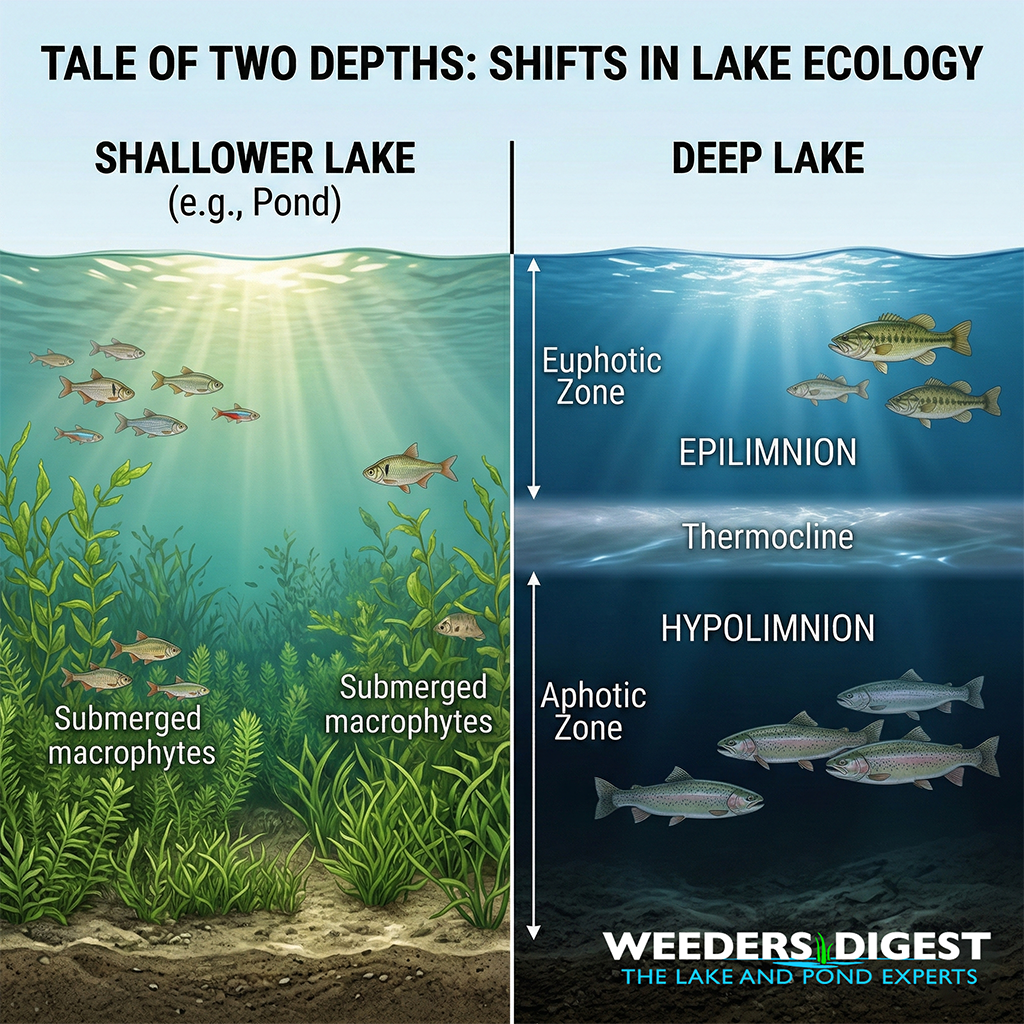
When you look at a body of water, it’s easy to assume that a lake is just a larger version of a pond, but the reality is much more fascinating. The primary difference between my shallow pond and your deep lake isn't just the distance to the bottom; it's how sunlight and temperature dictate the entire rhythm of life within them. In a shallow ecosystem, sunlight often reaches all the way to the floor, allowing plants to grow across the entire basin. This creates a highly productive, "busy" environment where nutrients cycle quickly and the water stays roughly the same temperature from top to bottom.
Deep lakes, on the other hand, are defined by their layers. Because the sun cannot reach the dark, chilly depths, these lakes develop a distinct thermal structure. This stratification acts like an invisible barrier, separating the warm, oxygen-rich surface from the cold, nutrient-dense bottom. While my shallow water might be prone to sudden algae blooms due to its warmth and light, your deep lake acts as a massive heat sink, responding much more slowly to the changing seasons.
Understanding these differences is crucial for anyone managing a water body. In a shallow system, the interaction between the sediment and the water is constant, meaning every fallen leaf or bit of runoff has an immediate impact. In deep systems, the vast volume of water provides a buffer, but it also creates unique challenges, such as "lake turnover," where the entire water column mixes in the spring and fall, bringing deep-seated nutrients to the surface in one dramatic event.
The Science Behind It:
The fundamental ecological divergence between shallow and deep lacustrine systems is governed by the photic zone and thermal stratification. In shallow lakes, typically defined as having a mean depth of less than three meters, the euphotic zone—the layer where light intensity is sufficient for photosynthesis—frequently extends to the benthic sediment. According to research published in Hydrobiologia, this allows for the dominance of submerged macrophytes, which compete with phytoplankton for limiting nutrients like phosphorus and nitrogen. These systems often exist in "alternative stable states," shifting between clear-water phases dominated by vegetation and turbid phases dominated by algae.
Deep lakes are characterized by the formation of a thermocline, a distinct layer where temperature changes rapidly with depth. This physical property leads to the development of the epilimnion (warm surface layer), the metalimnion (the transition zone), and the hypolimnion (the cold, dense bottom layer). As noted by the University of Minnesota’s St. Anthony Falls Laboratory, this stratification inhibits vertical mixing. Consequently, the hypolimnion can become hypoxic or anoxic as bacteria consume oxygen while decomposing organic matter that sinks from the surface, a process that does not typically occur in well-mixed shallow systems.
The nutrient cycling, or internal loading, also differs significantly between these two environments. In shallow polymictic lakes, wind-induced mixing occurs frequently, continuously re-suspending nutrients from the sediment into the water column, which fuels primary productivity. In contrast, deep dimictic lakes only experience full vertical mixing during turnover events in the spring and autumn when the water column reaches a uniform density at approximately 4°C. This seasonal pulse of nutrients is a critical driver of seasonal succession in plankton communities.
Furthermore, the "edge effect" or littoral zone plays a much larger role in shallow lake ecology. In a shallow basin, the littoral zone may encompass 100% of the lake area, whereas in a deep lake, the pelagic (open water) zone dominates the energy flow. This results in different food web structures; shallow lakes are often driven by benthic-pelagic coupling, where fish and invertebrates move fluidly between the bottom and the surface, while deep lakes maintain more segregated niches for cold-water species like salmonids in the deep refuge of the hypolimnion.
Sources / References:
- Scheffer, M. (1998). Ecology of Shallow Lakes. Springer Science & Business Media.
- University of Minnesota - Water Resources Center: Lake Ecology Primer.