

Understanding My Lake's Depth Zones: Why Some Plants Love the Shallows While Others Dive Deep
Summary:
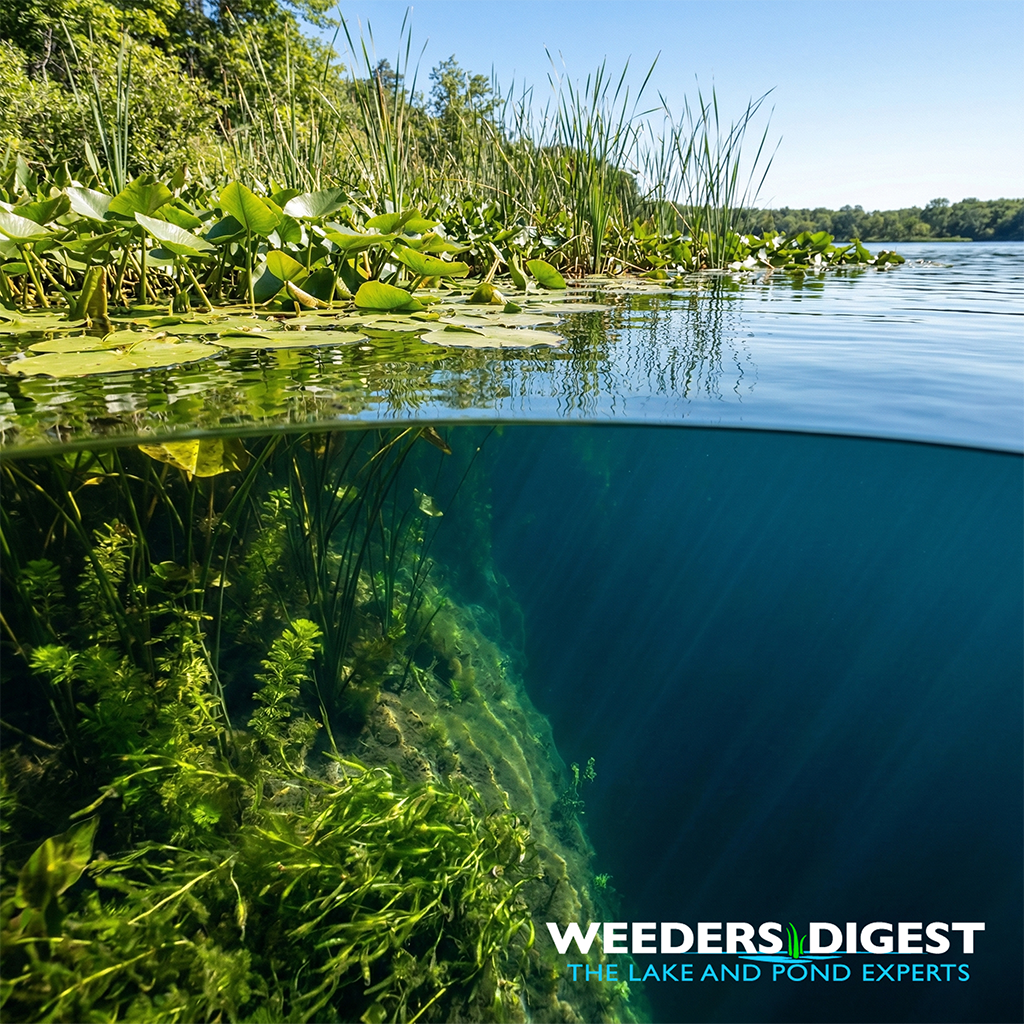
If you have ever waded into a lake or paddled a boat over a drop-off, you have likely noticed that the underwater landscape changes dramatically as the water gets deeper. Near the shoreline, you often see a lush "garden" of plants poking out of the water or floating on the surface. These plants are the sun-seekers of the lake world, thriving in the warm, bright, and nutrient-rich shallows where they can easily reach the air and withstand the gentle tug of waves.
As you move toward the center of the lake where the bottom drops away, the scenery shifts. The tall, grassy plants disappear, replaced by specialized species that live entirely submerged. These deep-water residents are the marathon runners of the aquatic world; they have adapted to survive in dimmer light and cooler temperatures, often growing in massive, flowing beds that provide critical cover for fish.
The reason your lake doesn't have the same plants everywhere comes down to a balancing act between light, pressure, and the soil at the bottom. Just like the plants in your backyard, aquatic species have specific "comfort zones." Some need the intense energy of the sun at the surface, while others have evolved clever ways to breathe and grow in the quiet, heavy darkness of the deep. Understanding these zones helps you see your lake not just as a body of water, but as a complex, multi-story apartment building for nature.
The Science Behind It:
The spatial distribution of macrophytes within lacustrine environments is primarily governed by the attenuation of photosynthetically active radiation (PAR) and the physical energy of the benthic environment. In the littoral zone, light is rarely a limiting factor, allowing for the dominance of emergent and floating-leafed taxa. Research published by the University of Florida's IFAS Extension notes that water clarity directly dictates the maximum colonization depth, as plants require a specific percentage of surface light—often between 1% and 25% depending on the species—to maintain a positive net primary production.
In shallow water, plants must contend with high-energy wave action and fluctuating water levels. Species found here often possess aerenchyma tissue—specialized spongy gaps in their stems—which provides both buoyancy and a conduit for oxygen to reach roots submerged in anaerobic (oxygen-poor) sediments. According to Chambers (1987) in Aquatic Botany, the relationship between sediment composition and water depth also plays a critical role; shallow areas often accumulate coarser sediments due to wave "washing," whereas deeper, calmer zones collect fine organic matter and silts that offer different nutrient profiles for deep-water specialists.
Deep-water or submerged macrophytes have evolved distinct physiological adaptations to thrive in the hypolimnion-adjacent regions. These plants often have thin, dissected leaves to maximize surface area for carbon dioxide absorption and light capture in low-light (scotopic) conditions. As hydrostatic pressure increases with depth, the structural integrity of the plant changes; deep-water species lack the rigid lignin found in terrestrial or emergent plants, relying instead on the density of the water itself for support.
Furthermore, the thermal stratification of a lake influences where specific species can persist. Shallow waters warm rapidly, accelerating metabolic rates and gas exchange, while deeper "drop-off" zones remain thermally stable but significantly cooler. This temperature gradient affects the solubility of dissolved oxygen and the rate of nutrient cycling from the sediment. Consequently, the transition from the littoral shelf to the pelagic drop-off represents a sharp ecological boundary where only the most specialized low-light adapted species can survive.
Sources / References:
- University of Florida IFAS: Circular 1075/AG233: Aquatic Plant Management
- Chambers, P.A. (1987). Light and Nutrients with Respect to the Relative Abundance of Aquatic Macrophytes. Aquatic Botany.