

Why Do Weeds Grow Thicker Near My Shoreline Than My Neighbor’s?
Why Do Weeds Grow Thicker Near My Shoreline Than My Neighbor’s?
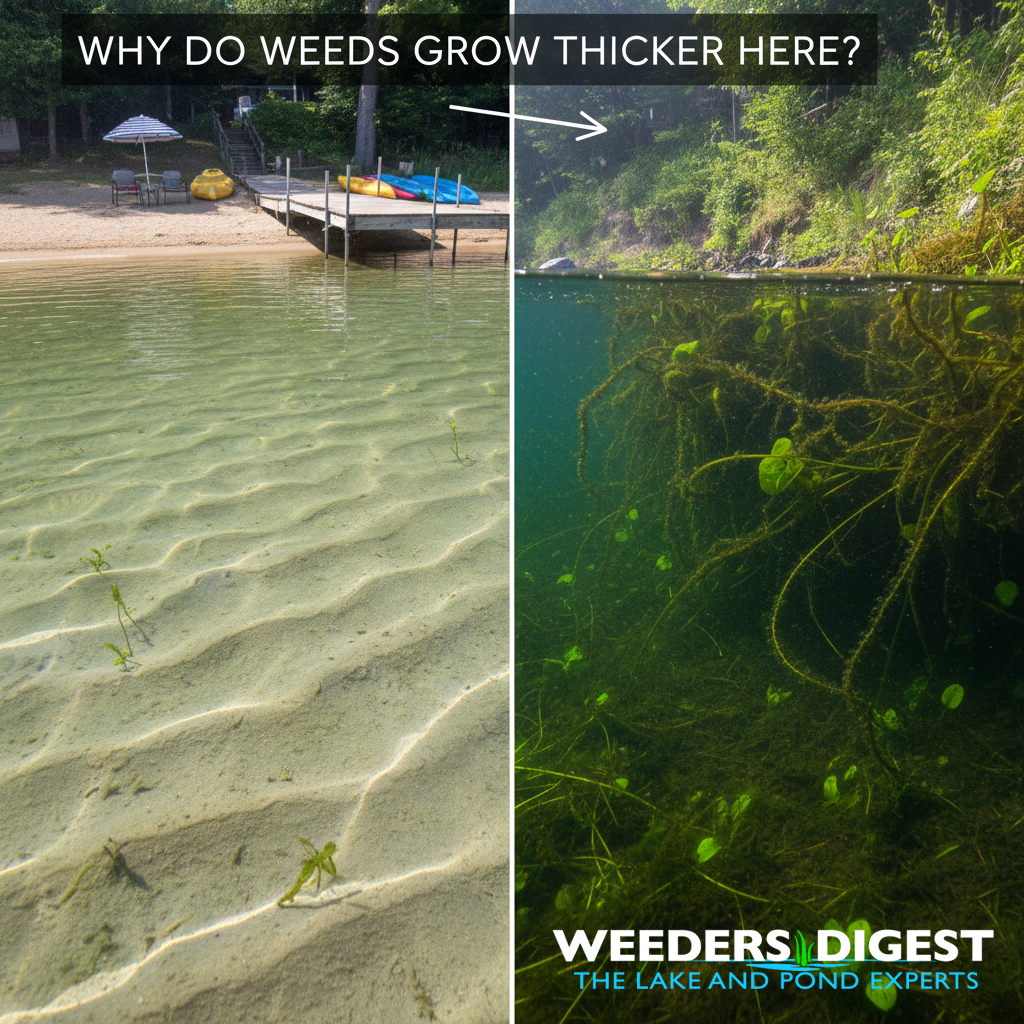
Summary:
It can be incredibly frustrating to look at your neighbor’s clean, sandy beach and then back at your own shoreline, which may be choked with thick weeds and muck. This disparity rarely comes down to luck or "better" water on their side; it is usually a result of the specific physical and chemical environment of your particular stretch of shore. Everything from the direction the wind blows to the way the land slopes behind your house creates a unique "micro-habitat." If your shoreline is protected from waves and receives more nutrient-rich runoff, it becomes a natural nursery for aquatic plants, while a neighbor just a few hundred feet away might have a wind-swept shore that prevents plants from ever taking root.
The Science Behind It:
The primary reason for varying weed density along a single lake is the difference in hydrodynamic energy. In limnology, we look at how waves and currents interact with the shoreline. If your neighbor's property is exposed to the "prevailing winds," the constant wave action creates a high-energy environment. This energy physically prevents fine organic sediments from settling and can uproot young seedlings before they establish. This results in a firm, sandy bottom. If your shoreline is in a "lee" or a protected cove, the water remains calm, allowing nutrient-rich silt and organic "muck" to settle. This creates a soft, fertile bed that is perfectly suited for dense aquatic plant colonization.
The "slope" of your lakebed, or its bathymetry, also dictates how much room weeds have to grow. A shallow, gently sloping shoreline creates a vast littoral zone—the area where sunlight can reach the bottom. In these shallow areas, 100% of the lakebed may be within the "photic zone," providing a massive footprint for growth. If your neighbor has a "drop-off" where the water depth plunges quickly to ten feet or more, the sunlight cannot reach the bottom as effectively, naturally limiting the area where weeds can physically survive. According to research in Aquatic Botany, even a slight difference in the angle of the underwater slope can result in a 50% difference in total plant biomass.
Another critical factor is nutrient loading from the immediate upland area. Your shoreline is the "filter" for whatever drains off your land. If your property has more lush landscaping, a steeper slope that encourages runoff, or even a different type of soil than your neighbor’s, your shoreline may be receiving a higher concentration of phosphorus and nitrogen. This is known as localized external loading. Scientific studies show that nutrients don't always disperse evenly across a lake; they often stay concentrated in the immediate area where they entered the water, effectively "fertilizing" your specific patch of weeds while leaving the neighbor’s side untouched.
Finally, we must consider the "founder effect" of invasive species. Many lake weeds, like Eurasian Watermilfoil, spread through fragmentation—small pieces of the plant break off and float until they find a place to root. If the natural currents of the lake happen to pull floating debris into your "pocket" of the shoreline, you will experience a much higher rate of new growth. Once these plants establish, they create a "trap" that catches more sediment and more fragments, leading to a self-reinforcing cycle of thickening vegetation. This combination of physical protection, fertile sediment, and current patterns explains why two properties on the same lake can have such vastly different underwater landscapes.