

Why Does My Lake Look Like Different Colors at Different Times of Day?
 |
Summary:
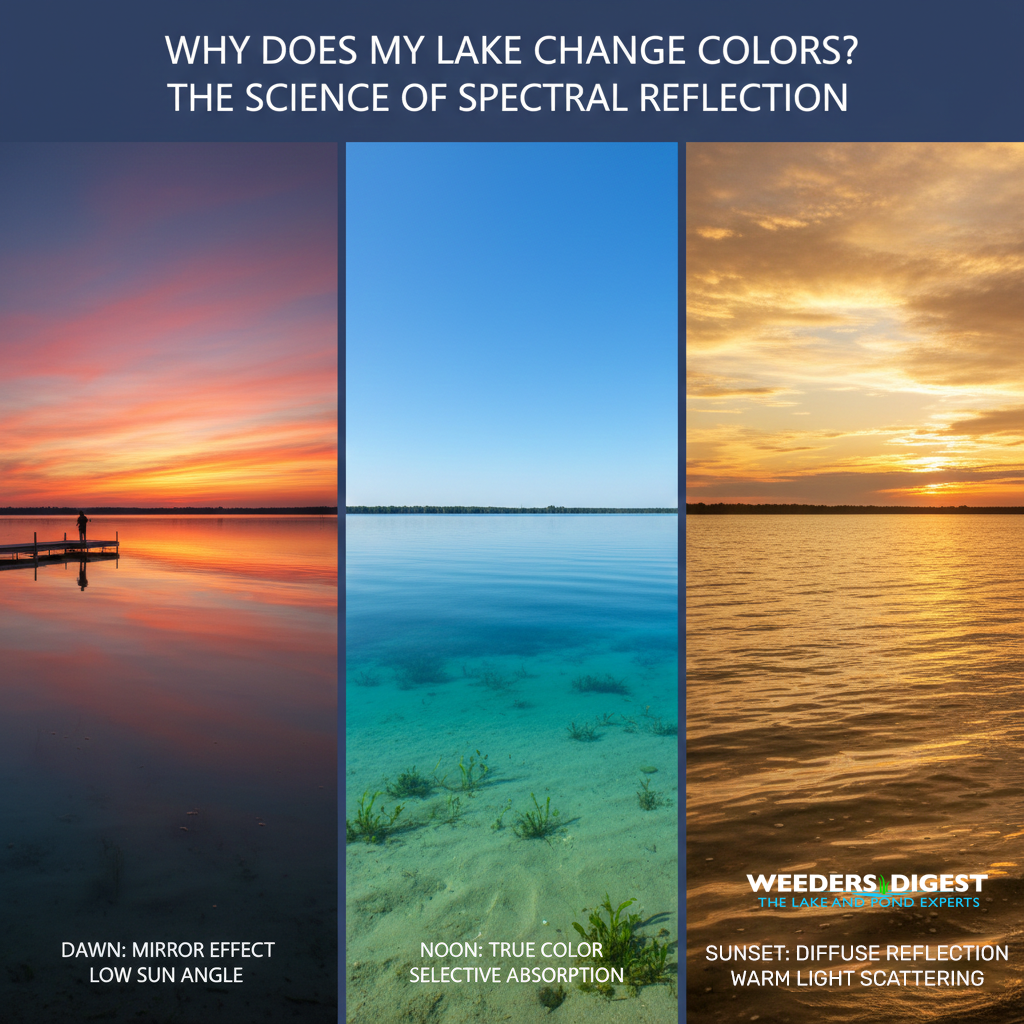
One of the most beautiful aspects of lakefront living is watching the water shift from a deep indigo at dawn to a bright turquoise at noon and a golden-bronze at sunset. You might wonder if the water itself is changing, but these shifts are actually a masterpiece of light physics and "spectral reflection." The color you see is a combination of how the sunlight hits the surface, what is floating in the water, and what is being reflected from the sky. Depending on the angle of the sun and the weather, your lake can act like a mirror, a window, or a prism, changing its appearance every hour.
The Science Behind It:
The primary driver of water color variation throughout the day is the angle of incidence of the sun's rays. When the sun is low on the horizon, such as during sunrise or sunset, the light hits the water at a shallow angle. According to Fresnel’s Law of Reflection, a low angle causes the surface of the lake to act more like a mirror, reflecting the vibrant oranges and reds of the sky (long-wavelength light) rather than showing the water’s internal color. This is why the lake often looks "metallic" or dark in the early morning; you are seeing the reflection of the atmosphere rather than the water itself.
As the sun moves higher toward the zenith (midday), the light hits the water more vertically. This allows the light to penetrate deeper into the water column rather than reflecting off the surface. Once the light is inside the water, a process called selective absorption and scattering takes over. Water molecules naturally absorb long-wavelength colors like reds and yellows while scattering short-wavelength blues and greens. Research from the U.S. Geological Survey indicates that the "true" color you see at noon is a result of this scattering, influenced by CDOM (Chromophoric Dissolved Organic Matter) and suspended particles like algae or silt.
The presence of microscopic life, such as phytoplankton, further alters the color based on the intensity of the light. During mid-afternoon, when photosynthesis is at its peak, the chlorophyll in algae absorbs blue and red light while reflecting green light, which can give the lake a distinct emerald hue. Scientific studies in Remote Sensing of Environment show that even the "clarity" of the sky plays a role; on a clear day, the lake reflects the blue of the Rayleigh-scattered sky, while on an overcast day, the "diffuse sky radiation" makes the lake look gray or leaden because the clouds are scattering all wavelengths of light equally.
Finally, the state of the lake’s surface—whether it is "glassy" or "rippled"—changes how light reaches your eyes. Smooth water allows for a specular reflection, creating the perfect "mirror" effect. However, wind creates waves that present thousands of different angles to the sun, causing diffuse reflection. This breaks up the light and can make the water appear lighter or "whiter" due to the foam and bubbles (whitecaps) which reflect all visible light. Understanding these optical properties helps scientists use satellite imagery to monitor lake health, as the "spectral signature" of the water at different times can reveal the concentration of nutrients and minerals without ever taking a physical sample.