

Why Does My Lake Water Clarity Change So Much From Year to Year?
 |
Summary:
It can be unsettling to see the water that was crystal clear last summer look cloudy or green this year, leading many to wonder if their lake is permanently "declining." However, it is perfectly normal for water clarity to fluctuate annually. A lake is a living, breathing system that reacts to the specific "weather diet" it receives each year. Factors like how much it snowed in the winter, how early the ice melted, and even the timing of spring rainstorms determine how much "fuel" (nutrients) the lake has to work with. These year-to-year changes are usually temporary shifts in the lake’s balance rather than a permanent change in its health.
The Science Behind It:
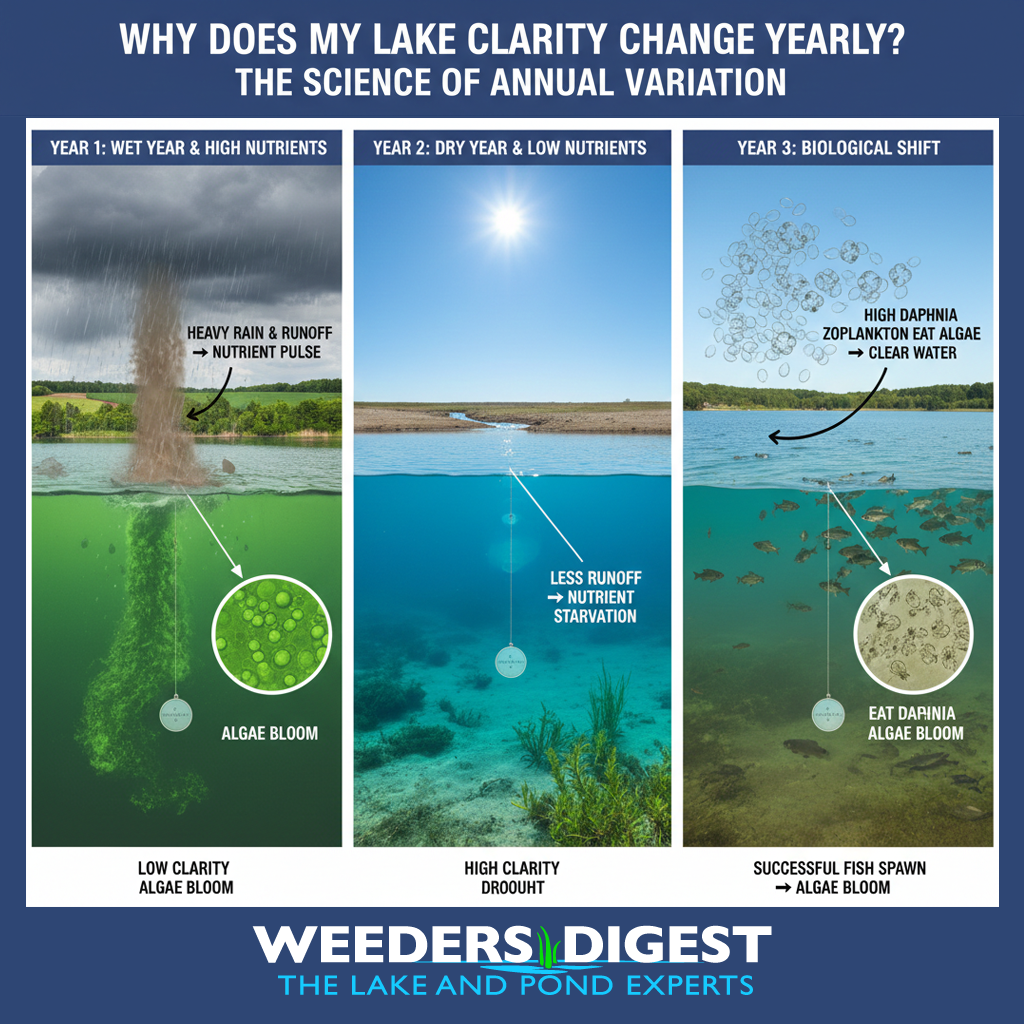
The primary driver of annual clarity variation is the nutrient loading associated with regional weather patterns. Lakes are heavily influenced by their "watershed"—the surrounding land that drains into them. In a year with heavy spring runoff or frequent high-intensity rainstorms, the lake receives a "pulse" of phosphorus and nitrogen washed in from the soil. According to research from the North American Lake Management Society (NALMS), this influx of nutrients can trigger an "algal-dominated state" for that season. Conversely, in a drought year, less runoff enters the lake, often leading to significantly higher transparency and deeper Secchi disk readings.
The timing of the ice-out and the subsequent "spring turnover" also sets the stage for the entire year. If the ice melts early and the water warms up quickly, it can lead to a longer growing season for both rooted plants and algae. This is often dictated by the thermal stability of the water column. In some years, a lake may stay "stratified" (layered) for a longer period, trapping nutrients at the bottom. In other years, a particularly windy or cool summer might cause the lake to mix more frequently, a process known as intermittent mixing, which brings those bottom nutrients back to the surface and fuels mid-summer cloudiness.
Biological cycles also play a massive role in year-to-year changes. Many lakes go through cycles of "boom and bust" for certain species. For example, a year with a high population of Daphnia (tiny water fleas) will result in exceptional clarity because these organisms are efficient algae-eaters. However, if a successful fish spawn occurs, the young fry may decimate the Daphnia population, leading to an algae bloom the following summer. Scientific studies in Limnology and Oceanography describe these as top-down effects, where changes in the food web temporarily override the water chemistry to dictate how clear the lake appears.
Finally, we must consider climatic oscillations. Multi-year patterns like El Niño or local decadal cycles can influence groundwater levels and evaporation rates. During a series of "wet years," the lake's residence time—how long it takes for the water to be completely replaced—decreases, which can flush out some nutrients but also bring in more sediment. Because of these complex variables, scientists look for long-term trends (10–20 years) rather than year-to-year data to determine a lake's true health. A single "murky year" is often just a natural response to a specific set of environmental circumstances, rather than a sign of systemic failure.