

Why Does the Bottom of My Lake Feel Like Mucky Quicksand?

Summary:
If you have ever waded into your lake only to feel the ground disappear beneath your feet, you know how unsettling that "quicksand" sensation can be. You aren't actually sinking into a bottomless pit, but you are likely stepping into a thick accumulation of organic muck, often referred to as "unconsolidated flocculent material." This occurs when decades of fallen leaves, dead aquatic plants, and fish waste settle at the bottom and fail to decompose completely.
Over time, these layers create a gelatinous, semi-fluid barrier between the water and the firm mineral soil below. Because this material is high in water content and very low in density, it cannot support your weight, creating that alarming sinking feeling. It is a very common phenomenon in older or "eutrophic" lakes where biological productivity is high but the natural breakdown process has slowed down.
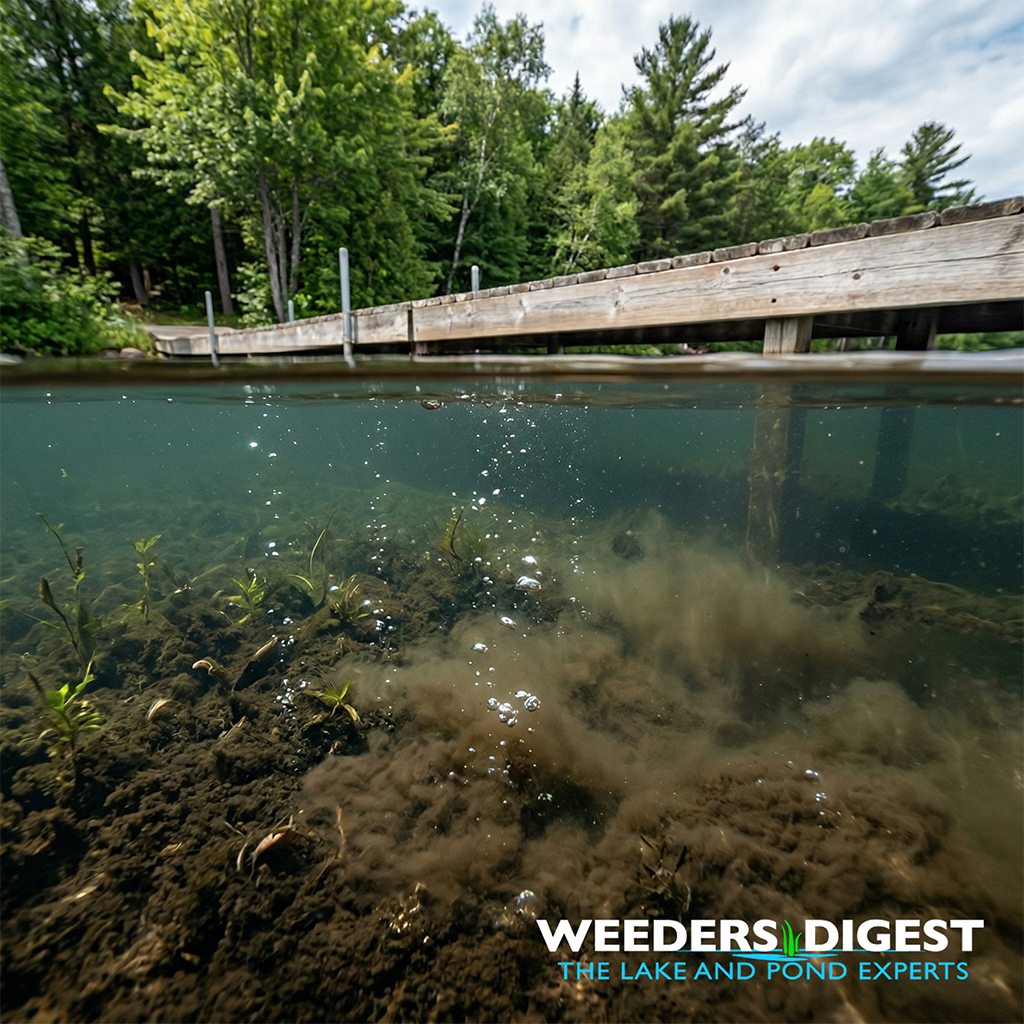
In certain areas of your lake, such as protected coves or near docks, the water is often still enough to allow these fine particles to settle undisturbed. While it feels like a trap, it is actually a sign of a high-nutrient environment where the "recycling" system of the lake—the aerobic bacteria—can’t keep up with the amount of organic matter falling to the bottom.
The Science Behind It:
The "quicksand" sensation at the lake bottom is professionally characterized as the accumulation of highly hydrated organic sediments, often termed "gyttja." This material consists of a complex matrix of particulate organic matter (POM), microscopic algae, and colonial bacteria. According to research from the University of Florida’s IFAS Extension, these sediments accumulate when the rate of primary production (growth of weeds and algae) exceeds the rate of microbial decomposition. As this organic debris piles up, it undergoes a process of physical compaction and chemical transformation, but maintains a high porosity that allows it to behave more like a fluid than a solid.
The physics of the "sinking" feeling is governed by the bulk density and shear strength of the sediment. In many inland lakes, the top layer of muck can have a water content exceeding 90%. Because the particles are suspended in a loose, flocculent state, they possess very little internal friction. When a load—such as a human foot—is applied, the material undergoes "liquefaction," where the stress causes the sediment to behave like a viscous liquid rather than a supportive surface. This is particularly prevalent in anaerobic (oxygen-deprived) zones where the absence of oxygen prevents aerobic bacteria from efficiently breaking down the lignin and cellulose in plant matter.
Sediment distribution within a lake is rarely uniform and is heavily influenced by "sediment focusing." As noted in studies published in Limnology and Oceanography, wind-driven waves and currents tend to erode fine particles from shallow, high-energy shorelines and redeposit them in deeper, quiescent basins or protected littoral zones. This explains why one section of a shoreline may be firm sand while a nearby cove feels like a bottomless mire. The localized accumulation is a result of the lake’s morphology and the hydrodynamic energy of the water column.
Furthermore, the presence of certain gasses, such as methane and hydrogen sulfide, can increase the "fluffiness" of the muck. These gasses are byproducts of anaerobic respiration by methanogenic archaea in the deep sediment layers. As these gas bubbles form and attempt to rise, they create interstitial spaces within the muck, further reducing its density and structural integrity. This result is a substrate that offers almost no resistance to downward pressure, leading to the characteristic "quicksand" effect experienced by those venturing into the water.
Sources / References:
- University of Florida IFAS: Performance of Muck Removal Strategies
- Journal of Limnology: Sedimentation and Lake Management Patterns