

Why is my lake changing so much faster than it used to?
Summary:
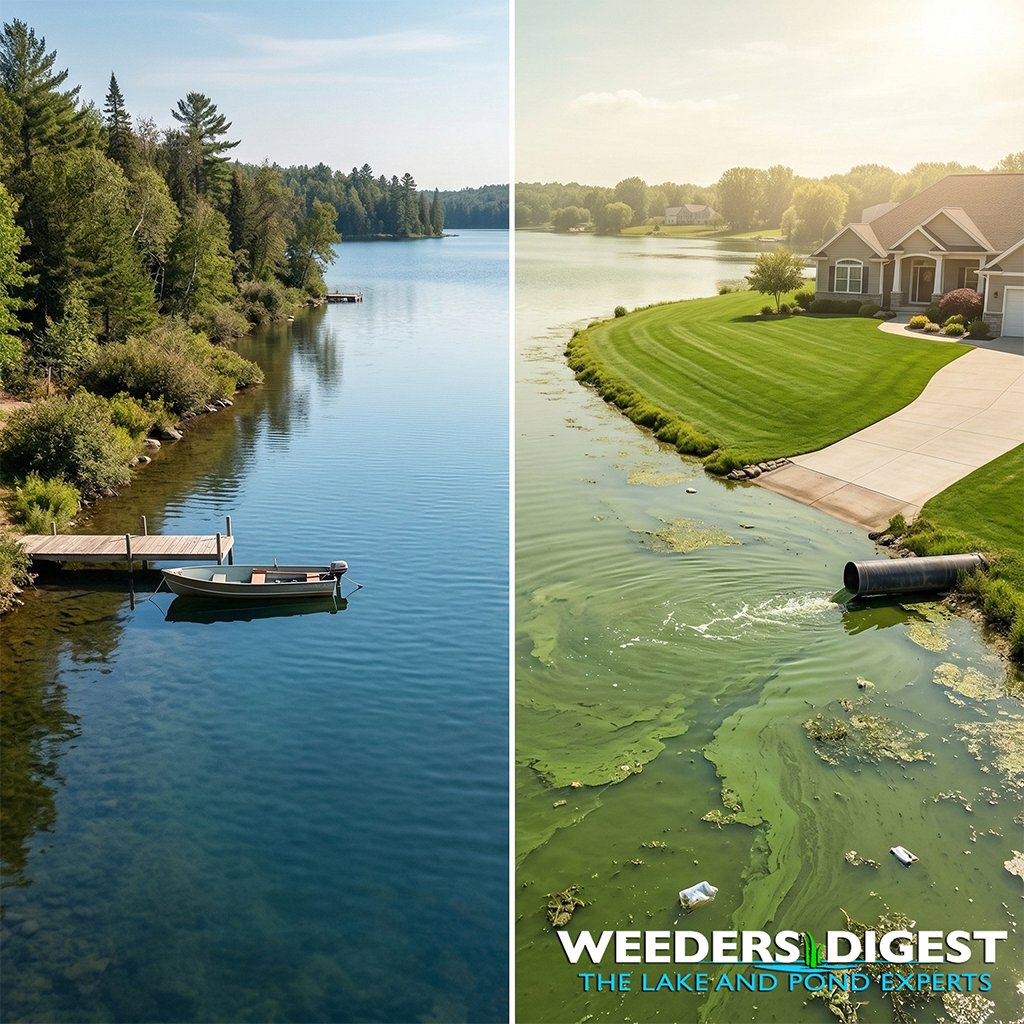
If you feel like your lake is aging right before your eyes, you aren't imagining it. Many lakefront homeowners have noticed that the clear water they remember from childhood is being replaced by murky "pea soup" or thick mats of weeds much earlier in the season than in decades past. In the world of lake science, we call this "cultural eutrophication," and it’s essentially the process of a lake growing old at warp speed due to human influence.
The reason for this sudden shift is a "perfect storm" of modern factors. Our local landscapes have changed; where there were once thick woods to filter rainwater, there are now manicured lawns, paved driveways, and aging septic systems. These changes act like a funnel, sending massive amounts of "liquid fertilizer" (nitrogen and phosphorus) into the water every time it rains. When you combine this excess food with the warmer, shorter winters we've seen lately, the lake's biology kicks into high gear, causing plants and algae to grow faster and longer than ever before.
It is also important to realize that lakes have a "memory." For years, they may have absorbed these nutrients into the bottom mud without much visible change. However, many lakes are now reaching a tipping point where that stored pollution is starting to leak back into the water column. This "legacy" effect, paired with a changing climate, means that even a small amount of new runoff can trigger a massive, overnight change in water quality.
The Science Behind It:
The accelerated transformation of lacustrine ecosystems in the 21st century is primarily driven by the synergistic interaction between anthropogenic nutrient loading and climate forcing. Historically, the process of eutrophication—the natural enrichment of a water body with nutrients—occurred over geological timescales. However, recent data indicates that human activities have compressed this timeline into decades. Research published in Environmental Science & Technology highlights that warming lake temperatures significantly intensify "internal loading," a process where phosphorus sequestered in bottom sediments is rereleased into the water column during periods of thermal stratification and anoxia (O'Reilly et al., 2015).
Climate change acts as a primary catalyst for these rapid biological shifts. As air temperatures rise, lakes experience shorter periods of ice cover and earlier onset of summer stratification. This extended "growing season" allows cyanobacteria (blue-green algae) to outcompete beneficial diatoms and green algae. Because cyanobacteria thrive in warmer, stiller waters, the increased thermal stability of the water column gives them a distinct physiological advantage. Furthermore, extreme precipitation events—now more frequent due to shifting hydrologic cycles—transport massive pulses of "allochthonous" organic matter and dissolved nutrients from the surrounding watershed into the lake basin (Zhang et al., 2023).
The phenomenon of "legacy nutrients" also explains why changes appear to happen suddenly. For decades, lakes have acted as sinks for nitrogen and phosphorus derived from agricultural runoff and urban development. Research in the Journal of Limnology suggests that many temperate lakes have reached a saturation threshold. When the hypolimnion (the cold, bottom layer of a lake) loses its dissolved oxygen, chemical reactions at the sediment-water interface trigger the release of these stored nutrients. This creates a self-sustaining loop of degradation that can continue even if external pollution sources are mitigated.
Furthermore, the "Anthropocene" has introduced unique stressors such as atmospheric nitrogen deposition and the loss of shoreline "buffer zones." The removal of native riparian vegetation eliminates the natural filtration system that once regulated the flow of chemicals into the water. According to findings in Frontiers in Ecology and Evolution, even remote alpine lakes—previously thought to be isolated from human impact—are showing rapid ecological shifts due to the long-range transport of particulate nutrients (Zhang et al., 2023). This global "browning" and nutrient enrichment are fundamentally altering the metabolic rates of aquatic organisms, leading to the rapid loss of biodiversity and the dominance of invasive species.
Sources / References:
- O'Reilly, C. M., et al. (2015). Rapid warming of world's lakes in the contemporary period. Geophysical Research Letters / NASA Study. https://www.nasa.gov/news-release/study-shows-climate-change-rapidly-warming-worlds-lakes/
- Zhang, C., et al. (2023). Synergistic effects of climate warming and atmospheric nutrient deposition on the alpine lake ecosystem. Frontiers in Ecology and Evolution. https://www.frontiersin.org/journals/ecology-and-evolution/articles/10.3389/fevo.2023.1119840/full