

Why is the Muck in My Enclosed Bay Getting Deep So Fast?

Summary:
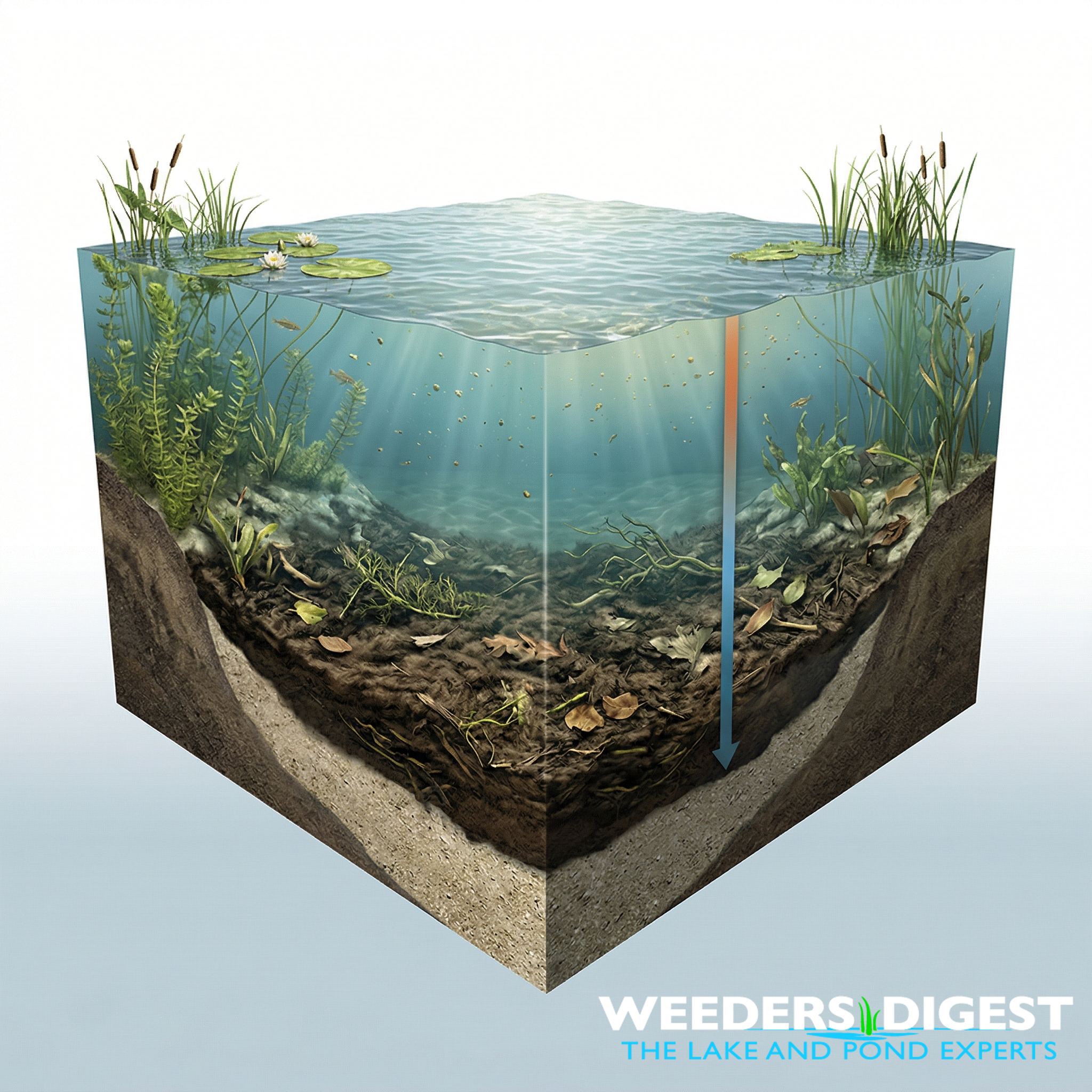
If you have noticed that the bottom of your bay is turning into a soft, dark "mayonnaise" much faster than the rest of the lake, you aren't imagining things. Enclosed bays act like natural sediment traps. Because these areas are protected from the main body of the lake, the water moves much slower, allowing every bit of organic debris—like falling leaves, dying weeds, and runoff—to settle right to the bottom instead of being washed away.
Once that material hits the floor of your bay, it starts a process of decomposition. However, in these quiet, shallow areas, the oxygen at the bottom often gets used up faster than it can be replaced. Without oxygen, the natural bacteria that eat muck slow down significantly. This creates a "snowball effect" where the rate of new organic matter piling up far outpaces the rate at which the lake can break it down, leading to that rapid increase in muck depth you see every season.
The Science Behind It:
The rapid accumulation of organic sediment, colloquially known as muck, in enclosed lacustrine embayments is driven by the principles of hydrodynamics and the biological oxygen demand (BOD) of the benthic zone. In open-water systems, fetch—the distance over which wind blows across water—generates wave energy and currents that maintain fine particulate matter in suspension. However, the morphology of an enclosed bay restricts fetch, creating a low-energy depositional environment. According to research from the University of Florida's IFAS extension, when water velocity decreases upon entering these sheltered zones, the suspended load of organic and inorganic solids precipitates out of the water column in a process known as sedimentation.
Beyond physical settling, the biochemical environment of a bay significantly influences muck depth through the process of anaerobic decomposition. In high-energy areas of a lake, wind-driven mixing ensures that dissolved oxygen reaches the sediment-water interface. In stagnant, enclosed bays, thermal stratification and high nutrient loading often lead to hypoxia or anoxia at the bottom. A study published in Journal of Freshwater Ecology notes that under anaerobic conditions, microbial decomposition of organic matter is significantly less efficient than aerobic respiration. This results in the accumulation of partially decomposed organic material, which retains high water content and creates a flocculent, "mucky" texture.
Nutrient loading from the surrounding terrestrial landscape also plays a critical role. Enclosed bays often serve as the primary catchment points for storm-water runoff, which carries nitrogen and phosphorus. These nutrients stimulate the growth of filamentous algae and macrophytes within the bay. When these organisms reach senescence and die, they contribute a massive seasonal volume of biomass to the benthic layer. This internal loading cycle ensures that even without external inputs, the bay continues to "produce" its own muck through the recycling of nutrients within the restricted basin.
Furthermore, the physical structure of the bay limits the "flushing rate," or the time it takes for the total volume of water to be replaced. A low flushing rate allows for the concentration of dissolved organic carbons (DOC), which can further inhibit light penetration and alter the microbial community. Research by the North American Lake Management Society (NALMS) suggests that in shallow, restricted areas, the accumulation of muck can become self-perpetuating; as the bay becomes shallower due to sediment, it supports more plant growth, which in turn leads to more organic deposition, eventually transitioning the area from a limnetic environment toward a wetland state.
Sources / References:
- University of Florida IFAS: Understanding Lake Sediments and Muck
- North American Lake Management Society (NALMS): Managing Lake Sediments