

Why Leaving Your Cut Lake Weeds to Rot is a Recipe for Disaster
Summary:
When you finish a long afternoon of cutting weeds away from your dock or beach, it is incredibly tempting to just let the fragments float away or sink to the bottom. After all, they are natural organic matter, so they should just disappear back into the lake, right? Unfortunately, leaving those cut plants in the water is one of the quickest ways to ruin the very swimming area you are trying to improve.
Think of those cut weeds as a massive injection of "plant food" back into your lake. As they die and decompose, they release all the nutrients they stored throughout the summer—specifically phosphorus and nitrogen—directly back into the water column. This acts like a high-powered fertilizer for the next generation of weeds and, even worse, for smelly green algae blooms.
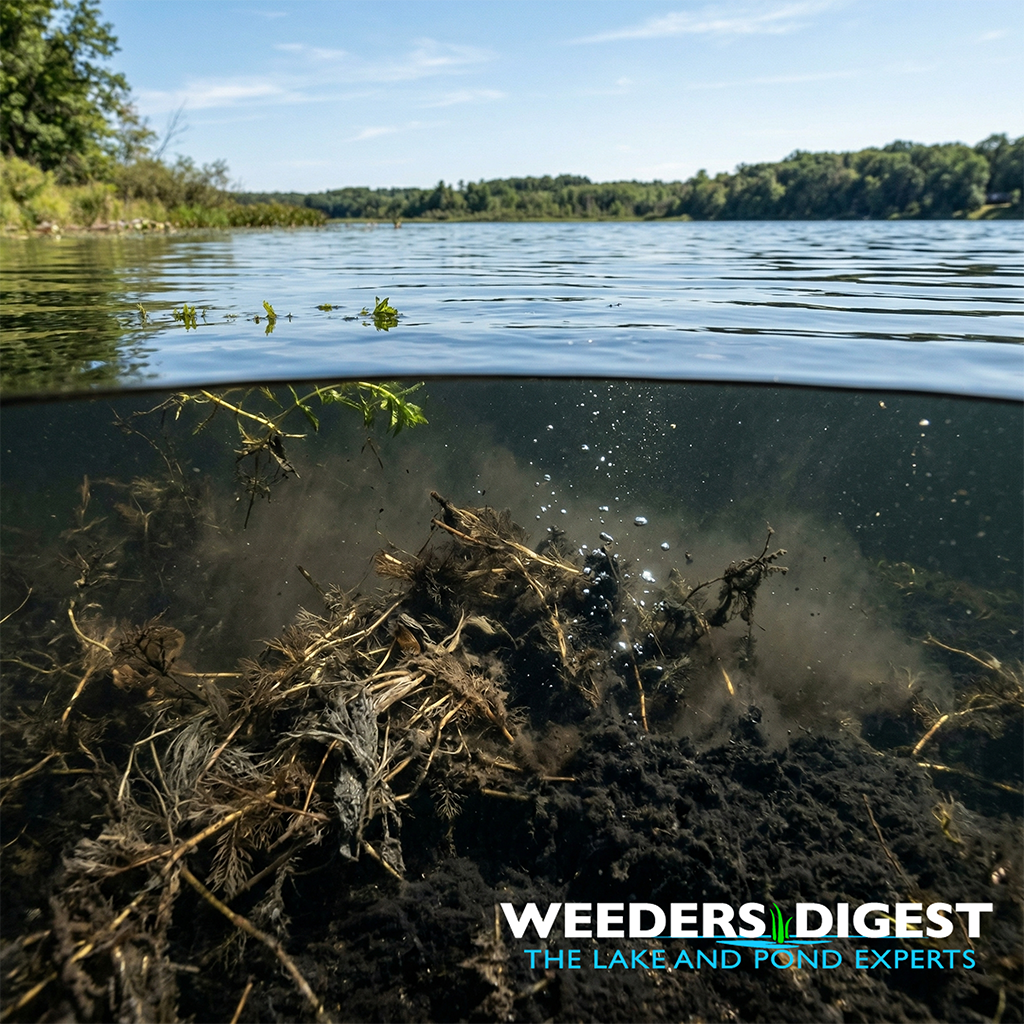
Beyond the nutrient spike, rotting vegetation creates a thick, mucky layer of "black Mayonnaise" on the lake floor. This organic sludge is unpleasant to walk on and consumes the oxygen that fish and beneficial insects need to survive. Instead of cleaning your lake, leaving the cuttings behind actually accelerates the aging process of the water body, leading to more weeds and shallower water next season.
To keep your water clear and your shoreline firm, you must remove every bit of cut vegetation from the lake. Once the plants are out of the water and on dry land, they become excellent compost; but inside the water, they are a primary driver of poor water quality and ecosystem collapse.
The Science Behind It:
The decomposition of aquatic macrophytes within a closed or semi-closed lacustrine system triggers a sequence of biogeochemical shifts that can fundamentally alter the trophic status of the lake. When vascular plants are severed and left to decay, the process of mineralization begins, where organic forms of nutrients are converted back into inorganic, bioavailable forms. Research from University of Florida’s IFAS Extension indicates that submerged aquatic vegetation can contain significant concentrations of phosphorus and nitrogen within their tissues. Upon senescence and subsequent microbial breakdown, these limiting nutrients are rapidly released into the water column, often fueling secondary pulses of phytoplankton or cyanobacteria blooms.
Furthermore, the metabolic breakdown of high-loaded organic matter requires substantial amounts of dissolved oxygen (DO). Aerobic bacteria consume oxygen to facilitate the decay process, a phenomenon measured as Biochemical Oxygen Demand (BOD). In localized areas with dense accumulations of cut weeds, this can lead to hypoxic or even anoxic conditions near the sediment-water interface. According to studies published in Lake and Reservoir Management, these low-oxygen environments not only stress or kill benthic macroinvertebrates and fish but also trigger "internal loading." Internal loading occurs when anoxic conditions at the lake bottom cause a chemical release of phosphorus previously bound to iron in the sediments, further compounding the nutrient enrichment problem.
The physical accumulation of necrotic plant tissue contributes significantly to the process of lake succession and "filling in." As cellular structures like lignin and cellulose break down slowly in an aquatic environment, they settle into a flocculent organic layer known as "gyttja" or muck. This accumulation reduces the depth of the littoral zone and creates a highly fertile substrate that is ideal for the colonization of invasive species, such as Myriophyllum spicatum (Eurasian Watermilfoil). This creates a feedback loop where the decay of one generation of weeds provides the structural and nutritional foundation for an even denser infestation in the following growing season.
From a mechanical standpoint, many invasive aquatic plants utilize fragmentation as a primary mode of reproduction. When weeds are cut but not harvested, each small segment containing a node has the potential to drift, settle, and develop a new root system. This process, known as vegetative propagation, allows a localized cutting effort to inadvertently seed a lake-wide infestation. Scientific literature on invasive species management emphasizes that without total biomass removal, mechanical harvesting can act as a dispersal mechanism rather than a control method, effectively increasing the total surface area covered by the target species.
Sources / References:
- University of Florida IFAS: Managing Aquatic Plants in Florida Research Priorities
- Wisconsin Department of Natural Resources: Ecological Consequences of RNA (Residual Native Aquatic) Vegetation