

Why My Favorite Swimming Hole Has a Sandy Floor While Your Lake is Pure Muck

Summary:
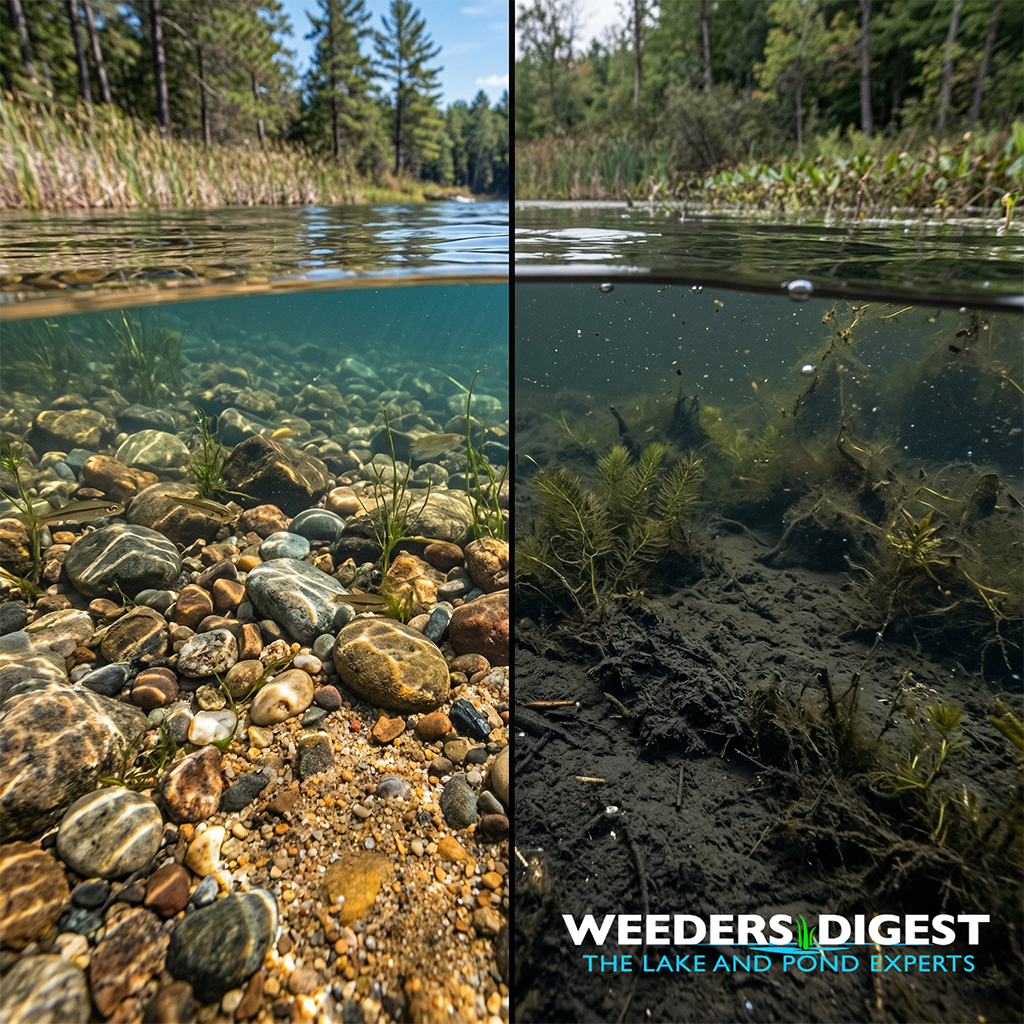
If you have ever stepped off a dock and felt your toes sink into a cold, squishy abyss of mud, you have experienced the reality of lake aging. It is a common mystery for many homeowners why one lake can have a beautiful, firm, and rocky shoreline while another just a mile away feels like a giant bowl of chocolate pudding. The answer isn't just luck; it is a combination of how the lake was born and how it has lived over the last several thousand years.
The bottom of a lake is essentially a giant collection plate. Everything that falls into the water—leaves, dead algae, fish waste, and runoff from the land—eventually settles at the lowest point. In some lakes, the water moves enough to sweep this "gunk" away or keep it from settling in the first place. In others, the lake acts like a massive trap, allowing organic debris to pile up year after year until the original rocky floor is buried under feet of soft sediment.
Geology also plays a massive role in what you feel underfoot. Some lakes were carved out of solid bedrock by glaciers and have very little soil surrounding them, keeping them crisp and clear. Others sit in basins surrounded by rich, loose soil or wetlands. These lakes are constantly being fed "food" (nutrients) that fuels plant and algae growth, which eventually dies and turns into that soft, black muck we all try to avoid during a summer swim.
Ultimately, the difference between a rocky bottom and a muddy one comes down to the balance between what is coming into the lake and how fast the lake can process it. Understanding this helps us realize that a lake isn't just a static body of water, but a living system that is constantly changing its "floor" based on its environment and age.
The Science Behind It:
The divergence in benthic composition between neighboring lacustrine systems is primarily governed by the principles of basin morphometry, hydrodynamics, and the trophic state index. According to research published by the University of Minnesota Extension, the initial substrate of a lake is determined by its post-glacial geologic origin. Lakes situated in high-energy environments with significant fetch—the distance wind travels over open water—often maintain a "hard" bottom of cobble, gravel, or sand. This is due to wave action and littoral currents that prevent the settling of fine particulate matter, effectively winnowing away smaller organic particles and depositing them in deeper, depositional zones known as "profundal" areas.
Conversely, the accumulation of "muck" is a byproduct of a biological process known as lacustrine succession or eutrophication. As documented in studies regarding sediment accumulation rates in North American lakes, the transition from a rocky to a muddy substrate is accelerated by the input of allochthonous organic matter from the surrounding watershed and autochthonous production within the water column. In shallow, sheltered lakes with low water flushing rates, dead macrophytes and phytoplankton settle on the floor, where microbial decomposition occurs. If the rate of organic deposition exceeds the rate of decomposition, a layer of anaerobic sapropel—rich, dark organic mud—begins to sequester the original mineral substrate.
The chemistry of the surrounding watershed also dictates the presence of clay and silt. Lakes located in drainage basins with high proportions of fine-grained glacial till or clay-heavy soils experience higher rates of mineral sedimentation. This is often contrasted with "kettle lakes" or those formed in granitic shields, where the lack of erodible mineral material and lower nutrient concentrations result in "oligotrophic" conditions. In these clear, nutrient-poor environments, biological productivity is limited, meaning there is less organic "rain" falling to the bottom to create the soft sediment layers found in more "eutrophic" or nutrient-rich systems.
Furthermore, the slope of the lake bed, or its bathymetry, influences the stability of the bottom. Steeper underwater slopes allow for the gravitational transport of fine sediments toward the center of the lake, often leaving the near-shore littoral zones rocky or sandy. In contrast, flat-bottomed lakes act as more efficient sediment traps across their entire area. Research from the Michigan State University Extension emphasizes that human activities, such as shoreline development and the removal of native buffer zones, significantly increase the loading of sediments and nutrients, rapidly transforming firm-bottomed areas into mucky environments through a process often referred to as "cultural eutrophication."
Sources / References:
- University of Minnesota Extension: Understanding Lake Water Quality
- Michigan State University Extension: Focus on the Bottom - Lake Sediments