

Why My Lake Looks Like a Jungle: The Truth About Mild Winters and Explosive Weed Growth
 |
Summary:
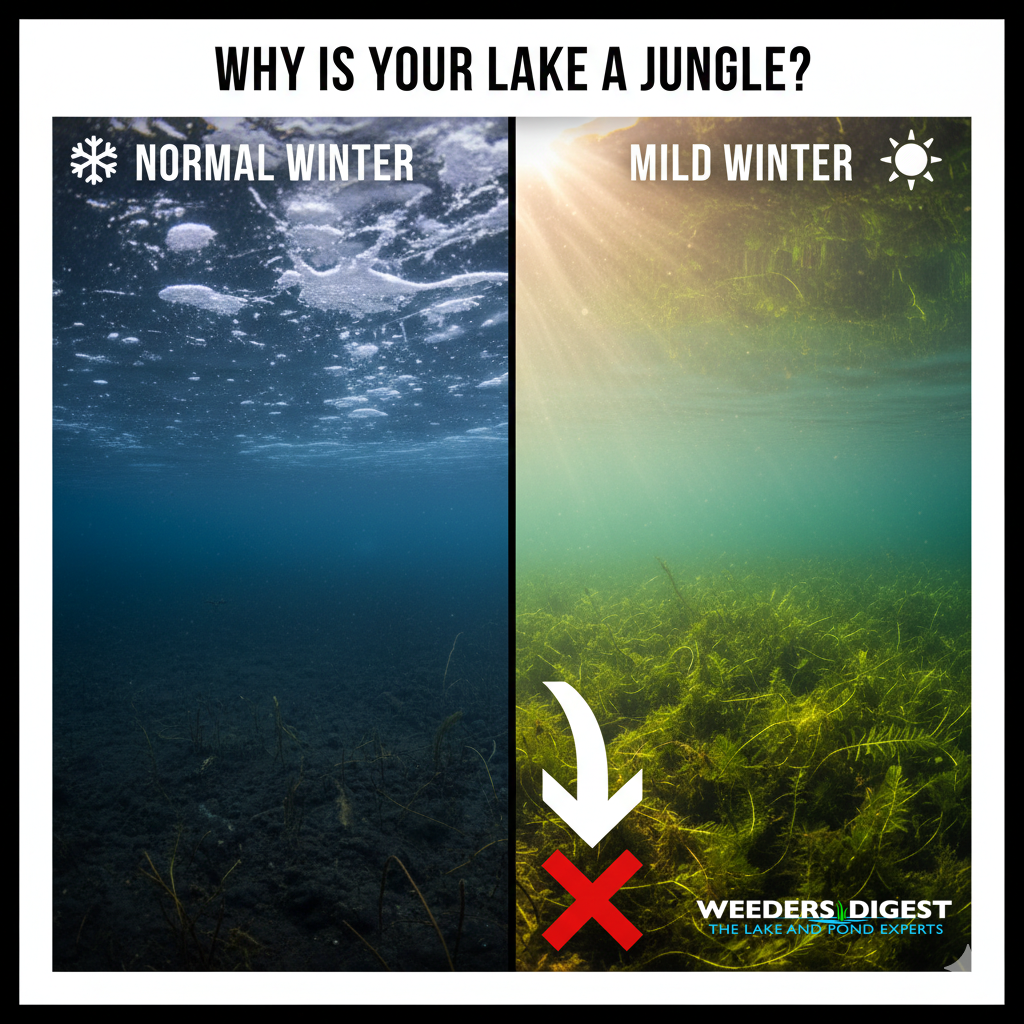
If you’ve noticed that your shoreline looks more like a dense forest than a swimming area after a particularly warm winter, you aren't imagining things. Usually, a long, freezing winter acts as a natural "reset button" for our lakes and ponds. Thick ice and heavy snow block out the sunlight, effectively putting aquatic plants into a dark, cold hibernation or killing off the more sensitive species. When the winter stays mild, that reset button never gets pushed.
Instead of a dormant period, the plants get a massive head start. Without a thick layer of ice to block the sun, underwater weeds can continue to photosynthesize and grow even during the "off-season." By the time spring officially rolls around, these plants aren't just starting to sprout; they are already well-established and ready to take over. It’s the aquatic equivalent of the weeds in your garden getting a three-month head start while you were still wearing a light jacket.
Furthermore, mild winters often mean less "winterkill" for invasive species that thrive in slightly warmer conditions. These aggressive plants, like Eurasian Watermilfoil, are particularly good at capitalizing on lack of ice cover. They remain evergreen under the water, soaking up every bit of available light. When the water temperatures begin to climb in early spring, they have already claimed the best real estate on the lake bottom, leaving native plants in the shade.
Essentially, a mild winter removes the environmental hurdles that normally keep aquatic vegetation in check. You end up with a longer growing season, more surviving biomass from the previous year, and a biological "sprint" that starts weeks earlier than usual. Understanding this shift is the first step in realizing why your water management strategy needs to adapt to our changing seasonal patterns.
The Science Behind It:
The phenomenon of accelerated aquatic plant proliferation following mild winters is primarily driven by the attenuation of irradiance and the metabolic rates of macrophytes. In typical temperate winters, the formation of black ice and subsequent snow cover creates a high albedo effect, reflecting up to 90% of incoming solar radiation. This lack of light, combined with temperatures near $4^{\circ}C$ at the benthic zone, forces most aquatic plants into a state of physiological dormancy or senescence. Research indicates that when ice cover is thin or intermittent, the photic zone remains active, allowing for significant sub-ice photosynthesis.
According to studies on lake phenology, the timing of "ice-off" is a critical predictor for the seasonal peak of biomass. A mild winter results in an earlier thermal stratification of the water column. As the surface water warms more rapidly, it creates a stable environment for opportunistic invasive species such as Myriophyllum spicatum (Eurasian Watermilfoil) and Potamogeton crispus (Curly-leaf Pondweed). These species are known for their ability to maintain green tissue under ice; when the ice-off occurs prematurely, these plants utilize the early-season phosphorus pulse—often fueled by winter runoff—to achieve dominance before native species break dormancy.
The nutrient dynamics of a lake also shift significantly during a mild winter. Without a prolonged period of ice cover, wind-driven mixing can continue late into the season or resume much earlier, preventing the development of anoxic conditions at the sediment-water interface. While this may sound beneficial, it often facilitates the continuous cycling of internal phosphorus loads. Research published in Limnology and Oceanography suggests that warmer winter bottom temperatures can increase the metabolic rates of microbial communities in the sediment, leading to higher mineralization rates and a more "nutrient-ready" environment for macrophytes as soon as the spring photoperiod increases.
Furthermore, the lack of a "hard freeze" preserves the vegetative structures of many perennial weeds. Many aquatic plants propagate through turions, rhizomes, or fragments. In a severe winter, a portion of this reproductive biomass is lost to freezing or prolonged darkness. Conversely, mild conditions ensure a higher survival rate of these propagules. When the Growing Degree Days (GDD) begin to accumulate in early spring, the sheer volume of surviving overwintering biomass provides a massive biological platform for rapid expansion, leading to the "jungle" effect observed by stakeholders.
Sources / References:
- https://www.canr.msu.edu/news/not-all-winter-kills-are-bad
- https://aslopubs.onlinelibrary.wiley.com/journal/19395590