

Why My Pond is Overwhelmed: The Truth About Nutrient Loading
 |
Summary:
When I talk to lakefront homeowners about their water quality, the term "nutrient loading" often sounds like a complex chemistry problem. In simple terms, think of your pond like a dinner plate. A healthy pond has just enough food to keep the ecosystem moving. Nutrient loading is what happens when we keep piling more and more food onto that plate—specifically nitrogen and phosphorus—until the system can’t keep up. This "overfeeding" doesn't come from a single source; it's the result of everything from lawn fertilizers and grass clippings to septic runoff and even bird droppings washing into your water.
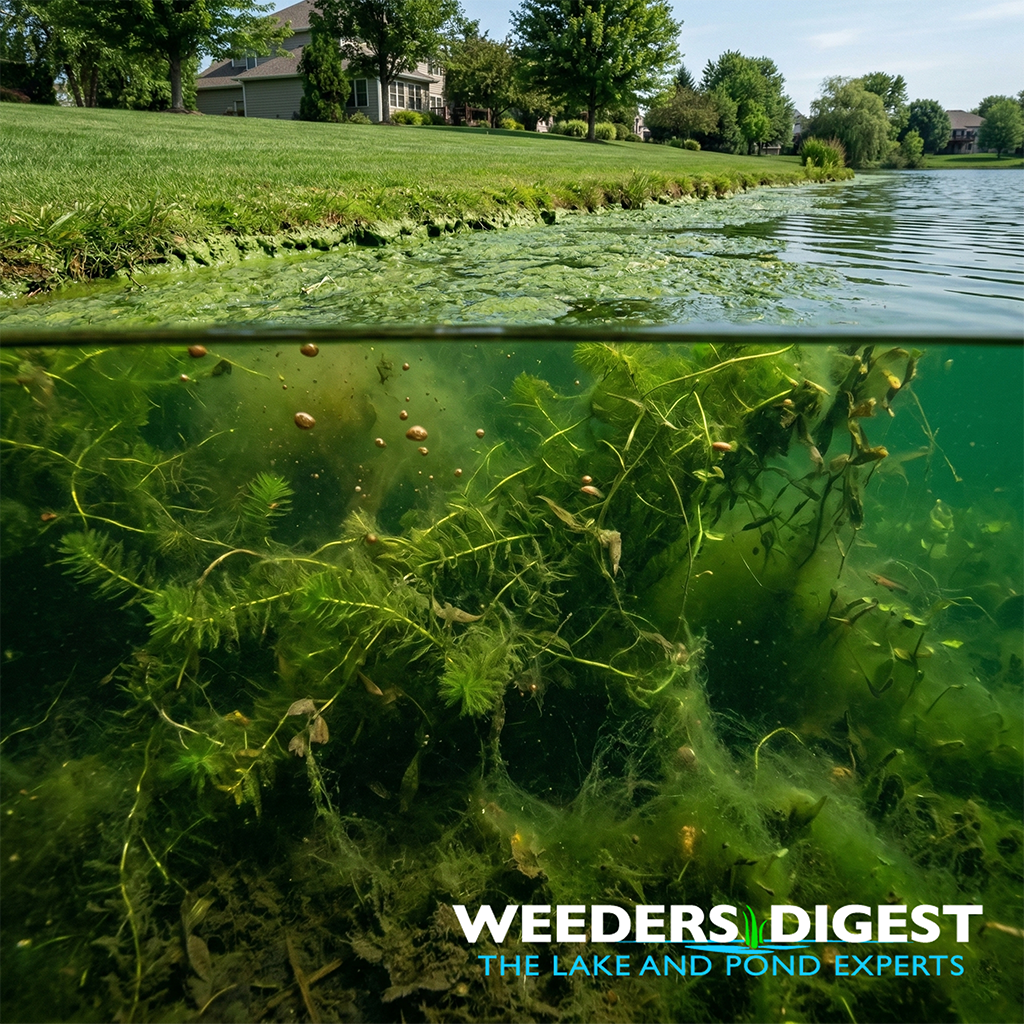
Once your water body is overloaded, the balance shifts dramatically. Those extra nutrients act like high-octane fuel for unwanted guests. Instead of a clear, blue swimming hole, you end up with a soup of bright green algae and dense mats of aquatic weeds. It is essentially a process of rapid aging; your pond is being pushed to grow more plant life than it naturally should, leading to murky water, foul odors, and a loss of the recreational space you love.
Understanding this concept is the first step toward taking back control of your shoreline. If we don’t stop the flow of these "invisible" pollutants, any physical removal of weeds is just a temporary fix. It’s about managing the diet of your pond to ensure it stays lean, clean, and healthy for years to come.
The Science Behind It:
Nutrient loading, primarily concerning phosphorus ($P$) and nitrogen ($N$), is the fundamental driver of cultural eutrophication in freshwater ecosystems. While these elements are essential for primary production, their anthropogenic acceleration into a water body disrupts the natural trophic state. According to research published in Water Research, phosphorus is typically the limiting nutrient in freshwater systems; therefore, even a minute increase in its concentration can trigger exponential biomass production in phytoplankton and cyanobacteria. This process involves the transition of a water body from an oligotrophic (low nutrient) or mesotrophic (moderate nutrient) state to a highly productive eutrophic or hypereutrophic state.
The mechanics of nutrient loading are categorized into two distinct pathways: external and internal loading. External loading refers to the transport of nutrients from the surrounding watershed via surface runoff, groundwater infiltration, and atmospheric deposition. Schallenberg (2020) highlights that land-use changes, such as increased impervious surfaces or agricultural intensification, significantly elevate the flux of dissolved inorganic phosphorus into receiving waters. Once these nutrients enter the water column, they are assimilated by aquatic plants and algae, leading to increased turbidity and a reduction in the photic zone.
Internal loading represents a more complex biochemical challenge. Over time, phosphorus accumulates in the bottom sediments, often bound to iron or aluminum compounds. When the hypolimnion (the bottom layer of water) becomes anoxic—usually during summer stratification—chemical reactions occur at the sediment-water interface. Under these reducing conditions, the bond between iron and phosphorus breaks, releasing "legacy phosphorus" back into the water column. This internal recycling can sustain algal blooms even after external sources of pollution have been strictly mitigated, creating a self-perpetuating cycle of degradation.
The ecological consequences of sustained nutrient loading extend beyond aesthetics. As massive blooms of algae die off, aerobic bacteria consume the available dissolved oxygen during the decomposition process. This leads to hypoxic conditions, which can result in significant fish kills and the loss of benthic biodiversity. Furthermore, certain species of cyanobacteria favored by high nitrogen-to-phosphorus ratios can produce microcystins—potent hepatotoxins that pose serious risks to human health and domestic animals. Managing nutrient loading requires a dual approach: stabilizing the watershed to reduce external inputs and addressing the legacy nutrients sequestered within the sediment.
Sources / References:
- US EPA: Causes of Eutrophication and Nutrient Pollution
- ScienceDirect / Water Research: Phosphorus Dynamics in Freshwater Systems