

Why My Proven Lake Management Strategy Might Be Failing Your Waterfront
Summary:
It is incredibly frustrating to invest time, emotion, and money into cleaning up your shoreline only to have the weeds return with a vengeance or the water turn a soupy green just weeks later. When I talk to homeowners about their managed ponds, the most common complaint is that a treatment "didn't work." Usually, it’s not that the method itself was a total failure, but rather that it was a temporary fix for a much deeper, systemic problem within the ecosystem. Think of it like putting a bandage on a wound without cleaning out the infection; the surface might look better for a moment, but the underlying issue remains.
Many lake management attempts fail because they focus strictly on the symptoms—the visible weeds or algae—instead of the nutrient loading and sediment health that fuel that growth. If you kill off a massive bloom of weeds without addressing the muck at the bottom or the runoff coming from your lawn, you are essentially creating a massive pile of organic compost underwater. This "internal loading" provides a buffet of nutrients for the next generation of aquatic pests, leading to a cycle of expensive, repetitive treatments that never seem to get ahead of the problem.
Successful management requires a shift in perspective from "eradication" to "balance." Nature is incredibly resilient and will always move toward a state of high productivity if the conditions are right. If your pond has high phosphorus levels and plenty of sunlight, something will grow there. If it’s not the lilies you just removed, it will be the filamentous algae that takes their place. Understanding the unique personality of your specific body of water is the only way to break the cycle of failed interventions.
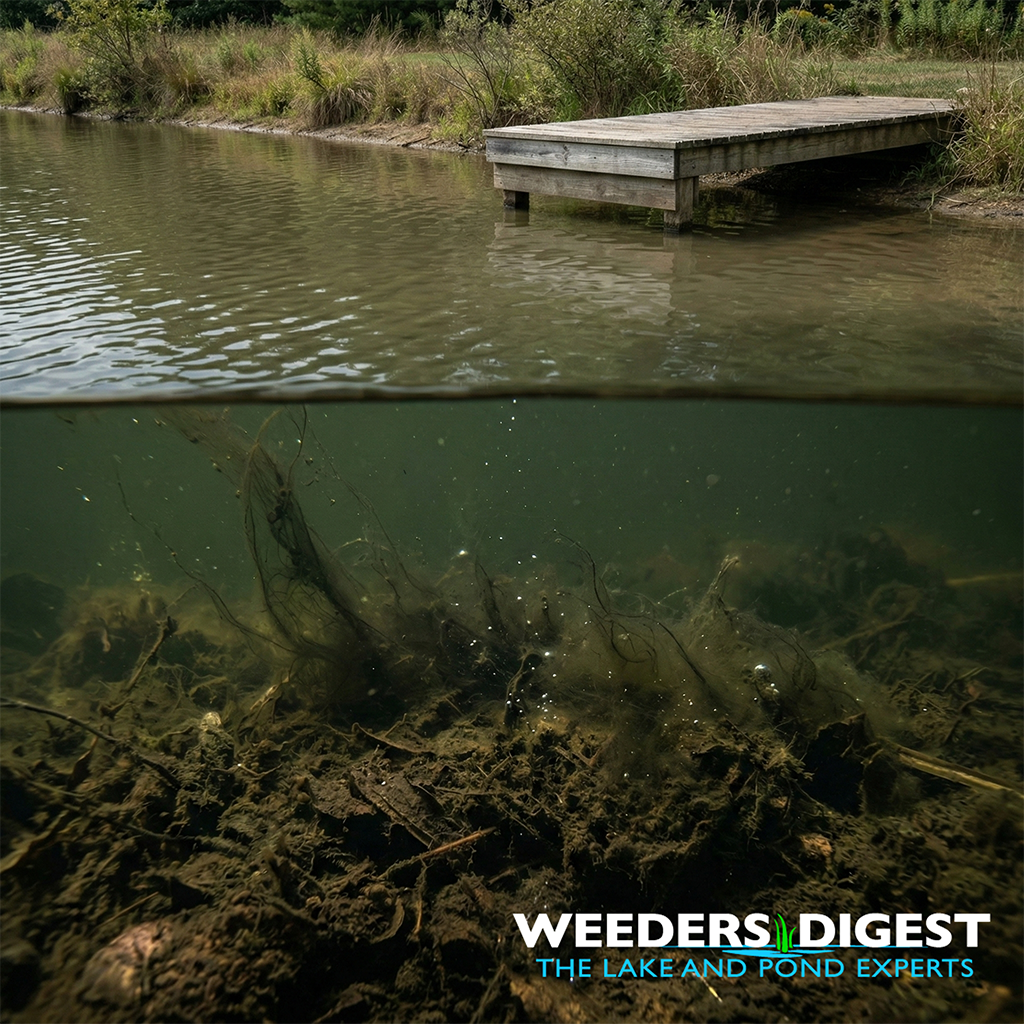
To truly fix a lake, we have to look beyond the water's surface and examine the complex chemical and biological interactions happening in the benthic zone—the very bottom of your lake. Without a holistic approach that considers water chemistry, oxygen levels, and nutrient cycling, even the most expensive professional treatments are likely to fall short of your expectations.
The Science Behind It:
The failure of aquatic management strategies is frequently attributed to a phenomenon known as "alternative stable states" in shallow lake ecology. According to research published in Lakes & Reservoirs: Science, Policy and Management for Sustainable Use, shallow aquatic ecosystems tend to exist in one of two states: a clear-water state dominated by submerged Macrophytes, or a turbid state dominated by phytoplankton. When a management intervention, such as a large-scale herbicide application, removes the dominant vegetation without altering the nutrient concentrations, the ecosystem often flips into a turbid state. This transition is driven by the sudden release of nutrients from decaying plant matter, which triggers an algal bloom that prevents the re-establishment of beneficial plants.
Nutrient legacy, specifically internal phosphorus loading, is a primary driver of recurring management failures. Even when external nutrient inputs from the watershed are mitigated, the phosphorus stored within the benthic sediments can continue to fuel eutrophication. A study from the University of Minnesota highlights that under anoxic conditions—common in the deep pockets of many ponds—iron-bound phosphorus is released from the sediment back into the water column. This internal recycling ensures that the "fuel" for nuisance growth remains present regardless of surface-level removals. If a management plan does not include aeration or nutrient inactivation (such as alum or lanthanum-modified clay), the chemical environment remains predisposed to rapid re-colonization by opportunistic species.
Biotic resistance and the "pioneer species" effect also play significant roles in perceived failure. When native vegetation is aggressively removed, it leaves an ecological niche wide open. Invasive species like Myriophyllum spicatum (Eurasian Watermilfoil) are highly adapted to colonize disturbed environments more rapidly than native flora. This leads to a secondary infestation that is often more difficult and costly to manage than the original population. Effective management must therefore incorporate integrated pest management (IPM) principles that prioritize selective control and the promotion of competitive native species to occupy the vacant niche.
Furthermore, the "one-size-fits-all" application of chemical or mechanical controls often ignores the specific water chemistry parameters that dictate efficacy. Factors such as pH, alkalinity, and dissolved organic carbon (DOC) can significantly alter the half-life and toxicity of various algaecides and herbicides. For instance, copper-based algaecides lose effectiveness in high-alkalinity waters as the copper ions precipitate out of the solution before they can be absorbed by the target organisms. Without a comprehensive baseline of limnological data, management interventions are frequently poorly timed or improperly dosed, leading to sub-optimal results and the development of herbicide resistance over time.
Sources / References:
- University of Minnesota Extension: Phosphorus in Lake Systems
- Journal of Aquatic Plant Management: Integrated Management of Invasive Aquatic Plants